Ever dreamt of having a personal fitting room right on your phone? One that shows you exactly how that shirt or dress will look on your body, not just a model's? That’s the simple but powerful idea behind Fitroom AI, an advanced virtual try-on platform that's starting to change how we shop for clothes online.
What Is Fitroom AI and Why Does It Matter

At its core, Fitroom AI is like a digital tailor. It closes that frustrating gap between seeing an item online and knowing how it will actually fit when it arrives at your door. The platform cleverly serves both sides of the fashion world—the shoppers buying the clothes and the brands selling them.
For shoppers, it’s a straightforward app that takes the guesswork out of buying. You just upload a photo, and suddenly you can build a virtual wardrobe, test out different styles, and see how a garment drapes on your specific figure before you even think about clicking "buy." It's a huge confidence booster that makes the whole experience feel more personal and reliable.
A Tool for Shoppers and Sellers
For e-commerce brands, Fitroom AI is a serious tool for tackling some of the industry’s biggest headaches. Online retailers are constantly fighting high return rates, a problem that bleeds profits and creates logistical nightmares. By adding a virtual try-on feature, brands can dramatically lower the odds of a customer ordering the wrong size in the first place.
The technology's value comes from two key offerings:
- Virtual Fitting Room: This is the feature everyone sees. It lets you upload your photo and see clothing realistically rendered on your body.
- AI Clothes Changer: This is more of a back-end service for retailers. It can digitally place garments onto a diverse range of professional models without the time and expense of a traditional photoshoot, helping brands get new products online much faster.
The demand for this kind of AI-driven tech is undeniable. After launching in early 2025, the Fitroom app by SilverAI JSC shot to a top spot on Vietnam’s App Store, showing just how quickly users caught on. You can learn more about the company's dual approach on the Fitroom website.
This isn't just about making things easier; it's about fundamentally shifting the economics of online fashion. When customers feel sure about what they're buying, conversion rates go up and return rates go down.
Ultimately, Fitroom AI is a glimpse into the next wave of fashion retail. It’s helping build a more interactive, trustworthy, and efficient system for everyone involved. We're finally moving beyond static product photos to a dynamic, personalized shopping journey that once felt impossible online.
How the Virtual Try-On Technology Works

When you first use a Fitroom AI virtual try-on, it feels a bit like magic. But behind the curtain, there’s a sophisticated mix of computer vision and deep learning that makes it all happen. It all kicks off with one simple thing: your input.
To get started, you just need to upload a full-body photo or punch in your body measurements. This is the foundation for everything that follows—the digital canvas the AI will use to "dress" you. The better the quality of that initial photo, the more realistic and accurate the final result will be.
Once you’ve submitted your info, the AI’s real work begins. It creates a personalized digital model—an avatar—that mirrors your unique shape and posture. This isn't just a flat, 2D cutout; it's a complex 3D representation that understands form and dimension.
Creating the Digital You
To build your avatar, the system’s algorithms get to work analyzing your photo. They pinpoint key body landmarks like your shoulders, waist, and hips to map out your exact proportions. Think of it like a master tailor taking your measurements, but without ever needing a measuring tape.
This process breaks down into a few key technical steps:
- Human Pose Estimation: First, the AI figures out your posture and where your limbs are positioned in the photo.
- Body Shape Analysis: Next, it analyzes your body’s contours to build a 3D mesh that matches your specific physique.
- Garment Parsing: At the same time, the AI is also analyzing the product photo of the clothing, isolating the item from its background and understanding its shape.
This first phase is all about getting the models right—both for you and for the clothing. It sets the stage for the most impressive part of the process.
Simulating Fabric and Fit
This is where the true artistry comes into play. The AI doesn't just slap a picture of a shirt onto your avatar. It uses a technique called neural rendering to simulate how that piece of clothing would actually hang, fold, and stretch on your body.
It’s a lot like what a CGI artist does for a blockbuster movie. To make a superhero’s cape flow realistically in the wind, they have to understand physics. Fitroom AI does something very similar by simulating fabric properties to predict how a garment will drape and move.
The AI has been trained on massive datasets of different fabrics, so it knows a silk blouse hangs differently than a rigid denim jacket. It understands how light bounces off satin versus cotton, allowing it to render realistic shadows and highlights that make the image believable. The simulation even accounts for the fabric’s weight, texture, and elasticity.
Finally, the system merges the rendered garment with your digital avatar to produce the final try-on image you see on screen. This whole intricate process takes just a few seconds, but it’s what turns a simple photo into an incredibly powerful tool for making confident purchase decisions. This is the core technology that makes the Fitroom AI experience so compelling.
Unlocking Real Business Growth for E-commerce Brands
While the tech behind virtual try-on is certainly impressive, its real value is measured in the tangible results it brings to the table. For e-commerce brands, a tool like Fitroom AI isn't just a novelty; it's a powerful engine for growth that directly tackles some of the industry's most stubborn challenges.
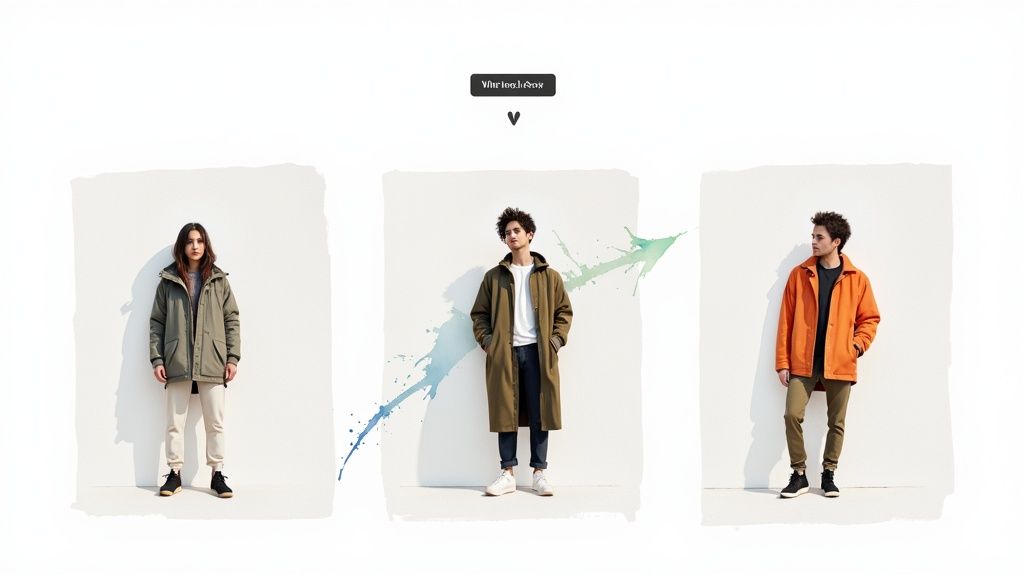
One of the most immediate wins comes from features like the AI Clothes Changer. This tool lets brands sidestep expensive, time-consuming photoshoots by generating an endless stream of model variations for their product catalogs. Instead of wrestling with logistics, retailers can showcase their collections on a diverse range of models, improving representation and getting products live much faster.
From Better Experience to Better Metrics
But the real game-changer is the virtual fitting room right on the product page. When a shopper can genuinely visualize how an item will look on them, their confidence to buy goes through the roof. That confidence is what moves the needle on the key performance indicators (KPIs) that actually matter to an online business.
A huge advantage of integrating Fitroom AI is its proven ability to increase e-commerce conversion rate. It works by knocking down the biggest barrier in online clothes shopping: the fear that it won't fit.
By turning a flat product image into an interactive, personal experience, brands can seriously boost shopper engagement. This builds trust and simply makes the buying decision easier.
Reducing that uncertainty doesn't just push the initial sale across the line; it also helps solve the expensive headache of returns. Even the early AR mirror pilots back in the 2010s showed a clear lift in conversions, and today's high-fidelity tech makes that impact even sharper. Industry analysis consistently shows that virtual try-on can cut return rates by 10–30%, a massive win for any retailer's bottom line.
To see just how these features translate into concrete business outcomes, let's map them out.
Mapping Fitroom AI Features to E-commerce Impact
The table below breaks down the connection between what Fitroom AI does and how it directly improves the metrics you care about.
It's clear that each piece of the technology is designed not just for a "wow" factor but to solve a specific business problem, leading to a healthier, more profitable operation.
Driving Core E-commerce Goals
At the end of the day, bringing Fitroom AI into your workflow helps you hit several core business goals at once. It's built to create a better customer experience that fuels a more sustainable e-commerce machine.
Here’s a quick rundown of the benefits:
- Increased Conversion Rates: Shoppers who are confident about the size they’re choosing are far more likely to click "buy."
- Reduced Product Returns: A better fit decision upfront means fewer items coming back, which saves a ton on reverse logistics and lost revenue.
- Higher Average Order Value (AOV): With that extra dose of confidence, customers are often more comfortable adding another item or two to their cart.
- Enhanced Customer Engagement: An interactive try-on tool makes for a memorable shopping trip, encouraging people to come back again.
For any brand looking to sharpen its sales funnel, these outcomes are exactly what you're after. By solving a fundamental customer problem, this technology provides a clear path to growth. You can find more ideas in our guide on how to increase online sales.
A Practical Guide to Integrating Fitroom AI
So, you’re sold on the idea of a virtual fitting room. Great. But how do you actually get a tool like Fitroom AI working on your e-commerce site? It might seem like a huge technical hurdle, but the process is surprisingly flexible and built to work with brands of all shapes and sizes.
Your first step is deciding how you want to plug it in.
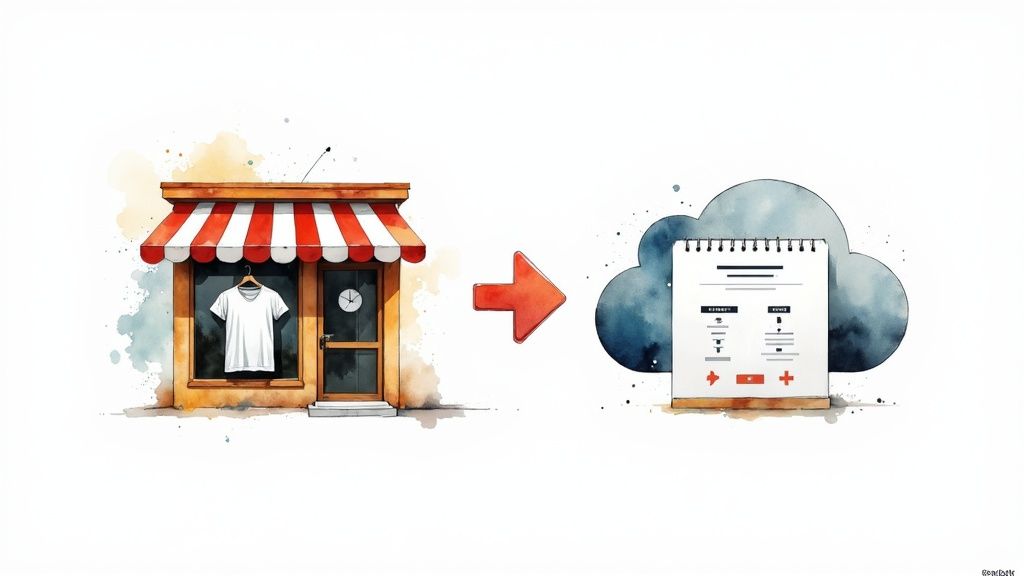
The simplest approach for most stores is a direct plugin or app. If you're running on a major platform like Shopify, Magento, or WooCommerce, there’s likely a ready-made solution that gets the virtual try-on button onto your product pages with just a few clicks. For a deeper dive, understanding various e-commerce platform integrations is a solid starting point.
If your website is custom-built or you need more granular control over the experience, an API (Application Programming Interface) integration is the way to go. This route gives your developers the power to weave the try-on feature into your site exactly how you envision it. Think of it as the difference between buying a pre-fab shed versus building one from scratch—one is faster, the other offers total customization.
Preparing Your Product Data
No matter which path you take, the AI is only as smart as the data you feed it. The magic of virtual try-on depends entirely on the quality of your inputs. For each garment, you’ll need to get a few key assets ready.
- Clean Product Photos: The AI needs clear, front-facing shots of your apparel. Think flat lays on a neutral background or photos on a mannequin. This helps the system understand the garment’s true shape and details without any distortion.
- Detailed Sizing Charts: Don't just upload your standard chart. Provide exact measurements for every size—bust, waist, inseam, length, you name it. This is the bedrock for the AI's size recommendations and fit simulation.
- Fabric Composition: Details like “95% Cotton, 5% Spandex” are non-negotiable. The AI uses this to calculate how a fabric will drape, stretch, and move, which is critical for a realistic simulation.
Think of it as giving a master chef a recipe. The better the ingredients you provide—your photos, sizing specs, and fabric data—the more incredible the final result will be. High-quality inputs create a believable and trustworthy try-on experience that customers will actually use.
Optimizing the User Experience
Once you're integrated, you need to make sure shoppers actually use the feature. Placement is everything. The "Try It On" button should be impossible to miss, sitting right next to the "Add to Cart" button on your product pages.
The language you use matters, too. Clear, direct calls-to-action like "See How It Fits" or "Virtual Try-On" immediately tell the shopper what to expect. It's a small tweak that can make a huge difference in engagement and, ultimately, conversions.
This kind of visual tool pairs perfectly with other interactive technologies. You can learn more about how these elements work together by checking out our piece on the rise of conversational AI in e-commerce.
Current Limitations and the Future of Virtual Fit
While it’s easy to get excited about a tool like Fitroom AI, we need to keep our feet on the ground. Like any emerging technology, virtual try-on isn't magic—it has real challenges that both brands and shoppers should know about.
But here’s the thing: today's limitations are also a roadmap to an incredibly exciting future for virtual fit.
One of the biggest hurdles right now is getting the accuracy perfect every single time. The AI is fantastic at simulating fit for standard body types and common fabrics, but it can sometimes get tripped up by the exceptions.
Think about extremely complex clothing—garments with intricate draping, asymmetrical cuts, or delicate lace. These can push the rendering engine to its limits. The same goes for representing the fit on the vast spectrum of unique human body shapes. For now, it’s an incredibly powerful guide, not a flawless mirror. Yet.
Navigating Privacy and User Trust
This is a big one: data privacy. For any virtual try-on to work, it needs photos and sometimes detailed measurements from the user. That immediately brings up valid questions about how that sensitive data is being handled, stored, and protected.
Building and maintaining trust with your users is non-negotiable. Any legitimate provider has to be completely transparent with their data policies. They must guarantee that user images are only for generating the try-on and aren't stored indefinitely without clear permission. For any e-commerce business, picking a Fitroom AI partner with an ironclad commitment to data security is crucial for protecting customers and your brand's reputation.
The real challenge isn't just about the tech; it's about making people feel safe. The entire future of virtual fit hinges on creating a secure, transparent space where users are comfortable sharing the data needed for that personalized magic to happen.
The Exciting Horizon for Virtual Fit Technology
Looking ahead, the evolution of this tech is set to completely blur the lines between shopping online and in a physical store. We're moving way beyond today's capabilities and into a much smarter, more immersive e-commerce world.
Here are a few advancements right around the corner:
- Hyper-Realistic Rendering: Future versions will create visuals that are almost impossible to tell apart from a real photo. Imagine seeing every tiny wrinkle in a linen shirt or the exact way velvet catches the light, all simulated perfectly on your own digital avatar.
- AI-Powered Stylists: The next logical step is for the AI to go beyond just showing you the fit. It'll start acting like a personal stylist, giving you recommendations based on what flatters your body shape, what pairs well with items you’ve already tried, and what’s aligned with the latest style trends.
- Metaverse and AR Integrations: This technology is a natural for augmented reality (AR) and the metaverse. It won't be long before you can "walk" through a virtual store as your avatar, trying on digital outfits that you can then buy and have shipped to you in the real world.
These aren't just small tweaks; they point to a massive shift in how we'll all interact with fashion online. To stay on top of it, brands need to watch the entire landscape. You can get a head start by exploring the key fashion industry trends to watch in 2025. Today’s limitations are simply tomorrow’s to-do list for innovation.
Got Questions About Fitroom AI?
It's only natural to have a few questions when you're looking at bringing a powerful new tool like Fitroom AI into the mix. Let's dig into some of the most common ones that pop up and get you some straight answers.
Getting these details sorted is the first step to seeing what this tech can really do.
Just How Accurate Is the Virtual Try-On?
This is the big one, right? Fitroom AI gets impressively close to reality by using some pretty sophisticated neural rendering and fabric simulation. It's fantastic at showing how a shirt will drape or how a dress will follow your general shape, all from a single photo.
But let’s be real—it's not a digital tailor. Think of it as an expert style guide, not a final fitting. While it massively cuts down on the guesswork of online shopping, the final result can depend on the quality of the photo you upload and how complex the clothing is. The tech is always getting better, but for now, it gives you a very, very good idea of what to expect.
What Do We Need to Give the AI to Make It Work?
To get Fitroom AI up and running, you just need a few of the standard assets you already have for your e-commerce site. The AI feeds on this info to create its magic.
Here’s the typical shopping list:
- Good Product Photos: Clear, front-on shots of the garment are a must. Think mannequin or flat-lay pictures.
- Your Sizing Charts: The AI needs the specific measurements for each size to do its calculations.
- Fabric Info: Details like “90% Cotton, 10% Elastane” are crucial. This tells the AI how the material will stretch, hang, and move.
Bottom line: the better the data you feed it, the more realistic the virtual fit will be for your customers.
Is This Going to Be a Headache to Integrate?
Not necessarily. How easy it is to plug Fitroom AI into your store really depends on your e-commerce platform and who you have on your tech team. The good news is that it was designed to be accessible. For big platforms like Shopify or WooCommerce, there are often simple plugins that make setup a breeze.
If you have a custom-built site, you'll likely use an API (Application Programming Interface) to get things connected. This might sound intimidating, but it's a standard process that a developer can handle. The documentation is usually solid, and the Fitroom team is there to help guide you through it.
The whole point is to make virtual try-on a tool you can actually use, not a technical nightmare. Whether it's a quick plugin install or a custom API job, there's a clear path for almost any online store to get started.
What Happens to User Photos and Data?
Privacy is, and should be, a huge deal. Any reputable virtual try-on service like Fitroom AI is built with this top of mind. User photos are typically processed just to generate the try-on image and aren't stored long-term unless someone explicitly says it's okay.
Any body measurements that are gathered are anonymized and used to make the underlying fit-prediction models smarter. A trustworthy provider will have a crystal-clear privacy policy explaining exactly what they collect and how they protect it, following rules like GDPR. It’s always smart for both businesses and shoppers to give that policy a quick read.
Ready to turn your content into videos that people actually want to watch? With Aeon, you can create high-quality, on-brand videos from any text, audio, or existing footage—automatically. No film crew required. Learn more and see how Aeon can scale your video strategy.