
Let’s be honest: staring at a blank page to kick off a new campaign is a recipe for missed deadlines and wasted budget. I’ve been there. A solid marketing campaign planning template is your best defense, turning those big, abstract goals into a clear, actionable roadmap everyone can follow.
The Blueprint for Flawless Marketing Campaigns

Think of your campaign plan as the single source of truth. It's what keeps your team aligned, tracks every dollar, and makes sure every objective is measurable right from the start. It’s the tool that pulls you out of reactive, gut-based decision-making and into the world of strategic, data-driven campaigns that actually hit their marks.
In this guide, you'll find our comprehensive, downloadable templates. We've created a streamlined one-page version that's perfect for quick launches and a more detailed alternative designed for those complex, multi-channel initiatives. Both are built to give you structure without killing your creativity.
Why Structure Is Your Greatest Asset
Without a structured plan, even the most brilliant creative idea can fall flat. I've seen it happen. A well-defined document is crucial because it forces you and your team to answer the tough questions before you spend a single dollar on ad creative or content production.
So, what does this structured approach actually do for you?
- It gets everyone on the same page. A good plan ensures marketing, sales, and product teams are all working from the same playbook with a shared understanding of the goals. No more siloed efforts.
- It keeps your budget in check. You can allocate and track spending effectively, preventing those costly overruns and making sure you’re getting the most out of every dollar.
- You can see problems before they happen. By mapping out the entire campaign, you can anticipate potential roadblocks—like a design bottleneck or a key holiday—and develop contingency plans early on.
- It creates clear accountability. When every task, deadline, and metric has an owner, it fosters responsibility and keeps the project moving forward smoothly.
A great marketing campaign planning template doesn’t just organize tasks; it crystallizes your strategy. It’s the difference between hoping for success and engineering it.
Before we dive into filling out the template, it's worth taking a look at a proven product launch strategy template if that's your goal, as many of the principles overlap.
Ultimately, defining your objectives, target audience, and key performance indicators (KPIs) upfront is what lays the foundation for a successful and measurable outcome. The following sections will walk you through exactly how to fill out each part of our template, step by step.
Laying the Groundwork for Your Campaign

Before a single line of ad copy gets written or a creative concept is mocked up, you have to build a rock-solid foundation. It’s a step I’ve seen teams skip far too often. The excitement to do something takes over, and the essential groundwork gets missed, which is precisely where many campaigns start to go wrong.
The first few sections of the planning template are designed to stop that from happening. They force you to get strategic clarity right from the very beginning, starting with a hard look at where things stand today. Without this context, you're not planning—you're just guessing.
Run a Quick Situational Analysis
Don't worry, this doesn't need to be a month-long research project. All you need is a focused, honest assessment to gather just enough intelligence to make informed decisions for this campaign.
Start by digging into your own history. Pull the data from your last two or three similar campaigns. What you're really looking for are patterns.
- Past Wins: Which channels genuinely delivered the highest ROI? Was there a specific message or creative that really clicked with your audience? Pinpoint what drove success and think about how you can replicate or build on it.
- Past Losses: Where did you completely miss the mark? Did a particular ad creative totally flop? Was one channel a black hole for your budget? Understanding why something failed is just as valuable as knowing why it worked.
- Competitor Actions: Take a quick scan of what your top two or three competitors are up to. What campaigns are they running? What’s the main message they're pushing? You aren’t looking to copy them, but to spot gaps in the market or find an opportunity to take a completely different angle.
This quick analysis provides the raw material for your entire strategy. It grounds your plan in reality, pulling you away from assumptions and toward decisions backed by actual data. It’s an essential first step that informs everything to come, from your goals to your channel mix.
Set SMART Goals for Your Campaign
Once you have a clear picture of the landscape, it’s time to define what success actually looks like. This is arguably the most critical piece of the entire planning process. Vague objectives like "increase sales" or "boost brand awareness" are useless because they give your team no clear direction or benchmark for performance.
This is where the SMART goal framework is so valuable. It’s a simple but incredibly powerful tool for turning fuzzy wishes into objectives that are clear, actionable, and measurable. Every primary goal you set in your template should be filtered through this lens.
Specific: Be precise. Instead of "get more leads," a specific goal is "increase marketing qualified leads (MQLs) from our new ebook." Measurable: Define the exact metric you'll use to track progress. It could be a 25% increase in sign-ups or hitting a cost per acquisition (CPA) below $50. Achievable: Is the goal realistic given your budget, timeline, and resources? Setting an impossible goal just demoralizes your team from the start. Relevant: Does this goal directly support the company's bigger objectives? If the business priority is breaking into a new market, a campaign focused on retaining existing customers might be a distraction. Time-bound: Every goal needs a deadline. "By the end of Q3" or "within the next 60 days" creates urgency and a clear timeframe for evaluation.
Let's see this in action. A weak goal is something like: "We want to grow our email list."
A SMART goal, on the other hand, sounds like this: "Achieve a 15% increase in email subscribers from our organic blog traffic by the end of Q2, maintaining an average cost per lead of under $3."
The difference is night and day. That kind of clarity gets everyone on the same page and gives you a concrete target to aim for. The data backs this up, too. Historically, in 2024, only 42% of unstructured campaigns hit their objectives, compared to 78% for those using plans with clear milestones. For more on how these goals fit into the creative process, check out our guide on how to write a creative brief.
Mapping Your Strategy From Audience to Budget
Once your SMART goals are locked in, it's time to get into the real meat of the strategy. This is where you map out the "how"—connecting those high-level objectives to a tangible plan of action.
We’ll break this down into the four pillars that turn a good idea into a campaign that actually performs: defining your audience, crafting your message, selecting your channels, and allocating your budget. Getting these right is the difference between shouting into the void and speaking directly to the people who matter most, in the places they hang out, with a message that hits home.
Pinpoint Your Ideal Customer
Before you even think about writing copy or designing an ad, you have to know exactly who you're talking to. Vague descriptions like "millennials" or "small business owners" just won't cut it anymore. The best campaigns are built on a deep, almost personal understanding of a specific group of people. That’s why a detailed audience persona is non-negotiable.
This persona needs to be more than just demographics. You have to dig into the human elements that actually drive their decisions.
- Pain Points: What's the real problem they're trying to solve? What keeps them up at night?
- Motivations: What are their career goals or personal ambitions? What does a "win" look like for them?
- Watering Holes: Where do they really spend their time online? Are they scrolling LinkedIn, plugged into industry podcasts, or lurking in niche Subreddits?
- Content Preferences: Do they binge short-form video, prefer deep-dive articles, or just want a quick-scan newsletter?
Answering these questions transforms a generic target into a real person. For example, instead of targeting "e-commerce managers," your persona becomes "Maria, a 32-year-old e-commerce manager at a mid-sized fashion brand. She's completely overwhelmed by the constant demand for fresh ad creative and struggles to keep up with production timelines."
Suddenly, you know exactly who you’re trying to help.
Craft a Message That Resonates
Now that you have Maria in mind, your next move is to craft a core message and value proposition that speaks directly to her world. This isn't about a clever tagline; it's the central promise you're making to her. It has to answer her unspoken question: "Why should I care about this?"
Your core message has to be simple, memorable, and consistent everywhere you show up. It needs to zero in on the unique benefit you offer, framed in a way that solves the exact pain points you just uncovered.
A powerful value proposition doesn't just list features; it sells a solution to a problem. It bridges the gap between what your product does and what your audience truly needs.
For Maria, a message focused on "saving 10 hours a week on ad creation" will land with much more impact than one about "AI-powered design tools." Always lead with the outcome, not the technology.
Select Your Marketing Channels Wisely
Okay, so where are you going to deliver this message? The goal isn't to be everywhere. It's to be in the right places. The good news is your persona research has already done most of the heavy lifting here.
Don't spread yourself too thin. Pick a primary channel where you know your audience is hyper-active and then choose one or two secondary channels to back it up. For instance, you might make LinkedIn your main stage for reaching Maria, supported by a targeted email nurture sequence and some retargeting ads on industry websites she visits.
Your marketing campaign planning template is the perfect place to outline how you’ll adapt your core message for each channel while keeping it consistent. A video on LinkedIn will have a totally different vibe than a text-based email, but that underlying value prop needs to shine through in both.
Allocate Your Budget for Maximum Impact
Finally, let's talk money. Budgeting can feel like the toughest part of campaign planning, but it's also where the rubber meets the road. A well-planned budget gives your strategy the fuel it needs to run without you accidentally burning through cash.
One of the biggest mistakes I see is teams improvising their spending on the fly. Don't do it. A 2025 HubSpot report found that 72% of successful campaigns had pre-allocated budgets, while those that winged it often overspent by as much as 40%. Using a template to map out your spending is a proven way to stay in control and maximize your ROI. You can learn more about the importance of structured templates from the 2026 planning guide.
Here’s a simple framework for breaking down your budget in the template:
This structure gives every dollar a job. And for teams using Aeon, you have a serious advantage. You can dramatically shrink that Content Creation budget. Tools like Quick Ad Maker and our AI-powered image generation let you produce top-tier assets in-house in a matter of minutes. This frees up a huge chunk of cash you can then reinvest into Ad Spend for even greater reach.
Building Your Campaign Timeline and Asset Plan
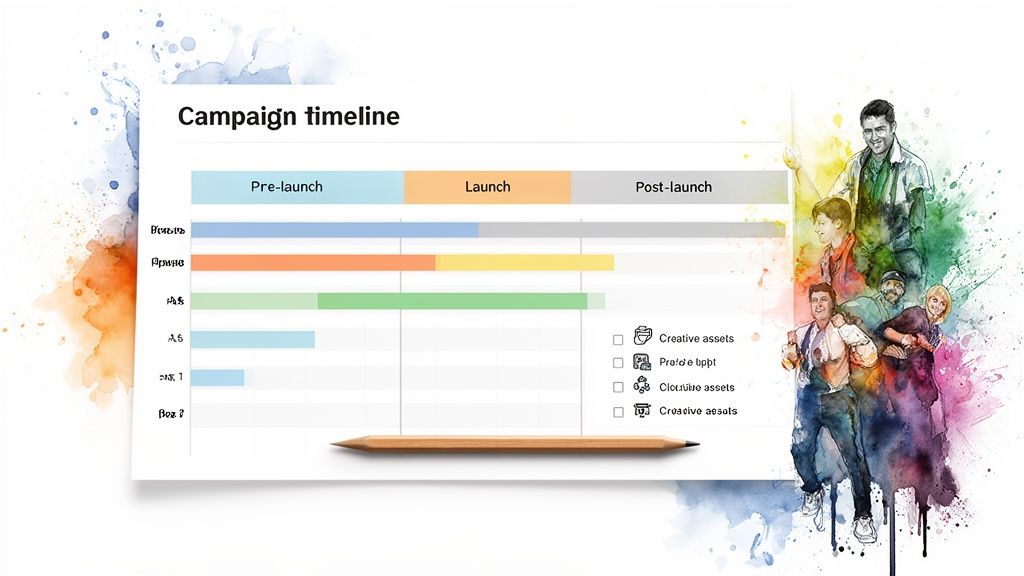
An idea without a timeline is just a dream. And a campaign without a concrete schedule? That’s a recipe for chaos. This section of your marketing campaign planning template is where you turn your big-picture strategy into a day-by-day, task-by-task action plan. It’s how you make sure every single piece of the puzzle clicks into place at exactly the right moment.
The goal here is simple: create a single source of truth that everyone on the team can turn to. Whether you’re a fan of detailed Gantt charts or a simple shared calendar, the principle is the same. You need to visualize the entire project from start to finish. This kind of visibility is what keeps the team accountable and prevents those critical tasks from slipping through the cracks.
Structuring Your Campaign Timeline
A simple way to get your head around the timeline is to break it into three distinct phases. This structure brings a ton of clarity and helps you focus on the right priorities at the right time, turning a mountain of tasks into manageable hills.
- Pre-Launch Phase: This is all your upfront work. Think initial brainstorming, writing creative briefs, producing all your assets, setting up tracking pixels, and getting those final stakeholder approvals. Honestly, this is often the longest and most critical part of the whole campaign.
- Launch Phase: This is go-time. This phase covers the initial campaign push, keeping a close eye on early performance, and being ready to squash any bugs that pop up. For a week-long promotion, this phase might be the full week. For a major quarterly initiative, it could be the first 72 hours.
- Post-Launch Phase: The job isn't done when the campaign "ends." This is when you dive into performance analysis, pull together a final report with key learnings, and archive your assets and data for the next campaign.
An effective timeline doesn't just list deadlines; it tells the story of your campaign. By mapping out dependencies—like needing final ad copy before design can even start—you can spot potential bottlenecks weeks in advance and keep the project flowing smoothly.
Research backs this up time and again. Teams with detailed campaign plans have been shown to cut their execution timelines by as much as 50%, enabling them to launch in under 30 days instead of the typical 60-90. When you clearly lay out milestones, timelines, and channel-specific actions, you create the alignment needed to move fast and get things done.
Planning Your Creative Assets
Right alongside your timeline, you need an organized asset plan. This is just a detailed inventory of every single piece of content you need to make the campaign a success. We’ve all been there—the last-minute scramble for a missing ad size or an unwritten email. It's stressful, and it’s completely avoidable with a bit of foresight.
Your asset plan should list out every single deliverable, from a 15-second TikTok video to a long-form blog post. For each one, you need a concise creative brief. Think of this as a mini-plan for the asset itself.
A good creative brief should answer three simple questions:
- What is this asset's specific job? (e.g., "Drive clicks to the new landing page.")
- What is the single most important message? (e.g., "Our new feature saves you five hours a week.")
- What action should the user take? (e.g., "Click 'Start Free Trial'.")
This simple process ensures every piece of content you create has a clear purpose and directly supports your campaign goals. It eliminates the guesswork for your creative team and leads to more effective, cohesive assets across the board. If you want to go deeper on organizing your content, check out our guide on how to create a content calendar.
This is also where a tool like Aeon becomes a game-changer. Once your asset list is locked in, you can use Quick Ad Maker to generate dozens of high-converting ad variations in minutes. Need a specific image for that blog post? Aeon's AI image generation can create studio-quality visuals on demand. By integrating your planning with production, you can dramatically speed up that pre-launch phase and get to market faster.
Measuring Success and Optimizing Performance
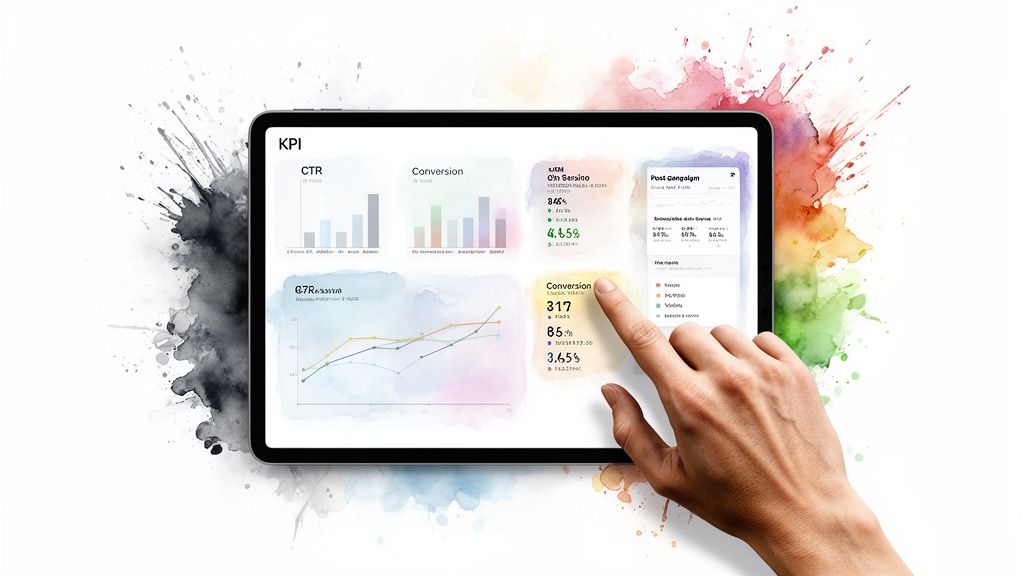
Hitting "launch" isn't the finish line; it's the starting pistol. The real work—and the real wins—come from obsessively tracking what happens next, learning from the numbers, and making smart tweaks to get even better results. This final part of the template is all about creating that cycle of constant improvement.
This isn't about getting buried in spreadsheets. It’s about being laser-focused on the metrics that actually matter. It all starts by tying your Key Performance Indicators (KPIs) directly back to those SMART goals you worked so hard to define. Every single number you track should have a clear purpose.
Connecting Goals to Real-World Metrics
If you can’t measure it, you can’t manage it. Your template has a dedicated spot to list your main KPIs for exactly this reason. Think of them as the vital signs of your campaign's health.
For example, tracking "social media likes" when your goal is sales is a rookie mistake. You need a direct line between what you measure and what you want to achieve.
- Goal: Increase qualified leads by 20%.
- KPIs: Not just leads, but the conversion rate on your landing page, your cost per lead (CPL), and the number of true marketing qualified leads (MQLs) you generate.
- Goal: Boost brand awareness in a new market.
- KPIs: Look at social media reach and impressions, the volume of brand mentions, and the amount of direct website traffic coming from that specific region.
- Goal: Drive sales for a new product.
- KPIs: Keep an eye on the click-through rate (CTR) of your product ads, your add-to-cart rate, and, of course, the big one: return on ad spend (ROAS).
Your marketing dashboard shouldn't be a vanity board. It should be a command center that tells you a story, showing you what’s working and—more importantly—what’s broken.
This approach turns measurement from a boring report card into an active feedback loop. When you see your CPL creeping up, you can immediately dig in. Is it ad fatigue? Is the landing page not converting? This lets you pivot on the fly instead of waiting until it's too late.
The Post-Campaign Analysis Framework
Once the dust settles, the work still isn't over. Your marketing campaign planning template includes a section for post-campaign analysis, which is absolutely non-negotiable for long-term growth. This is where you bottle up all the lessons that will make your next campaign a whole lot smarter.
During this review, your team needs to get honest and answer a few critical questions:
- Performance vs. Goals: Did we hit our KPIs? If we missed, what were the biggest roadblocks?
- Budget vs. Actuals: Where did we go over or under budget, and what drove that variance?
- Audience & Messaging: Did our core message actually land? Were our audience personas accurate?
- Key Learnings: What’s the single biggest takeaway we can apply to the very next thing we do?
This process builds institutional knowledge so you're not constantly repeating the same mistakes. By writing these insights down, you’re not just ending a campaign; you’re building a smarter foundation for the next one. For a much deeper dive into this, you can read our guide on measuring content marketing ROI. This kind of discipline is what separates the good marketers from the great ones.
Your Questions on Campaign Planning Answered
Even with the best marketing campaign planning template, a few questions are bound to pop up. That’s just part of the process of turning a static document into a living, breathing strategy.
Let’s walk through some of the most common questions I hear from teams. Getting these details right from the start will make your planning smoother and a whole lot more effective.
How Detailed Should My Marketing Campaign Plan Be?
The honest answer? It depends on the campaign's complexity and scale. There’s no magic formula, but the guiding principle is this: give just enough information to get everyone on the same page without creating a monster document no one will ever read.
For a small, single-channel push—say, promoting a new blog post on LinkedIn—our one-page template is your best friend. It’s lean, fast, and forces you to focus on what matters. But for a major, multi-channel product launch with all its moving parts, you’ll definitely want the detailed version to keep things from going off the rails.
The real goal is clarity, not complexity. If your plan clearly communicates the goals, roles, timeline, and budget, you've nailed the right level of detail.
If you’re feeling overwhelmed, just start with the non-negotiables: your SMART goals, a crystal-clear audience persona, your core messaging, the allocated budget, and your chosen channels. Get those right, and you're 90% of the way there.
How Often Should I Update My Campaign Plan?
Think of your plan as a living document, not something carved in stone. It has to adapt to what’s happening in the real world. A final, thorough review with all key stakeholders right before launch is non-negotiable—it ensures everyone has signed off and is ready to hit "go."
Once the campaign is live, you should be checking your performance metrics against the plan at least weekly. This is how you stay agile. It’s how you spot an underperforming channel and can quickly shift that budget over to a winner before it's too late.
For longer campaigns that stretch over a quarter or more, a formal monthly check-in is a great practice. It's the perfect time to assess progress against your major milestones and make any strategic pivots that are needed.
What Are the Biggest Mistakes to Avoid When Planning?
Over the years, I’ve seen a few common missteps that can derail even the most promising campaigns.
The biggest one, by far, is creating the plan in a silo. When the marketing team builds the plan without looping in sales or product, you almost always end up with a disconnected customer experience. It’s a recipe for disaster.
Another classic error is setting vague, unmeasurable goals like "improve brand awareness." How do you measure that? If you can’t attach a specific KPI to a goal, you can't prove success or failure, which makes it impossible to learn anything.
Finally, don't just fill out the template and forget it. Forgetting to track your actual spend against your budget or, even worse, skipping the post-campaign analysis is like throwing away free tuition. That analysis is your chance to get smarter for the next campaign, so don’t miss it.
Ready to stop scrambling and start strategizing? Aeon puts a full creative team in your pocket, combining expert playbooks with AI tools to help you ideate, design, and launch campaigns in minutes. See how Aeon can transform your workflow with a $5 trial.