
Short-form video marketing is all about creating and sharing quick, punchy videos—usually under 90 seconds—that grab your audience's attention on platforms like TikTok and Instagram Reels. The goal is to deliver value, whether that's a useful tip, a bit of entertainment, or a key piece of information, in a format that's super easy to consume.
Why Short-Form Video Is Your New Growth Engine

Let's be real: short-form video isn't some passing fad. It’s quickly become the main way modern brands talk to their customers and drive growth. And this shift is about more than just "short attention spans." It’s about showing up where your audience already is, with content that fits right into their daily scroll.
The real magic of this format is its psychological punch. These bite-sized videos give viewers a quick hit of dopamine—a nugget of info or a moment of entertainment—which is incredibly effective for building a genuine connection. It helps you foster a sense of community and keeps your brand from being forgotten.
The Strategic Shift from Creation to Repurposing
For a lot of teams, the thought of adding another content type to an already packed schedule feels like a nightmare. But here’s the thing: a successful short-form video marketing program isn’t about endlessly filming new, high-effort content. The real win comes from building a system that turns your existing assets into a steady flow of killer clips.
Think about it. You can turn your best-performing content into a video goldmine:
- Blog Posts: Pull out the key takeaways, powerful stats, or memorable quotes and animate them into slick text-based videos.
- Webinars: That one-hour session you hosted? It can be chopped up into a dozen or more micro-videos, each highlighting a specific question, tip, or expert soundbite.
- Podcasts: Grab the best audio snippets from your conversations and turn them into audiograms or use them as the audio track for visually engaging clips.
This isn't about creating more work; it’s about working smarter. By repurposing what you’ve already created, you build a content engine that hums along efficiently. You get a consistent pipeline of videos without burning out your team. Your content library transforms from a dusty archive into an active, strategic asset. To get the formatting right, check out our guide to vertical video marketing strategy.
The goal is to stop thinking of video as a single, resource-intensive project and start seeing it as an integrated part of your entire content ecosystem.
The Undeniable Momentum of Short-Form Video
The numbers don't lie. Short-form video is on track to make up 82% of all global internet traffic by 2026, making it a non-negotiable tool for any marketer.
This explosion is being driven by platforms like TikTok, Instagram Reels, and YouTube Shorts. On these apps, videos under 90 seconds can keep about 50% of viewers watching until the very end. That's a retention rate that longer videos can only dream of. It means your key messages and calls-to-action actually get seen.
Measuring What Matters for Video ROI
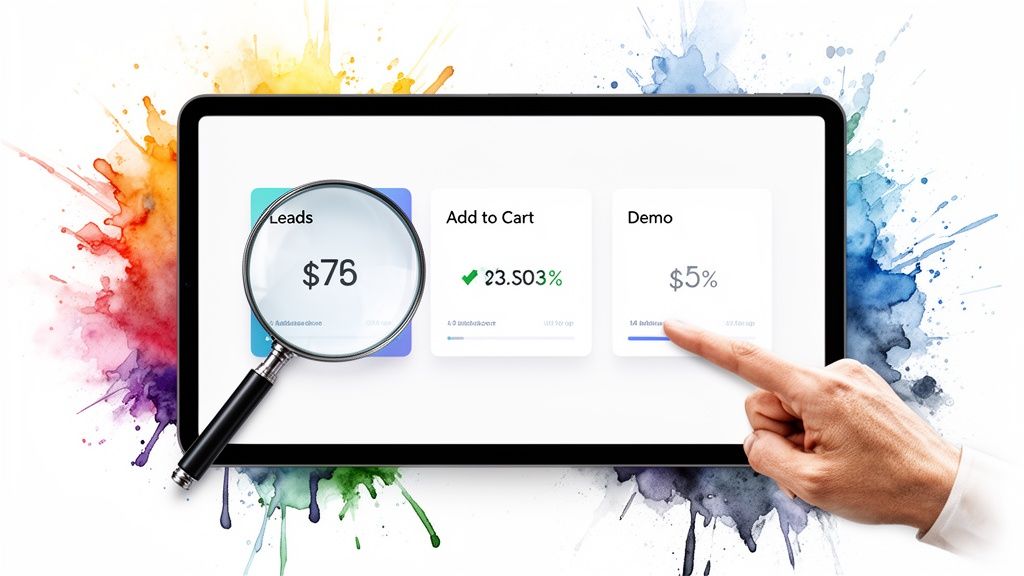
Jumping into a short-form video program without clear goals is like driving without a destination—you’ll burn a lot of fuel but you'll never actually arrive anywhere. To get executive buy-in and keep your budget secure, you absolutely have to look past vanity metrics like views and likes.
The numbers that really move the needle are the ones tied to business growth: lead generation, customer acquisition cost, and audience loyalty.
The trick is to draw a straight line from your video efforts to tangible business outcomes. This shift in thinking turns your content from a creative "nice-to-have" into a measurable revenue driver. What you measure will naturally look different depending on your specific goals and business model.
Defining Success for Your Team
For an e-commerce brand, success might hinge on the add-to-cart rate from your shoppable Instagram Reels. But if you’re a B2B software company, you’re probably more interested in tracking demo requests that came from your LinkedIn explainer videos. Every single video needs a job to do, and your analytics are there to tell you how well it's doing it.
This targeted approach doesn’t just bring clarity to your content strategy; it makes your reporting infinitely more powerful.
When you can walk into a meeting and show leadership that a specific TikTok series led to a 15% increase in qualified leads, you're speaking their language. It’s all about proving the direct, bottom-line value your short-form video marketing delivers.
Don't just count views; make your views count. The ultimate goal is to translate audience attention into measurable business action, whether that’s a sale, a sign-up, or a scheduled call.
The proof of video's impact is pretty staggering. Ad spending on short-form video is on track to hit $145.8 billion by 2028. That number makes sense when you see that 83% of video marketers report it directly boosted sales and 85% credit it with generating more leads.
Mapping KPIs to Business Objectives
To really nail down the impact of your videos, you need a solid strategy for measuring social media ROI for your church or any other organization, for that matter. It all starts by connecting what the business needs with what your videos are built to accomplish. This framework is your North Star, keeping you from getting lost in a sea of irrelevant data.
We’ve put together a practical table to help you map common business goals to specific, trackable video KPIs. Think of this as a starting point for building out your own measurement plan, making sure every clip you create is tied to a meaningful outcome. For a deeper dive into this, check out our complete guide on measuring content marketing ROI.
Aligning Video KPIs with Business Objectives
This table maps common business goals to specific, trackable short form video metrics, helping teams measure what truly matters.
By defining these connections from the get-go, you create a powerful feedback loop.
If your main objective is lead generation but your videos are only racking up high share counts (a brand awareness metric), you know it’s time to tweak your content or your call-to-action. This data-first approach lets you iterate with confidence, constantly improving your results and proving the immense value of your short-form video program.
Choosing the Right Platform for Your Audience
Making a brilliant video is only half the job. If your masterpiece never gets in front of the right eyeballs, all that effort goes to waste. This is where a sharp, deliberate platform strategy moves from a "nice-to-have" to a critical part of your short form video marketing program.
You have to go way beyond basic demographics and get into the weeds of each channel's unique culture.
Your audience isn't the same person everywhere they go online. Think about it: are they on TikTok looking for raw, trend-driven entertainment? Or are they scrolling Instagram Reels for beautiful tutorials and product inspiration? Nailing this distinction is what separates the pros from the amateurs who just cross-post content and hope for the best.
When you tailor your content to feel native to each platform, you dramatically increase its chances of resonating with viewers and getting a nod from the algorithm. A video that feels out of place is a video that gets scrolled past.
Understanding the Big Three Platforms
TikTok, Instagram Reels, and YouTube Shorts are the dominant forces in the short-form game, but they each have their own personality. They come with different algorithmic quirks, audience mindsets, and content formats that kill it. Getting a handle on these differences is how you make smart choices instead of just guessing.
-
TikTok: This is the undisputed king of trends and viral moments. Its algorithm is famously powerful, often pushing content to users based purely on their interests, not just who they follow. TikTok is the place for brands that want maximum reach and are willing to show a more human, less polished side of their personality.
-
Instagram Reels: Tightly woven into the entire Instagram experience, Reels is a powerhouse for visually driven brands, especially those that already have a solid follower base. It’s also fantastic for driving sales directly with shoppable tags and has a massive, thriving influencer community.
-
YouTube Shorts: As a feature of the world's second-largest search engine, Shorts gets a massive boost from YouTube's user base and search power. It’s an incredible platform for building brand awareness, especially with educational or "how-to" content that can hook viewers and pull them into your longer videos. For a complete game plan, think about developing a robust social media marketing strategy that ties all your efforts together.
The best platform isn't just the one with the most users. It's the one where your people are hanging out, engaged, and actually open to hearing from you. Don't chase a viral TikTok trend if your ideal customers are decision-makers looking for answers on YouTube.
Matching Content to Platform Culture
Okay, so you've figured out where your audience lives online. The next move is to make sure your content speaks their language by aligning it with the unwritten rules of that platform. A one-size-fits-all approach is a recipe for getting ignored.
For instance, a B2B tech company could crush it on YouTube Shorts by creating quick, helpful tutorials that solve common customer problems. This instantly positions them as an expert and naturally funnels people toward their more in-depth content. If you want to go deeper on this, check out our ultimate guide to creating YouTube Shorts.
On the flip side, a direct-to-consumer fashion brand would almost certainly find more traction on Instagram Reels. They can lean into high-quality visuals, trending audio, and collaborations with influencers to create aspirational content that drives sales right there in the app.
A Quick Platform Comparison
Deciding where to put your time and money means knowing exactly what you're getting with each platform. This table breaks down the core strengths and what users are looking for on the top channels.
Ultimately, your platform choice has to be a strategic decision, backed by data and a real understanding of how your audience behaves online. My advice? Start by focusing on one or two platforms where you know you can make a real dent. It's far better to own a single channel than to spread yourself too thin across all of them. Master one, learn from what the data tells you, and then expand your reach with confidence.
Building Your Content Creation Workflow
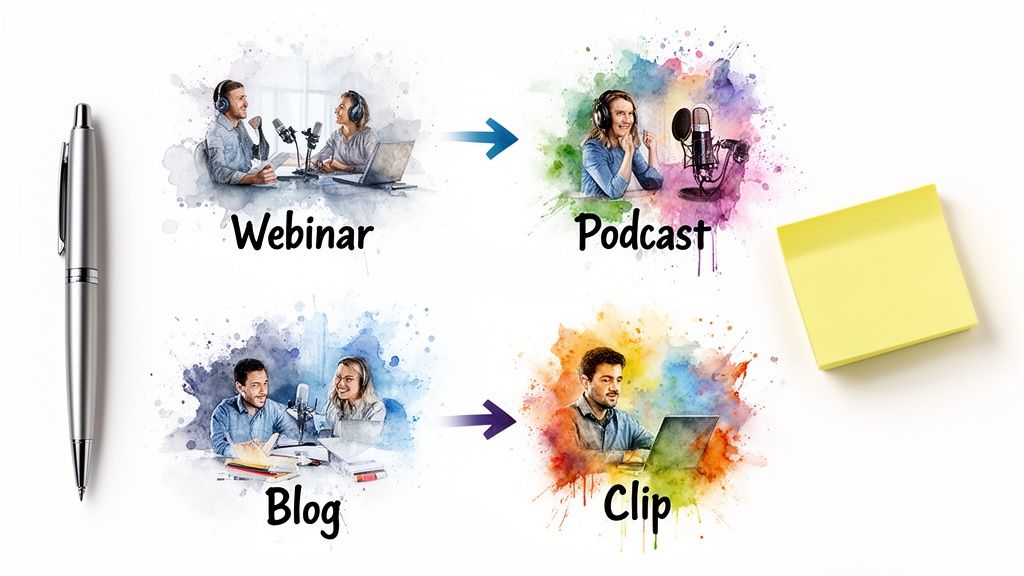
Here’s a secret the best video teams know: a winning program isn't built on a huge production budget. It’s built on a smart, repeatable, and scalable workflow. The brands dominating short form video marketing aren't always creating the most original content from scratch; they've just mastered the art of efficiency.
It all comes down to a system that can turn one core idea into a dozen different assets. This is how you maintain a consistent posting schedule without completely burning out your creative team. It’s about working smarter to keep your content pipeline full and your audience engaged.
Establish Your Content Pillars
Before you even think about a single video idea, you need to lock in your content pillars. These are the 3-5 core themes your brand is going to own. Think of them as guideposts that keep every single video you create aligned with your expertise and what your audience actually cares about.
For a B2B software company, for example, those pillars might look something like this:
- Productivity Hacks
- Team Collaboration
- The Future of Work
- Customer Success Stories
Defining these pillars is a game-changer for brainstorming. Instead of your team staring at a blank calendar wondering what to do next, they have a clear framework to ideate within. It makes the entire creative process more focused and a whole lot less painful.
The most common mistake I see brands make is creating random, one-off videos just to chase a trend. Content pillars provide the strategic foundation you need to build real authority and a loyal following over the long haul.
This structured approach prevents creative fatigue and ensures your content library tells a cohesive story about who you are. Every video, no matter how short, adds another brick to that foundation.
Master the Art of Repurposing
The engine of any truly scalable video workflow is repurposing. All that long-form content you've already created—webinars, blog posts, case studies, podcasts—is a goldmine. It's packed with potential short-form videos just waiting to be extracted.
I’ve seen a single one-hour webinar get sliced and diced into a full week’s worth of high-impact video content. The trick is to train your eye to spot those distinct, valuable moments within the larger piece that can stand on their own as a compelling short clip.
Here’s what that looks like in practice:
- Clip Key Insights: Find a 30-second segment where an expert shares a killer tip or a surprising statistic. Add some dynamic captions and a clear title, and you're good to go.
- Animate a Quote: Pull a memorable quote from a presentation and turn it into a kinetic typography video. These are quick to make and super shareable.
- Create a Q&A Snippet: Grab a specific question from an audience Q&A and the expert’s answer. This format is incredibly relatable because it solves a real-world problem.
- Build a Listicle Video: If your webinar covered "5 Ways to Improve X," create five separate short videos, each one focusing on a single point.
- Use an Audiogram: Extract a powerful audio clip and layer it over a branded template with a simple waveform animation. This is perfect for sharing powerful soundbites on platforms where users might not have sound on.
This "playbook" approach transforms content creation from a daunting, unpredictable task into something more like a well-oiled assembly line.
Automate the Heavy Lifting with AI
Let's be real: manually editing dozens of video clips is a soul-crushing time sink. This is where modern AI-powered platforms become absolutely essential for any serious short form video marketing effort. Tools like Aeon can take on the tedious, repetitive work, freeing up your team to focus on strategy and creative direction—the stuff humans are actually good at.
Imagine uploading a single webinar recording and letting an AI automatically:
- Pinpoint the most engaging moments based on speech patterns and keywords.
- Generate a full transcript so you can create clips just by highlighting text.
- Add your brand-compliant captions, logos, and graphics to every single video.
- Resize and reformat clips for TikTok, Reels, and YouTube Shorts in a matter of seconds.
This level of automation completely changes the game. It allows a small team to produce content at the scale of a much larger one, ensuring you can post consistently without ever sacrificing quality. It's the bridge between your ambitious content goals and the resources you actually have.
Sample Production Playbook From One Blog Post
To make this more concrete, here's a simple playbook showing how you could turn a single blog post into a whole slate of short-form videos.
This is just one example, but you can see how quickly one piece of cornerstone content can multiply your output, keeping your channels active and your audience engaged with minimal extra effort.
Optimizing Your Videos for Maximum Reach

So you’ve hit “publish.” Don’t walk away just yet—the real work is just getting started. The small details you nail down in the next few minutes can be the difference between a video that falls flat and one that catches fire. Optimization isn’t an afterthought; it’s a core part of your short form video marketing strategy that determines if your content ever finds its people.
Think of the platform's algorithm as your first and most important viewer. You need to feed it the right signals—captions, hashtags, audio choices—so it knows exactly who to serve your video to. Get this right, and your content goes from a static post to a dynamic conversation starter.
Crafting Captions That Hook and Hold
Your video's caption has two jobs. First, it has to stop the endless scroll. A killer opening line is your best weapon here, because viewers decide in a split second if your content is worth their time.
Second, the caption needs to add context and, more importantly, drive engagement. Don't just summarize the video. Ask a pointed question. Share a surprising stat. Tell people what to do next. A simple prompt like, “What’s your take on this? Drop a comment below,” can be incredibly effective at boosting comments and signaling to the algorithm that people care about your content.
And don't forget: a massive chunk of your audience—up to 92% on mobile—watches videos on mute. Your caption and any on-screen text are your only hope of getting the message across.
Decoding the Hashtag Game
Hashtags are how new audiences find you, but throwing a bunch of popular ones on your post is a great way to get lost in the crowd. A tiered, strategic approach works much better.
- Broad, high-volume tags: Use one or two to connect with massive trends (like #MarketingTips).
- Niche-specific tags: Add a few that are hyper-relevant to your specific audience and topic (like #B2BContentStrategy). The competition is lower, and the viewers are higher quality.
- Branded tags: Create a unique tag for your company or a campaign (like #AeonVideoWorkflow) to track conversations and build a community.
The idea is to give the algorithm a balanced mix of signals that precisely define your content and its ideal viewer. It’s a much smarter play than just chasing huge, irrelevant audiences.
The most successful creators treat video as a two-way conversation, not a broadcast. Every comment is an opportunity to deepen a relationship and boost your video's visibility.
Leveraging Platform-Specific Features for Growth
Every platform offers a unique toolkit to boost your content's reach. Ignoring these is a huge mistake. What crushes it on TikTok might not land the same way on Instagram Reels or YouTube Shorts.
For instance, using trending audio on TikTok and Instagram can give you an instant algorithmic leg-up. Those platforms are actively looking for and promoting content that uses popular sounds. On Instagram, the collaboration feature is a game-changer, letting you post to your profile and a collaborator’s simultaneously, effectively doubling your initial reach.
Responding to comments is another powerful, universal signal. When you reply, especially in that first hour after posting, you kickstart a feedback loop. This burst of activity tells the platform your content is sparking a conversation, which encourages it to push your video to an even wider audience. The goal is to turn passive viewers into active participants.
Little things, like a custom thumbnail, can have a huge impact on click-through rates, especially on platforms like YouTube Shorts where it shows up in search and suggested feeds. A truly effective short form video marketing workflow bakes all of these optimization steps into the creation process, ensuring every video you publish is primed for success from the get-go.
Of course. Here is the rewritten section, crafted to sound like it was written by an experienced human expert.
Your Burning Questions About Short-Form Video Marketing
As teams start to get serious about short-form video, the same handful of questions pop up again and again. Getting clear, no-nonsense answers to these is the key to moving past the starting blocks and building a program that actually works.
Let’s tackle the most common questions we hear from teams just like yours.
How Do We Start Short-Form Video Marketing with a Limited Budget?
This is where almost everyone starts, and honestly, it’s a good thing. A tight budget forces you to be scrappy and smart, which builds a strong foundation. The secret isn't finding more money; it's getting hyper-efficient with what you already have.
Forget about new video shoots for now. Your best bet is to dive into the content you've already created. Think blog posts, customer case studies, webinar recordings, or even podcast clips. With a platform like Aeon, you can automatically spin those existing assets into a whole library of ready-to-post videos. That move alone slashes your production costs and time commitment right off the bat.
Also, stop trying to be everywhere at once. Pick the one platform where you know your audience hangs out and focus all your energy there.
The biggest budget-killer is spreading yourself too thin. Get really good at one channel first. And for any original shots you need? Your smartphone is more than enough to get high-quality footage.
Finally, don't even think about paid ads until you've nailed your organic content. In the early days, consistency and being genuinely helpful will give you a far better return than a slick, expensive-looking video.
What Are the Most Common Mistakes to Avoid in Short-Form Video?
The absolute biggest mistake we see is creating videos that look and feel like a traditional ad. People are on TikTok and Instagram to be entertained and connect, not to watch a polished sales pitch. Anything that feels overly corporate or "markety" is an instant scroll.
Another classic blunder is completely ignoring platform-native trends and audio. Using a trending sound isn't just a gimmick; it’s how you signal to the algorithm that your content is relevant right now. Not using them is like trying to have a conversation in a language no one else is speaking.
And don't forget the fundamentals:
- You need a clear call-to-action (CTA). Seriously, just tell people what to do next. "Follow for more tips" is simple, but it works.
- Don't use a one-size-fits-all strategy. Posting the exact same video across every platform without any tweaks is lazy, and it shows.
- Adapt your content for each channel. Take a minute to adjust the caption style, hashtags, and on-screen text so it feels like it belongs there.
How Often Should We Be Posting Short-Form Videos?
Look, consistency beats frequency every single time. But if you need a number to aim for, a great starting point for most brands is 3-5 times per week on your main channel. That's enough to stay on the radar and keep the algorithm happy without burning out your team.
The golden rule is quality over quantity. It's way better to post three genuinely great videos a week than seven sloppy ones that nobody engages with. This is exactly where an automated production workflow saves the day—it makes a consistent schedule feel totally manageable.
Once you have a rhythm going, you can start looking at your analytics to see which days and times get the most traction, then adjust your schedule to match. The goal is to find a pace you can stick with for the long haul.
How Do We Measure the ROI of Our Short-Form Video Efforts?
Measuring ROI starts all the way back at the goals you set in the beginning. If your metrics aren't tied to real business outcomes, you're just tracking vanity numbers.
If your goal is brand awareness, you should be watching metrics like:
- Reach and Impressions: How many unique eyeballs saw your content.
- Shares: How many people liked your video enough to pass it on.
- Follower Growth: A simple measure of whether your audience is growing.
For lead generation, you need to track actions that push someone further down the funnel. We're talking about website clicks from your bio link (use UTM parameters!), form completions on a landing page, or newsletter sign-ups you can attribute directly to a video campaign.
If you're an e-commerce brand, it gets even more direct. You can track add-to-carts and sales that originate from shoppable video features. A great tactic is to use unique promo codes mentioned only in your videos to draw a straight line from a view to a purchase.
The final piece is connecting all this activity to your bottom line. Once you know the value of a new lead or the average order value from a sale driven by video, you can calculate a real ROI and prove that all this effort is making a tangible impact on the business.
Ready to turn your existing content into a powerful video engine? With Aeon, you can automatically transform articles, webinars, and podcasts into a steady stream of engaging short-form videos, saving your team hundreds of hours. See how it works and start creating at scale today.