Social marketing videos aren't just a "nice-to-have" anymore—they're the main event. We're talking about short, snappy videos that stop the scroll on crowded feeds, build real emotional connections, and get people to actually do something in a way a static image just can't.
Why Social Video Is No Longer Optional
Trying to get noticed on social media with just text is like trying to whisper at a rock concert. It's just not going to work. A business without video today is like a storefront with no sign. You might be there, but you’re incredibly easy to miss.
The reality is, video has become the native language of social media, and any brand that isn't fluent is getting left behind.
This isn't just a passing trend; it's a fundamental shift in how people behave online. There are 5.42 billion social media users out there, making the fight for attention fiercer than ever. And the data doesn't lie: 78% of people would rather learn about a new product from a quick video on TikTok or Instagram Reels.
Marketers have taken notice. A whopping 93% are planning to spend more on social video because it delivers real results, from boosting product understanding (99%) to raising brand awareness (96%). You can see more insights in the latest social media reports.
The Core Power of Social Videos
So, what’s the secret sauce? What makes these short videos so effective? It really boils down to three simple functions that work together to turn passive scrollers into genuine customers.
- Grabbing Attention: Think about how fast you scroll. Motion is the ultimate pattern interrupt. A well-made video can stop a thumb mid-flick and get a key message across in the first three seconds.
- Forging Connection: Video lets you show, not just tell. When you feature real people, share behind-the-scenes moments, or tell an authentic story, you build a level of trust and emotional connection that text and images can only dream of.
- Driving Action: Whether it's a simple "swipe up" or a direct purchase, videos are incredibly good at guiding people to take the next step. A clear call-to-action paired with compelling visuals makes it almost effortless for your audience to engage.
The real magic of social marketing videos is their ability to condense a complex message into a simple, emotionally resonant experience. They don't just broadcast information; they create a feeling, build a relationship, and spark a conversation in seconds.
Ultimately, social video is all about meeting your audience where they are and speaking their language. The rest of this guide will walk you through everything, from the initial spark of an idea to measuring tangible business results. We'll show you exactly how to turn those views into lasting value. For a deeper look, check out our guide on the fundamental power of video in marketing.
Matching Your Video to the Right Platform
Think of social media platforms as different parties. You wouldn't show up to a backyard barbecue in a tuxedo, right? And you definitely wouldn't wear board shorts to a black-tie gala. Creating one video and blasting it across every channel is the digital version of that same fashion faux pas.
Each platform has its own vibe, its own audience expectations, and its own unwritten rules.
Success with social video isn't about being everywhere. It's about showing up in the right place, in the right way. Your content needs to feel native to the platform—like it was made specifically for the people scrolling there. This means tweaking your style, tone, and even the video format to fit the environment so your message is welcomed, not ignored.
This is the fundamental power of social video: it grabs attention, builds real connections, and pushes people to act.

As you can see, it's a connected journey. You're leading viewers from a simple impression all the way to a tangible business result.
The Vertical Video Revolution: TikTok and Instagram Reels
Welcome to the fast-paced world of short-form, vertical video. Platforms like TikTok and Instagram Reels are built for quick, entertaining, and trend-heavy content. The audience here has an incredibly short attention span, so you’ve got maybe two seconds to make them stop scrolling.
The golden rule? Entertain first, sell second. People are on these apps for a quick dopamine hit, not a sales pitch.
-
TikTok: This is where authenticity and creativity reign supreme. Jump on trending sounds, participate in challenges, and don't be afraid to show the human, unpolished side of your brand. The content here feels raw and highly personal.
-
Instagram Reels: While it shares a lot of DNA with TikTok, Reels often has a slightly more polished, aesthetic feel. It's a fantastic spot for behind-the-scenes clips, quick tutorials, and visually satisfying transformations. If you're serious about short-form, digging into Instagram Reels best practices is a must.
YouTube: The Hub for Deeper Storytelling
If TikTok is a rapid-fire chat, YouTube is a deep-dive conversation. It’s the second-largest search engine on the planet for a reason—users come here with a purpose. They want to learn something, solve a problem, or be thoroughly entertained. This is where your longer, more detailed content can really shine.
While YouTube Shorts is in the ring with Reels and TikTok, the platform’s real strength is its ability to host in-depth content that builds authority and trust over the long haul.
Think of YouTube as your brand's digital library. It's where you house your most valuable, evergreen content—the detailed tutorials, product demos, and customer stories that provide lasting value.
A few formats that kill it on YouTube:
- Educational How-To Guides: Solve a very specific problem for your audience.
- In-Depth Product Reviews: Go deep on features and show the benefits in action.
- Customer Testimonials: Let your biggest fans tell their own success stories.
- Brand Documentaries: Share your mission, your values, and your journey through powerful storytelling.
Social Media Video Specifications at a Glance
Navigating the different video requirements for each social platform can feel like a moving target. This quick-reference table breaks down the essentials to help you optimize your content for every channel.
Keep this table handy as you plan your video strategy. A little bit of technical optimization goes a long way in making your content feel native and perform better across the board.
LinkedIn: The Professional Network
Video on LinkedIn is a whole different ballgame. The audience here is career-driven, professional, and looking for content that delivers real industry insights and business value. Forget the dance challenges; here, polished, data-backed narratives win the day.
Your goal isn't to go viral. It's to build credibility and establish yourself as an authority in your field.
Effective video types for LinkedIn include:
- Industry Trend Analysis: Share your expert take on recent developments.
- Company Culture Showcases: Highlight what makes your workplace great to attract top talent.
- Quick Tips and Advice: Offer valuable, bite-sized professional know-how.
- Case Studies: Present data-backed success stories from your clients.
Facebook: The Community Builder
Facebook remains a massively versatile platform where a whole range of video formats can work. The key here is community engagement. Videos that spark conversation, tell an emotional story, and are easily shareable are the ones that tend to take off.
Live video is especially powerful on Facebook. It allows for real-time Q&As, event streaming, and product launches that create an immediate connection with your audience. The platform's user base often skews a bit older than TikTok or Instagram, so content that resonates with them—like community highlights or family-oriented themes—can be incredibly effective.
Ultimately, your goal is to create social marketing videos that feel like they belong right there in a friend’s feed.
Building a Video Strategy That Actually Works
Great videos are never an accident. They’re the calculated result of a smart, well-defined strategy that ties your creative ideas directly to clear business objectives. So, let's move beyond the platform-specific details and start building your creative game plan.
This isn’t about sitting around waiting for a stroke of genius to hit. It's about using proven frameworks that get results, time and time again.

The Hook-Story-Offer Framework
In the blink-and-you'll-miss-it world of social media, you have maybe three seconds to stop the scroll. The Hook-Story-Offer (HSO) model is a brilliantly simple storytelling framework built for exactly this reality. Think of it as a reliable structure for every social video you make.
- Hook: These are the first few seconds designed to grab attention. It could be a provocative question, a surprising visual, or a bold statement that piques curiosity. The hook’s only job is to earn you another five seconds of their time.
- Story: This is the heart of your video. Here's where you connect with your audience by telling a relatable story, highlighting a problem they face, or showing off a transformation. The goal is to forge an emotional connection and build trust.
- Offer: This is your call to action (CTA). You’ve hooked them and told a compelling story—now what do you want them to do? It could be anything from "comment below" to "shop now" or "learn more." Just make sure the offer is crystal clear.
This simple formula gives every video a purpose and a path forward. It’s your blueprint for turning a fleeting moment of attention into a meaningful interaction.
Mapping Your Videos to the Marketing Funnel
Not all videos are created equal, mainly because not all viewers are at the same point in their journey with your brand. A truly effective strategy maps different types of videos to the different stages of the marketing funnel, guiding people from that first "hello" all the way to a purchase.
Think of it like building any relationship. You wouldn't push for a huge commitment on a first date, right? In the same way, you shouldn't hit someone with a hard sell the moment they discover your brand.
Your video strategy needs to be a conversation that evolves. Each piece of content should meet the viewer where they are, giving them the right value at the right time to gently nudge them to the next stage.
Here’s a practical way to align your video ideas with the funnel:
-
Top of Funnel (Awareness): At this stage, your goal is all about broad reach and brand discovery. Your videos should be highly engaging, super shareable, and just plain entertaining. Forget selling; you’re just trying to start a conversation and attract new eyeballs.
- Examples: Viral-style challenges, quick and entertaining tips, behind-the-scenes glimpses, and brand story videos.
-
Middle of Funnel (Consideration): Viewers here know who you are, and they’re sizing up their options. Your content needs to be more educational, positioning you as a trusted expert. This is where you build credibility and nurture that budding relationship.
- Examples: In-depth product demos, customer testimonials, how-to tutorials that solve a specific problem, and detailed case studies.
-
Bottom of Funnel (Conversion): These viewers are on the verge of making a decision. Your videos should focus on overcoming any last-minute objections and making it incredibly easy for them to act. The messaging can be much more direct and sales-focused here.
- Examples: Videos that feature limited-time offers, user-generated content from happy customers, and direct calls-to-action that link right to a product page.
This funnel-based approach shifts your video content from a random collection of posts into a cohesive system that drives real, measurable results. As you grow, a critical part of scaling this strategy involves learning how to translate videos to reach a global audience, turning your content into a powerful international asset. When you plan your videos with purpose, every single clip works together to build awareness, nurture leads, and ultimately, grow your business.
Your Modern Video Production Playbook
Let's be honest, the idea of "video production" can sound intimidating. But creating a steady stream of killer social marketing videos is way more achievable than you might think. You don't need a Hollywood budget or a full film crew to make a real impact.
The modern process is really just a simple, manageable playbook that any team can follow, no matter your size or resources. It's less about expensive gear and more about smart planning and using the right tools for the job. We'll break it down into three core phases.
Phase 1: Pre-Production and Planning
This is where the magic really happens—long before you even think about hitting the record button. A solid pre-production plan is the foundation for an efficient workflow and ensures every video you make actually has a point.
Rushing this stage is probably the single biggest mistake teams make. It leads to wasted time, confusing content, and a lot of frustration.
Your goal here is to create a detailed blueprint. Nail down your script. Create a shot list (which is just a checklist of every single clip you need to capture). Gather your props and equipment. Think of it like a recipe: you wouldn't start cooking without knowing the ingredients and the steps. This is the same idea.
For a deep dive into getting this stage right, check out your ultimate video production checklist for 2025. This level of planning is what separates amateur videos from content that looks truly professional.
Phase 2: Production and Filming
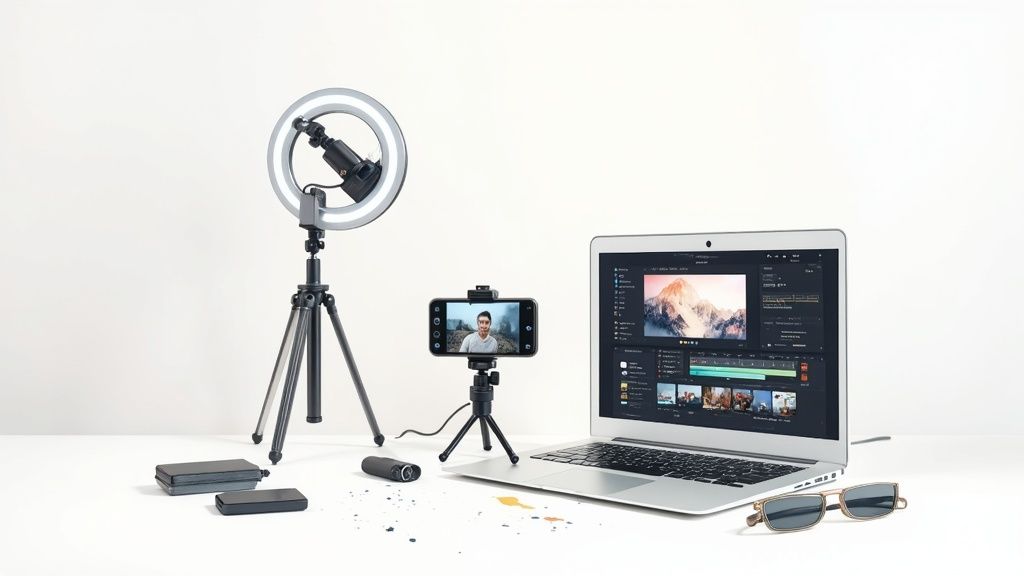
Alright, this is the action phase. It’s where all that careful planning comes to life as you capture the raw footage. The best part? The device you’re probably using to read this—your smartphone—is more than powerful enough to shoot high-quality video for social media.
While fancy cameras are nice, authenticity and a clear message almost always win on social. Instead of worrying about the camera, focus your energy on two simple, low-cost elements that make a massive difference.
- Lighting: Good lighting is completely non-negotiable. You don't need expensive studio lights. Just sitting in front of a window to use natural light is often your best bet. A simple ring light is another fantastic, affordable option for consistent, flattering light.
- Audio: Nothing makes viewers scroll away faster than bad audio. An inexpensive clip-on lavalier mic can dramatically improve your sound quality, making you sound clear and professional. People will forgive a slightly grainy video, but they will not put up with muffled, hard-to-hear audio.
The secret to great production isn't the camera you use, but how you use it. Stable shots, clear audio, and good lighting are the three pillars that will elevate your videos from looking homemade to looking polished and credible.
One last tip: always film more than you think you need. Grabbing extra takes and different angles (what we call B-roll) gives you so much more flexibility when you get to the editing stage. It’s always better to have too much footage than not enough.
Phase 3: Post-Production and Editing
Once the filming is done, it's time for post-production. This is where you assemble your clips, add graphics, layer in some music, and create a final, engaging video. This used to be a huge bottleneck, requiring complex software and a ton of technical skill, but modern tools have completely changed the game.
Today's editing landscape is packed with user-friendly apps that put professional-looking results within anyone's reach.
- Template-Based Apps: Tools like CapCut and Canva have libraries of pre-made templates that make adding animated text, slick transitions, and graphics incredibly simple. You can create visually dynamic videos in a fraction of the time it used to take.
- AI-Powered Editors: A new wave of AI editing tools can automatically find the best parts of your footage, cut out awkward pauses, and even generate subtitles with stunning accuracy. These tools can easily cut your editing time by more than half—a massive win for busy teams.
This is also where you add the final touches for social media success, like captions—especially since over 85% of social videos are watched with the sound off. By embracing these modern tools, you can build an efficient workflow to pump out high-quality social marketing videos without burning out your team or your budget.
How to Measure Your Video Success and ROI
Likes and views are great for a quick ego boost, but let's be honest—they don't pay the bills. If you want to prove the real-world value of your social marketing videos, you have to dig deeper than those surface-level numbers.
The whole point of measurement is to answer one simple question: "Did this video actually do what we needed it to do?" That means shifting your attention away from vanity metrics and toward the key performance indicators (KPIs) that connect directly to your business goals and show a real return on investment (ROI).
Moving Beyond Vanity Metrics
It's way too easy to get caught up chasing likes, shares, and raw view counts. While these numbers might signal that you're reaching people, they don't tell you a thing about true engagement or business impact. A video with a million views but zero leads is, for all intents and purposes, a failure.
Instead, we need to zero in on metrics that show us how your audience is actually behaving. These KPIs give you a much richer, more valuable layer of insight into what’s connecting and what’s falling flat.
Here are the core metrics that truly matter:
- Watch Time and Completion Rate: This is arguably the most important engagement metric of them all. It tells you exactly how long people are sticking around. A high completion rate is a clear sign that your content is compelling enough to hold attention right to the very end.
- Audience Retention: Nearly every platform gives you a graph showing precisely when viewers drop off. This is gold. A huge dip in the first few seconds means your hook is weak. A more gradual decline is pretty normal.
- Click-Through Rate (CTR): If your video has a link or a call-to-action (CTA), the CTR measures the percentage of viewers who actually clicked it. This is a direct measure of how persuasive your video was.
- Conversions: This is the ultimate bottom-line metric. Did viewers do the thing you asked them to do? This could be anything from signing up for a newsletter to downloading a guide or making a purchase.
Using Platform Analytics to Your Advantage
Every single major social platform—from Instagram to YouTube—provides a powerful suite of built-in analytics tools. Don’t just glance at the dashboard. You need to get in there and dig through the reports to find real insights about your audience and your content.
For example, Instagram Insights will show you the reach, saves, and shares on your Reels, giving you a crystal-clear picture of what resonates. YouTube Analytics goes even further, offering deep dives into audience demographics, traffic sources, and that all-important audience retention graph. Learning to read these tools is fundamental to refining your video strategy.
Think of your analytics dashboard as a direct feedback loop from your audience. They are telling you, with their actions, exactly what content they value most. Your job is simply to listen and adapt.
A Practical Guide to A/B Testing Your Videos
So, how do you make your results better over time? You test. A/B testing involves creating two versions of a video with one small difference to see which one performs better. It’s the best way to stop guessing and start making data-driven creative decisions.
Here’s a simple process to get you started:
- Isolate One Variable: You have to be disciplined here—change only one thing at a time. It could be the video thumbnail, the first three seconds (your hook), the call-to-action text, or even the background music.
- Define Your Success Metric: Decide what you're measuring before you even start the test. Are you hoping for a higher click-through rate, or are you trying to improve the average watch time?
- Run the Test: Show each version to a similar audience segment. Most ad platforms have built-in tools that make this part pretty straightforward.
- Analyze and Implement: Once you have a clear winner, take that learning and apply it to all your future videos.
By consistently tracking the right KPIs and methodically testing your creative, you build a powerful engine for improvement. This approach turns video marketing from a creative gamble into a predictable driver of business growth. For a more detailed breakdown of connecting content efforts to revenue, explore our guide on measuring content marketing ROI.
Of course. Here is the rewritten section, crafted to sound completely human-written and natural, following all your provided instructions and style examples.
Your Top Social Marketing Video Questions, Answered
Jumping into social video always kicks up a few questions. It’s totally normal. Let's cut through the noise and get you some straight, practical answers to the most common hurdles teams run into.
How Long Should My Social Marketing Videos Be?
The honest answer? It completely depends on the platform and what you’re trying to accomplish. There’s no silver bullet, but there are definitely some solid rules of thumb.
If you’re trying to grab eyeballs on a fast-scrolling feed like TikTok or Instagram Reels, shorter is almost always your best bet. Think under 30 seconds—just enough time to land a quick, memorable punch. But for something more in-depth on YouTube or a professional piece on LinkedIn, you can easily stretch that to 2-5 minutes, as long as every second is packed with value.
The golden rule is to deliver your value as fast as humanly possible. Your best guide is your own analytics. Dive in and see exactly where people are dropping off. That data doesn't lie, and it will tell you the perfect length for your next video.
Do I Really Need Expensive Equipment to Start?
Absolutely not. That powerful little camera you have in your pocket right now is more than enough to shoot great-looking video for social media. In fact, raw authenticity often connects better with audiences than a super-polished, high-budget production.
Instead of worrying about gear, just focus on these two things. They cost next to nothing and make a world of difference:
- Good lighting: Natural light from a window is your best friend, and it’s free. If you want a small upgrade, a simple ring light is a cheap and effective option.
- Clear audio: People will forgive a slightly shaky camera, but they will click away instantly if the audio is terrible. A cheap clip-on microphone is one of the best investments you can make.
How Often Should I Post Videos?
This one’s simple: consistency trumps frequency, every single time. It's way better to post one fantastic video a week, every week, than to drop five mediocre ones and then go silent for a month.
For the algorithm-hungry platforms like TikTok and Instagram, you'll see a real boost if you can manage 3-5 posts per week without letting quality slide. The key is to start with a realistic schedule you know you can maintain. Once you get your workflow down, you can start ramping up.
What's the Best Way to Add Subtitles?
Adding subtitles isn't optional anymore. With over 85% of social videos being watched on mute, you’re losing a massive chunk of your audience without them.
Luckily, it’s never been easier. Most platforms, including Instagram and TikTok, have built-in auto-captioning that does a surprisingly good job. For a bit more creative control or to fix any little errors, a third-party app like CapCut is a fantastic tool. Just be sure to give any auto-generated captions a quick proofread before you hit publish.
Ready to stop spending hours on video and start scaling your content strategy? With Aeon, you can turn any piece of content into a scroll-stopping social video in minutes. See how our AI-powered platform helps teams drive real engagement and revenue at Project Aeon.