The race to produce more content, faster, has created a massive headache for brand teams. Do you scale up production and risk a watered-down, inconsistent brand identity? Or do you protect your brand at all costs, even if it means moving slower? This is a huge issue in automated video, where speed often tramples right over brand integrity. The result? A disjointed, confusing experience for your audience.
This is exactly the problem style AI was designed to fix.
Why Brand Voice Gets Lost in Automated Content

Think about your brand's style guide. It’s not just a document; it’s a recipe. It’s your secret sauce, meticulously developed to create a consistent flavor that customers instantly recognize and learn to trust. Every single ingredient—from the exact hex code of your primary color to the timing of a video transition—adds to that signature taste.
When you’re creating content the old-fashioned way, you have a master chef (your creative director) watching over every dish, making sure it follows the recipe to the letter. But when you flip the switch on automation without guardrails, it’s like unleashing dozens of line cooks in the kitchen, and every one of them has their own take on the recipe.
The Breakdown of Brand Consistency
Without a central system calling the shots, tiny variations start to creep in. This video uses a font that’s almost right. That one has a transition that feels a little too aggressive. A third one has the logo shoved into the wrong corner.
On their own, these are just minor slip-ups. But when they happen over and over, they create a chaotic and jarring experience that feels completely off-brand.
This slow erosion of consistency causes some serious problems:
- It Erodes Customer Trust: An inconsistent look and feel can make a brand seem unprofessional, sloppy, and unreliable.
- It Weakens Brand Recall: If your visuals are always in flux, it's that much harder for people to form a strong, memorable connection to your brand.
- It Dilutes Marketing Impact: Every piece of off-brand content is a missed opportunity to reinforce who you are, making your overall marketing less effective.
The real challenge of automated content isn't just making it—it's making it right, every single time. Without an automated guardian for your brand rules, you risk churning out a high volume of content that actively undermines your brand.
The solution is to teach the machine your recipe. This is where a style AI becomes non-negotiable. It acts as your digital master chef, ensuring every single video created by the system is perfectly on-brand and full of your unique flavor. To dig deeper into this core idea, you can check out our guide on what is brand consistency and why it's key to building trust.
What Is Style AI and How Does It Work?

Think of Style AI as your brand’s digital guardian. It's not some off-the-shelf product you just plug in; it's a smart system designed to learn the unique creative DNA of your brand and then apply it consistently across every single automated video. The goal is to make every piece of content feel like it was painstakingly crafted by your in-house team, even when it’s being produced at an incredible scale.
Imagine training a new creative apprentice. This digital apprentice doesn't just look at your logo and call it a day. It dives deep, studying every piece of your brand identity—from formal guidelines to past campaigns—to build a true understanding of your visual and tonal language.
This breaks down into two main stages:
-
The Learning Phase: First, the AI analyzes your existing assets. It sifts through brand manuals, marketing materials, and previous video content, deconstructing your style into a set of machine-readable rules. It’s identifying everything from your exact color palettes and font choices to the specific rhythm and pacing of your editing.
-
The Creation Phase: Once trained, the system puts that knowledge to work. When a new video is generated, the Style AI acts as a creative filter. It ensures every element—text overlays, transitions, animations, you name it—perfectly aligns with the brand rules it learned.
This kind of technology is part of a massive trend. The global AI software market hit a value of $122 billion in 2024 and is projected to skyrocket to $467 billion by 2030, with generative AI leading the charge.
Breaking Down the Technology
So, what’s actually happening under the hood? A Style AI is a blend of several powerful technologies working in concert. It starts with machine learning models that use pattern recognition to identify the core components of your brand’s style from a huge dataset of your content.
Then, generative AI steps in to apply those rules creatively. If you understand how an AI script-to-video generator works, you’ve got a good window into this process. It's the engine that actually builds the video—placing elements, timing cuts, and rendering graphics all according to the learned style guide.
To better visualize this, let's break down the essential pillars of a Style AI system.
Key Components of a Style AI System
Each of these components plays a critical role in transforming abstract brand guidelines into consistently beautiful, on-brand video content at scale.
Style AI isn't about replacing human creativity; it's about scaling it. It automates the repetitive, rule-based tasks of brand application, freeing up your creative team to focus on high-level strategy and storytelling.
Ultimately, the goal is to bridge the gap between the raw speed of automation and the subtle nuances of a strong brand identity. When implemented correctly, a Style AI ensures that no matter how fast you create, your brand’s voice remains clear, consistent, and instantly recognizable.
For a broader look at the tools in this space, our complete guide to video maker AI is a great place to start.
The Core Elements of AI-Driven Video Branding
Think of a Style AI as your digital brand guardian. It’s not just slapping a logo on a video; it’s a system that meticulously manages the foundational building blocks of your content to make sure every single frame feels authentic to your brand.
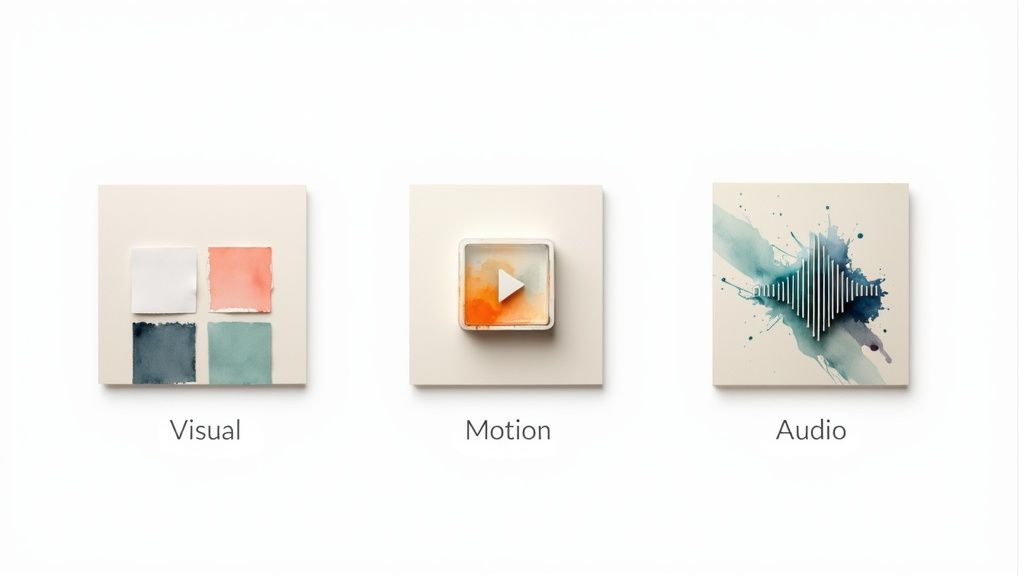
This isn't about one simple rule. It's about orchestrating a whole ecosystem of creative elements. We can break these down into three core areas: visual identity, motion and pacing, and audio and tone.
When these three pillars work together, they transform a generic, automated video into something that genuinely represents your brand. That granular level of control is what really sets a true Style AI apart from basic automation tools.
Visual Identity Enforcement
This is the most obvious and tangible part of AI-driven branding. A Style AI makes sure every visual component—down to the pixel—sticks to your brand guidelines. There’s simply no room for human error.
Here’s what it typically manages:
- Typography: The AI locks in the correct font families, weights, and sizes for all on-screen text, from headlines to lower-thirds.
- Color Palette: It guarantees that every element, whether it's a graphic overlay or a background color, uses the exact hex codes from your brand guide.
- Logo and Asset Placement: The system intelligently places logos, watermarks, and other brand assets in predefined safe zones for consistent positioning.
- Overlay and Graphic Design: It applies pre-approved templates for things like text boxes, call-to-action buttons, and other graphical elements.
Getting this right is becoming more and more critical. While a huge 60-72% of creatives use general AI assistants, the more specialized tools are gaining ground fast. We’re seeing 25-32% of users jump to these tools because they deliver a much higher level of polish, especially for visual work.
Motion and Pacing Control
Beyond the static visuals, a sophisticated style AI gets into the feel of a video by controlling its movement and rhythm. This is where your brand’s energy truly comes to life.
For a luxury brand, this might mean slow, elegant fades. For a tech startup, it could mean fast, energetic cuts that scream innovation.
By codifying motion principles, a style AI translates abstract brand attributes like "energetic" or "calm" into concrete video editing rules that are applied automatically and consistently.
The system governs things like transition speed, the style of animations (think a smooth slide-in versus a punchy pop-up), and the overall pacing of scenes. This ensures the viewing experience delivers the right emotional impact, every single time. As this technology evolves, understanding related tools like AI image generation is becoming essential for creating brand-consistent visuals within these video workflows.
Audio and Tonal Alignment
Finally, a Style AI handles the audio and language that define your brand’s voice. This goes beyond just what people see and creates a fully cohesive experience.
It maintains tonal consistency by:
- Enforcing Brand Voice: The AI can analyze on-screen text to make sure the language fits your brand’s personality—whether that’s professional, playful, or inspirational.
- Managing Sonic Identity: It can pull appropriate background music from a pre-approved library or even ensure that AI-generated voiceovers match a specific vocal profile.
By keeping a tight grip on these three pillars—visuals, motion, and tone—a Style AI provides complete brand governance. The end result? Every automated video is a true, accurate reflection of your brand.
How to Bring Style AI Into Your Workflow
Bringing a Style AI into your content process isn't like flipping a switch. It's a strategic move. The whole point is to weave this brand guardian so seamlessly into your tech stack that it becomes an invisible, powerful force for consistency.
Think of it less like buying a new tool and more like building a bridge between your brand bible and your production engine.
The first step, always, is to look inward. Before you can automate your brand's style, you have to get it "AI-ready." This means your brand guidelines need to be crystal clear, comprehensive, and digitally legible. Vague instructions like "use energetic transitions" just won't cut it for a machine. You need hard parameters, like "all scene transitions must be jump cuts under 0.2 seconds."
Once you have a solid, machine-readable brand book, you can start exploring how to actually plug this thing in.
Choosing Your Integration Path
Not all Style AI integrations are built the same. The right approach for you boils down to your existing systems, the sheer volume of content you're pumping out, and how much hands-on control your team needs. Each path strikes a different balance between raw power and out-of-the-box ease.
You’ve got three main ways to go:
- API-First Platforms: This is the most powerful and flexible route. An API-first platform like Aeon lets you directly pipe in content from your CMS or other data sources. Your Style AI sits in the middle, grabbing raw assets, applying all the brand rules, and then kicking out a finished video. It’s the command center.
- User-Friendly Plugins: For teams living inside design software, plugins are a godsend. These tools bring Style AI smarts directly into familiar spaces like the Adobe Creative Suite. This means designers can generate on-brand assets without ever leaving their favorite app.
- Headless Solutions: A headless Style AI is the silent operator. It works completely in the background, hooking into your workflow automation tools without any real user interface. It just automatically grabs content, processes it, and drops brand-perfect videos into a designated folder or platform.
This screenshot shows how a platform like Aeon can act as the central nervous system for this kind of setup, connecting all the different pieces of your content lifecycle.
Platforms built this way give you the bones to create a truly scalable media workflow where brand consistency is just part of the plumbing—it happens automatically.
Launching Your Pilot Program
Okay, so you've picked a path and maybe even a partner. Resist the urge to go for a company-wide, big-bang rollout. Please. The key to getting this right is to start small with a pilot program.
Pick one single, high-volume content format to test the waters. Maybe it's turning your blog posts into short social videos, or maybe it's creating simple product explainers. This tight focus lets you train the AI on your brand and work out the kinks on a manageable scale.
A successful pilot does more than just test the tech. It builds confidence internally and proves the value of Style AI to the people holding the purse strings, clearing the way for a much smoother, wider rollout.
This whole process is a crucial piece of building a smarter, faster content engine. You can dive deeper into these ideas in our guide on how media workflow automation can boost production efficiency. By starting with a smart, focused pilot, you make sure your Style AI actually delivers on its promise of scaling up without watering down your brand.
How Publishers and Brands Are Actually Using Style AI

This is where the rubber meets the road. The real power of a style AI clicks into place when you see how it’s being used to solve massive content problems right now. We're not talking about some far-off concept; this is a practical tool that publishers, retailers, and corporate teams are actively deploying to get ahead.
They’re automating brand consistency to not only speed up production but also sharpen their brand identity in a noisy market. Let’s dive into a few real-world scenarios where a style AI becomes the unsung hero of the content engine.
Use Case 1: The Global News Publisher
Imagine a major news organization trying to keep up with the relentless 24-hour news cycle. Their creative team, as talented as they were, had become a bottleneck. They simply couldn't manually churn out on-brand video summaries for every breaking story fast enough, leading to missed engagement opportunities on social media.
That’s when they brought in a style AI, connecting their content management system directly to a video generation engine.
-
The Fix: Every time a new article went live, the AI automatically whipped up a short, dynamic video summary. It intelligently pulled key quotes, applied the publisher’s precise fonts and lower-third graphics, and made sure every single video was perfectly aligned with their strict brand guidelines.
-
The Payoff: The publisher started producing hundreds of extra on-brand videos each week with zero additional work for their creative team. This directly translated to a major lift in social media engagement and, critically, more referral traffic back to their articles.
Use Case 2: The E-commerce Giant
An e-commerce giant was sitting on a catalog of over 50,000 products. Their challenge? Creating unique, compelling product videos for every single item—an absolutely impossible task. Traditional video production was out of the question due to cost and time, leaving most of their product pages with nothing but static images. This put them at a serious disadvantage against competitors who were already using video to drive sales.
Their mission was to automate the creation of brand-consistent product videos at a staggering scale.
The real challenge wasn't just making videos; it was making tens of thousands of them that all felt like they came from the same trusted brand, reinforcing a consistent customer experience from the first click to checkout.
The company plugged a style AI directly into their product information management (PIM) system. The AI ingested all the raw product data—images, descriptions, price, and specs—and used it to generate a punchy video for each item. Every video automatically included branded overlays, approved background music, and consistent call-to-action animations.
Use Case 3: The Corporate Marketing Team
A large corporation was wrestling with brand consistency in its internal communications. With dozens of departments creating their own training materials and announcements, their video content was a chaotic mess of different styles, fonts, and logos. This fragmented look not only weakened the internal brand but also made important communications feel unprofessional and disjointed.
The marketing team needed a foolproof way to empower employees to create videos while locking in brand compliance.
-
The Fix: They rolled out a style AI platform with heavily restricted templates. Employees could upload their own content, but the AI took care of all the styling. It automatically applied the correct corporate color palette, logo placement, and typography, no exceptions.
-
The Payoff: Almost overnight, all internal videos became uniform and professional. This did more than just strengthen the corporate brand internally; it saved the marketing team countless hours they used to spend policing content and fixing off-brand videos.
Common Mistakes to Avoid When Using Style AI
Jumping into a style AI project without a clear game plan can lead to some seriously frustrating results. While the tech is incredibly powerful, it isn't magic—it needs clear instructions and a thoughtful process to work its wonders. If you sidestep a few common pitfalls, you can set your team up for success right from the get-go.
One of the biggest blunders we see is underestimating the initial setup. Teams often assume the AI can just absorb their brand identity from a few scattered assets. That approach is a recipe for a mess of inconsistent videos. A style AI is only as good as the rulebook you give it.
Another frequent misstep is feeding the AI an incomplete or contradictory brand guide. If your own documentation has conflicting rules for logo placement or color usage, guess what? The AI will faithfully reproduce that chaos at scale. It ends up amplifying your existing brand inconsistencies instead of fixing them.
Overlooking the Human Element
Maybe the most critical mistake is adopting a "set it and forget it" mindset. Even the smartest style AI needs a human eye to guide and refine its work. Skipping a proper review process is a huge risk you don't want to take.
To dodge these issues, you just need to nail a few key practices:
- Start with a Bulletproof Guide: Before you even think about implementation, make sure your brand guide is detailed, up-to-date, and—this is crucial—machine-readable. Define everything from hex codes to animation timings with absolute clarity.
- Launch with a Single Format: Don't try to boil the ocean. Kick things off with one high-volume video format, like turning blog posts into social media clips. This lets you iron out the kinks in a controlled environment before you go big.
- Keep a Human in the Loop: Always, always have a person review the AI's output, especially in the early days. This quality check is how you catch errors and give the feedback that makes the AI smarter over time.
Think of a style AI as a powerful collaborator, not a replacement for your creative team. The goal is to let it handle the repetitive grunt work of brand application. That frees up your people to focus on what they do best: strategy and storytelling.
By avoiding these traps and taking a smart, step-by-step approach, your style AI initiative will actually deliver on its promise. You'll get high-quality, on-brand video content that strengthens your brand identity with every single frame.
Got Questions About Style AI? We've Got Answers
Thinking about bringing a style AI into your workflow? You’re not alone. Here are some of the most common questions we hear from teams just like yours, with some straight-to-the-point answers.
How Tech-Savvy Do I Need to Be to Use This?
Honestly, it depends on how deep you want to go. For many teams, especially those without a dedicated developer, a style AI can be surprisingly simple. Many platforms are built with a no-code, user-friendly interface. It's often as easy as uploading your brand assets and ticking a few boxes in a settings menu.
But if you’re looking for a truly seamless, automated setup, that’s where the API-first platforms come in. This is where your developers can shine, connecting the style AI directly into your CMS or other internal systems. This approach gives you the ultimate in flexibility and hands-off automation.
What Happens When We Rebrand?
This is where a style AI really proves its worth. A rebrand is a huge undertaking, but your video workflow doesn't have to be a headache.
When your brand gets a facelift—a new logo, a fresh color palette, a different font—you just update those core assets in the AI’s central settings. That’s it. The system instantly applies those new rules to every single video it creates from that moment on. No more hunting down old templates or manually updating hundreds of assets.
How Are These Tools Usually Priced?
Pricing typically falls into one of two camps, giving you options based on how your team works.
- Subscription-based: This is the most predictable route. You pay a set monthly or annual fee for a certain number of video creations. It’s perfect for teams that need to stick to a clear budget.
- Usage-based: This model offers more flexibility. You pay per video generated or by the amount of processing time used. If your production schedule is all over the place, this lets you scale your costs up or down to match your actual needs.
Ready to stop worrying about brand consistency and start automating your video creation? With Aeon, you can lock in your unique brand style across every single video, instantly and at scale. See how you can transform your content workflow at https://www.project-aeon.com.