So, what is multi-channel marketing, really?
At its core, it’s a strategy where a company uses a mix of different channels to talk to its customers. Instead of putting all your eggs in one basket, you engage with people on their favorite platforms—whether that’s social media, email, your website, or somewhere else entirely.
Understanding Multi Channel Marketing
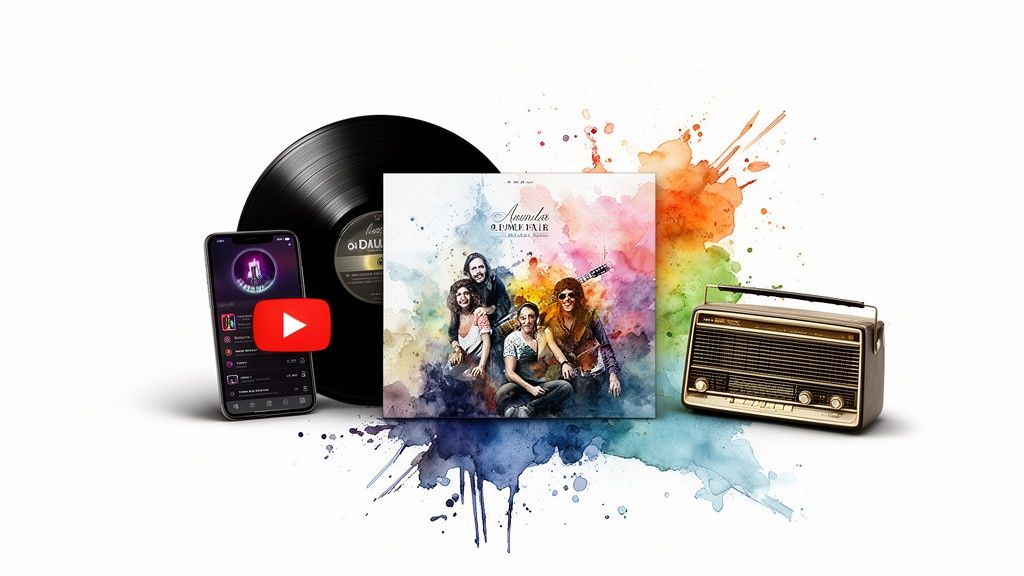
Think about how a band releases a new album. They don’t just drop it on Spotify and call it a day. They also press vinyl records for collectors, drop music videos on YouTube, and get their singles played on the radio. Each channel is designed to reach a different type of listener, right where they prefer to tune in.
That’s multi channel marketing in a nutshell.
It's all about meeting customers on their own turf instead of trying to herd everyone back to a single website. In this model, the brand sits at the center, broadcasting its message out to customers through several different, parallel avenues.
The Core Goal of a Multi Channel Approach
The main idea is simple: make it as easy as possible for people to find you and interact with your brand. This approach accepts the reality that a modern customer's path to purchase is rarely a straight line.
Someone might first see your brand in an Instagram ad, then sign up for your newsletter from a pop-up on your blog, and finally decide to buy after getting a promo code in an email.
Each of these touchpoints works as its own separate experience. The channels run alongside each other but don't necessarily talk to one another to create one unified conversation. The big wins from this approach are pretty clear:
- Expanded Reach: Being active on multiple platforms lets you cast a much wider net, connecting with all sorts of different audience segments.
- Customer Choice: You're giving people the power to engage with you on the channel they're most comfortable with.
- Increased Touchpoints: More channels mean more chances to get your brand name out there and gently guide people toward making a purchase.
A common hurdle is making these separate channels feel like they're part of the same team. Figuring out the best way of integrating ads, emails, and website is a huge step toward a more powerful and cohesive strategy. This focus on channel variety is what builds strong brand awareness and creates more opportunities to connect.
Multi Channel vs Omnichannel Marketing: What Is the Difference?
It’s easy to see why people use “multi-channel” and “omnichannel” interchangeably. On the surface, they sound like the same thing—using multiple channels to reach customers. But dig a little deeper, and you’ll find two fundamentally different philosophies for engaging with your audience.
Getting this distinction right is more than just semantics; it shapes your entire marketing strategy.
The Foundational Approach: Multi-Channel
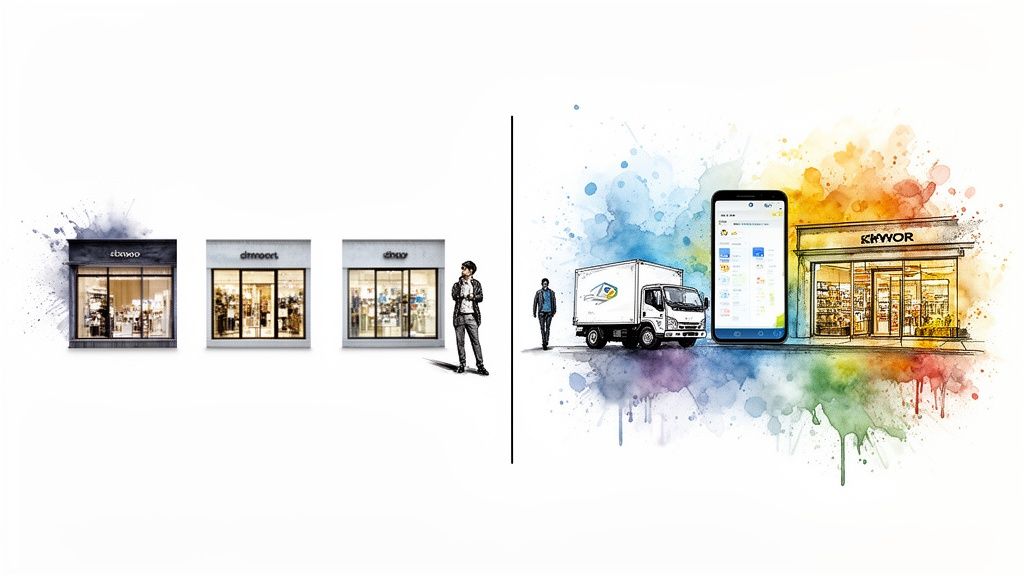
Think of multi-channel marketing like a franchise with several fantastic, but totally separate, locations. You can grab a coffee at their downtown shop or their airport kiosk. You’ll get the same great coffee, but the two locations don’t talk to each other. Your loyalty card from downtown won’t work at the airport, and the barista at the airport has no idea you’re a regular at the other spot.
In this model, the brand is the center of the universe. Each channel—social media, email, your website, a physical store—is a separate spoke leading back to that central brand, but they don’t connect with one another.
The Customer-Centric Evolution: Omnichannel
Now, imagine a completely different coffee experience. You order a flat white on a mobile app while on the train, and you get a notification when it’s ready. You walk into the shop, scan a QR code, and a locker pops open with your name and order on it. Every step is connected, seamless, and built around your convenience.
That’s omnichannel marketing.
Here, the customer is the center of the universe. All the channels orbit around them, constantly communicating to create one fluid, uninterrupted journey. If you add an item to your cart on your phone, it’s still sitting there waiting for you when you log in later on your laptop. The experience follows you.
The key takeaway is this: Multi-channel puts the brand at the center and gives customers multiple, separate ways to engage. Omnichannel puts the customer at the center and weaves all those channels together into a single, cohesive experience.
Most businesses start with a multi-channel setup, which is a critical first step. You have to be where your audience is. From there, you can start connecting the dots. To take that next step, check out our guide to a cross-channel marketing strategy for practical tips on unifying those touchpoints.
Multi-Channel vs Omnichannel: A Quick Comparison
The choice between these two approaches has huge implications for everything from your tech stack to the day-to-day experience your customers have. This table breaks down the core differences.
Ultimately, a multi-channel strategy is about being present on multiple platforms. An omnichannel strategy is about weaving those platforms into a single, intelligent conversation with your customer.
Alright, we’ve covered what multi-channel marketing is. But the real question is, why should you care? What does it actually do for your business?
The short answer: It’s how you turn a scattered presence into real, measurable growth. This isn't just about showing up on more platforms; it's about making it incredibly easy for people to find and connect with you, which directly impacts your bottom line.
Think of it this way: instead of having just one front door to your business, you're opening up several. You're meeting people where they already are, removing the friction that stops them from engaging. That’s a powerful shift.
Expand Your Brand's Reach
A multi-channel strategy is one of the fastest ways to get your brand in front of new eyeballs. Why? Because different people hang out in different digital neighborhoods.
The person who stumbles upon your brand through a TikTok video is probably not the same person who finds your blog via a Google search. The executive who follows your updates on LinkedIn might never see your Instagram feed. By setting up shop on various channels, you’re not just hoping customers will wander by—you're actively going to them. This casts a much wider net, filling the top of your funnel with a more diverse audience.
The magic really happens with consistent exposure. People rarely act on the first touch. Seeing your message across different platforms builds familiarity and, more importantly, trust. It’s a well-known marketing principle that people need multiple touchpoints before a message sinks in, a fact that really drives home the power of a multi-channel approach. You can dig into the stats on multiple touchpoints and how they build brand recall.
Deepen Customer Engagement and Boost Conversions
This isn’t just about attracting new people; it's also about building stronger relationships with the ones you already have. When you engage with customers on the platforms they use every day, you stay top-of-mind. It's how you build a community and a sense of loyalty that a single-channel strategy just can't replicate.
Here’s a classic e-commerce example of how this plays out:
- Discovery: A potential customer is scrolling Instagram and sees a snappy video ad for your new product. Their interest is piqued.
- Nurturing: They click the link in your bio and sign up for your newsletter. Over the next few weeks, you send them useful content and maybe a subscriber-only offer. You're building a relationship, not just pushing a sale.
- Conversion: Finally, a well-timed email with a 24-hour discount code gives them the nudge they need. They click through to your website and make the purchase.
See how that works? Each channel played a specific, vital role. Instagram sparked the initial interest, email nurtured the lead, and your website closed the deal. It’s a coordinated dance that creates a much smoother and more profitable journey for the customer.
Choosing the Right Channels for Maximum Impact
A multi-channel strategy is only as good as the channels you pick. The temptation is to be everywhere at once, but that’s a direct path to burning out your team and your budget—not getting results. The real goal is to make smart, deliberate choices based on where your brand can actually connect with people, not just chase the latest shiny object.
This means you have to stop looking at platforms as a generic checklist and start digging into the specific role each channel plays in your customer’s life. Different platforms solve different problems, and getting this right is the secret to putting your resources where they’ll do the most good.
Aligning Channels with Business Goals
Before you even glance at a list of social media apps, you need to know your audience cold. Where do they hang out online? What kind of content do they binge? Nailing down these answers gives you the foundation for everything that follows.
Once you know who you're talking to, you can start matching channels to your actual marketing goals. Not every channel is built to do the same job.
-
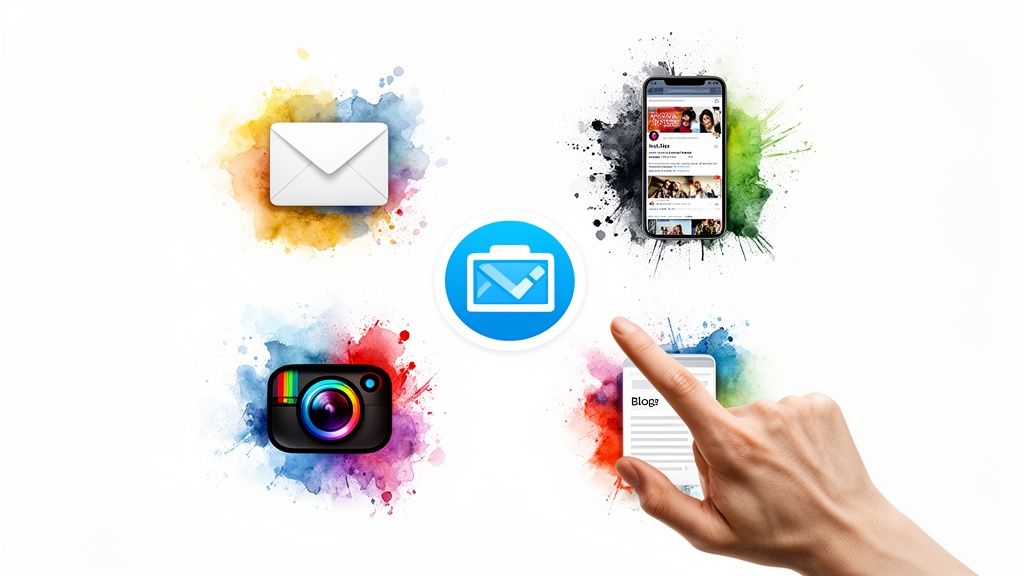
For Brand Discovery and Community: Platforms like TikTok and Instagram are visual playgrounds. They’re perfect for grabbing attention, showing off your brand’s personality, and building a loyal following through short-form video and interactive content.
-
For Nurturing and Direct Offers: Email is still the king of building relationships. It’s a direct, personal line to your audience, making it ideal for sharing high-value content, announcing new products, and driving sales with targeted offers.
-
For Authority and SEO: Your blog and website are your digital home base. This is where you prove you know your stuff with in-depth articles, case studies, and helpful resources. Think of it as the hub that pulls in organic traffic from search engines day in and day out.
The trick is to see these channels not as separate islands but as interconnected pieces of a bigger puzzle. Your Instagram might pull someone into a blog post, which then gets them to sign up for your newsletter, and eventually, they become a customer for life.
Maximizing Your Content’s Reach
One of the smartest ways to manage a multi-channel presence without losing your mind is to repurpose your content. This isn't about being lazy; it's about being efficient. You get the most bang for your buck from every single piece of content you create, saving time and hammering your message home across every platform.
For instance, one solid, well-researched blog post can fuel an entire campaign's worth of assets. You just have to break down the core ideas and spin them into different formats for different channels.
This could look like:
- Short-Form Videos: Pull out a few key stats or tips from the article and turn them into snappy 30-second videos for TikTok, Instagram Reels, and YouTube Shorts.
- Infographics: Visualize the data or a step-by-step process from the post and create a shareable infographic for platforms like Pinterest and LinkedIn.
- Email Newsletter: Round up the main takeaways in your newsletter, with a link back to the full article for your most dedicated subscribers.
This approach keeps your core message consistent while perfectly tailoring it to how people consume content on each platform. A recent survey showed just how diverse the modern marketer’s toolkit is, with email leading the pack at 82.4% usage, followed closely by social media and mobile web. You can discover more insights about channel marketing statistics to see how this mix works across different industries.
Ultimately, choosing the right channels is all about meeting your audience where they already are and giving them content in the format they love.
How to Build Your Multi Channel Marketing Strategy
Building a multi-channel marketing strategy that actually works isn't about planting your flag on every platform you can find. It’s about being smart—showing up in the right places with a message that connects.
Think of it as a playbook. It’s a deliberate process of figuring out your audience, deciding what a "win" looks like, and then showing up consistently. Let's break down how to get it done.
Develop Detailed Audience Personas
Before you even think about which channels to use, you have to know exactly who you're talking to. If you skip this part, you're basically just shouting into the void and hoping someone hears you.
You need to create audience personas, and I don't mean just jotting down age and location. We need to go deeper to understand the real people behind the screens.
Get into their heads by asking the right questions:
- Where do they hang out online? Are they doom-scrolling on TikTok, networking on LinkedIn, or asking for advice in niche Facebook groups?
- What content actually grabs their attention? Do they watch quick how-to videos, read long-form articles, or prefer interactive polls?
- What are their biggest headaches? Figure out the problems they're trying to solve, because that's where you come in.
The answers to these questions will dictate your entire channel strategy. If your audience is mostly Gen Z, going all-in on email while ignoring Instagram and TikTok is a recipe for failure. Use your existing analytics, send out a few customer surveys, and do some market research to build personas that are grounded in real data.
Set Meaningful Goals and KPIs
Okay, you know your audience. Now, what do you want them to do? Vague goals like "get more engagement" are basically useless. Your objectives have to be specific, measurable, and tied to actual business growth.
The whole point is to stop chasing vanity metrics and start focusing on what moves the needle. A great multi-channel approach isn't just about being seen; it's about driving performance you can measure with clear Key Performance Indicators (KPIs).
You should even break down your goals by channel to see how each one is contributing to the bigger picture.
Examples of KPIs That Matter:
- Channel-Specific Conversion Rate: Of all the people who clicked from your email newsletter, how many actually made a purchase?
- Customer Lifetime Value (CLV): How much revenue does the average customer you acquired through Facebook ads bring in over time?
- Cost Per Acquisition (CPA): How much are you spending on Google Ads to get one new paying customer?
Metrics like these give you a crystal-clear view of what's working and what's a waste of money, helping you put your budget where it will have the most impact. For a more detailed look at execution, this step-by-step guide to multichannel retailing success offers some really practical insights.
Craft a Consistent Brand Message
Your brand should feel like your brand, no matter where someone runs into it. But consistency doesn't mean you should just copy and paste the same message everywhere.
The real skill is adapting your core message to fit the vibe of each platform. The professional, slightly more formal tone you use on LinkedIn should feel completely different from the fun, visual-heavy content you post on Instagram.
Create a simple brand style guide that covers your main messaging points, tone of voice, and visual look. This keeps your brand feeling cohesive, even when you're tailoring content for different audiences. From there, you can start digging into different multi-channel marketing strategies for publishers to see how this all comes together. When you constantly check your performance data and tweak your approach, you turn a bunch of scattered touchpoints into a powerful, unified engine for growth.
Scaling Content Creation for Every Channel
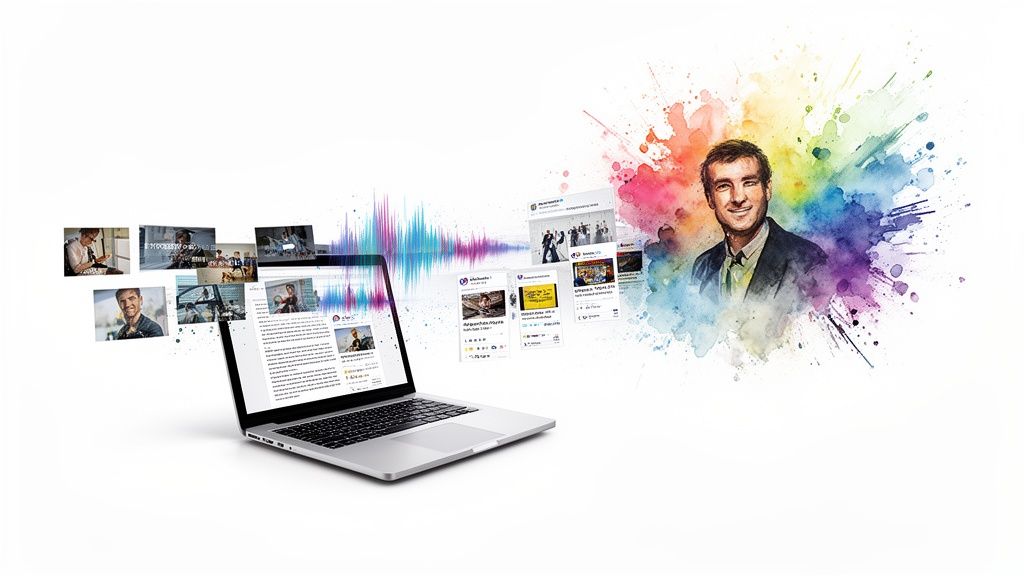
The biggest hurdle in launching a true multi-channel marketing strategy is the sheer volume of content it demands. Let's be honest—creating high-quality, tailored assets for every single platform can quickly exhaust even the most efficient teams, leading to burnout and a disjointed brand message.
This is the content scalability problem. How do you feed the beast of multiple channels without your quality slipping or your budget spiraling? The answer isn't about working harder; it's about working smarter by turning one core piece of content into a whole suite of assets.
From One to Many with Automation
This is where modern tools, especially those powered by AI, become a total game-changer for content teams. These platforms can grab a single foundational asset—like a deep-dive blog post, a new podcast episode, or a customer webinar—and multiply its impact.
Imagine turning one article into a dozen different assets in just minutes. This process, known as content repurposing, is absolutely essential for scaling your efforts. A publisher could, for instance, plug a blog post into an automated video creator and instantly generate:
- Short-form clips for TikTok and Instagram Reels, pulling out the juiciest quotes and stats.
- Audiograms that pair compelling audio snippets with animated waveforms for social feeds.
- Animated text videos perfect for dropping quick insights into an email newsletter.
This automated approach doesn't just save a massive amount of time. It also keeps your core message consistent across every single touchpoint.
By automating the creation of derivative assets, marketing teams are freed from repetitive production tasks. This allows them to shift their focus from manual execution to high-level strategy and creative ideation, driving more meaningful results.
Getting this efficiency down is more critical than ever. A staggering 86% of marketers report that multi-channel strategies are getting more effective year after year, which only highlights the need for scalable solutions. You can read more about these marketing channel statistics to see just how fast this trend is growing.
Exploring what is content repurposing is the first real step toward dominating your social feeds without completely exhausting your team.
Still Have Questions About Multi-Channel Marketing?
Even the sharpest marketing teams run into questions when they start juggling multiple channels. Let's tackle a few of the most common ones that come up.
How Do I Choose the Right Channels for My Business?
The best place to start is with your audience. Where are they already hanging out? Dig into your website analytics, social media insights, and even old-school customer surveys to figure out where they spend their time. After that, take a peek at what your competitors are doing and see which platforms are giving them traction.
A word of advice: don't try to be everywhere at once. It’s far better to pick 3-5 channels where you can show up consistently and build a real community. Always prioritize quality over quantity.
What Are the Biggest Challenges of Multi-Channel Marketing?
Honestly, the biggest hurdles are usually keeping your brand voice consistent across every platform, trying to make sense of data from a dozen different places, and simply creating enough fresh, tailored content to feed the beast.
Here’s how to get ahead of those challenges:
- Create a simple, central brand style guide so everyone knows the rules of engagement.
- Use a unified dashboard to pull all your analytics into one place.
- Bring in some automation tools to help you scale up your content creation without burning out your team.
How Can I Measure the ROI of My Multi-Channel Strategy?
You need to connect the dots between the KPIs you're tracking on each channel and your larger business goals. Attribution modeling is your best friend here—it helps you see which touchpoints are actually doing the heavy lifting and leading to conversions.
Keep your eyes on the big three: conversion rates per channel, customer acquisition cost (CAC), and overall customer lifetime value (CLV). A centralized analytics platform isn't just a nice-to-have; it's essential for getting a clear, accurate picture of what's working and what's not.
Ready to scale your content without scaling your workload? Aeon transforms your articles and audio into dozens of engaging videos for every channel in minutes. Discover how Aeon can automate your video creation today!