An AI outfit generator is basically a digital stylist with an infinite imagination, one that can dream up unique, personalized outfits in a matter of seconds. It works by blending a user's input—like their style preferences or even just a single picture of a shirt—with enormous fashion datasets to become a creative partner for brands and shoppers alike.
What Is an AI Outfit Generator

At its heart, an AI outfit generator is a smart tool that uses artificial intelligence to mix and match clothing items, building complete looks from the ground up. It’s less about complex algorithms and more about having a creative collaborator that just gets the rules of fashion, knows what’s trending, and can even learn an individual's personal taste.
This tech goes way beyond just randomly pairing a shirt with pants. It digs deeper, analyzing textures, colors, silhouettes, and patterns to put together combinations that are actually cohesive and look good. You could feed it a photo of a single skirt, and it can build out a whole wardrobe of complete outfits around that one piece, ready for any occasion.
Why This Technology Matters Now
The rise of AI outfit generators is a pretty big deal for the fashion industry. For years, personalization has been the holy grail for e-commerce brands, but it was always a tough and expensive thing to pull off at scale. These tools are changing the game, making hyper-personalized shopping experiences available to everyone.
This technology hits on several key needs in the industry right now:
- Supercharged Creativity: Designers and stylists can instantly spitball countless new ideas, completely blowing past creative blocks.
- A Better E-commerce Experience: Brands can show off their products on virtual models in endless combinations, which gets customers more engaged and ready to buy.
- Marketing on a Grand Scale: Marketing teams can crank out tons of unique visual content for social media, ads, and campaigns without needing a single expensive photoshoot.
It's getting impossible to ignore the impact. The market for these kinds of AI fashion tools has absolutely exploded, jumping from $100 million in 2020 to an estimated $250 million in 2023. And it’s not slowing down—projections show the market hitting $1.5 billion by 2030, all because the technology is fundamentally changing how fashion gets made.
An AI outfit generator is more than just a cool gimmick; it's a powerful engine for personalization, creativity, and efficiency. It gives brands a way to connect with customers on a much deeper level and helps people discover styles they never knew they’d love.
For anyone just trying to get their head around the basics, understanding what an AI outfit generator is offers a great starting point. The bottom line is that this technology is quickly becoming an essential tool that's reshaping how fashion is designed, sold, and worn.
To put it all in perspective, here's a quick rundown of what these platforms can do.
Table: Core Capabilities of Modern AI Outfit Generators
This table summarizes the key functions and benefits of AI outfit generator technology at a glance, helping readers quickly grasp its value proposition.
These capabilities show just how versatile this technology is, moving it from a simple "what-to-wear" app to a core part of the modern fashion ecosystem.
A Look Under the Hood of AI Fashion Tech
So, how does an AI outfit generator actually dream up a new look? It’s not pulling ideas out of thin air. The process is a fascinating blend of artistic intuition and some seriously powerful data analysis. Think of the AI as a hyper-focused fashion apprentice that has studied millions of outfits to learn what works—and how to create something entirely new.
A lot of these systems are built on something called Generative Adversarial Networks, or GANs. It sounds like a mouthful, but the idea behind it is pretty straightforward.
Imagine two AIs working in tandem. One is the "Generator," a student artist trying to create new fashion designs. The other is the "Discriminator," a tough-as-nails art critic who has seen it all. The Generator makes a new outfit, and the Discriminator compares it against a massive library of real-world fashion photos, telling it, "Nope, try again. That doesn't look real." This back-and-forth happens millions of times, with the Generator getting smarter and more creative with every attempt until its designs are good enough to fool the expert critic.
From User Input to Stylish Output
The whole creative process kicks off with your input. These are the raw ingredients the AI needs to get a feel for what you're after. When you give it a prompt or an image, the AI isn't just looking at the surface; it's breaking it down into core fashion elements like color, texture, and silhouette.
Most platforms will ask for a few common things:
- Text Prompts: This is as simple as it sounds. Typing "a casual summer outfit with a denim jacket and white sneakers" gives the AI a clear brief.
- Reference Images: Got a photo of a floral skirt you love? Upload it. The AI will use that as the centerpiece to build a whole look around.
- Style Parameters: You can often narrow things down further by selecting a vibe, like "bohemian," "minimalist," or "formal," to guide the overall aesthetic.
Once the AI has these inputs, it gets to work. It analyzes the patterns, colors, and shapes, cross-referencing everything with its internal database of fashion knowledge. This is basically its understanding of what makes an outfit look good.
The real magic is in the AI's ability to connect the dots between different trends, styles, and even fashion "rules." It doesn't just copy and paste what it's seen before; it synthesizes all that information to generate something that feels both new and familiar.
This is how abstract data becomes a tangible, stylish outfit. The AI knows that a silk blouse hangs differently than a cotton tee, or that certain color palettes just work for autumn. It’s this deep, contextual understanding that lets an ai outfit generator produce such high-quality visuals. If you're curious about how this applies to e-commerce, the tech behind virtual fitting rooms uses very similar principles. You can find more info on these applications at https://project-aeon.com/blogs/fitroom-ai.
The Final Creation: What the AI Delivers
After all that number-crunching and creative generation, the system gives you the final output. This isn't just a single static image; it can come in a few different flavors, depending on what the tool is built for. For businesses trying to scale up their content, these outputs are a goldmine.
The results usually fall into one of three buckets:
- Photorealistic Models: The AI can generate images of diverse virtual models wearing the newly designed outfits. This is a game-changer for e-commerce brands wanting to showcase products without footing the bill for expensive photoshoots.
- Virtual Outfits (Product Flats): You can also get "flat lay" images of the outfit, with all the clothing items arranged neatly. These are perfect for lookbooks, blogs, and style guides.
- Design Mockups: The AI can also produce quick design sketches or concepts for new clothes, helping designers visualize ideas in seconds before ever touching a piece of fabric.
At the end of the day, this technology translates a simple human idea into polished, ready-to-use fashion content. It’s an engine that bridges the gap between imagination and a finished visual, opening up sophisticated style creation to just about anyone.
What AI Outfits Can Do For Your Business
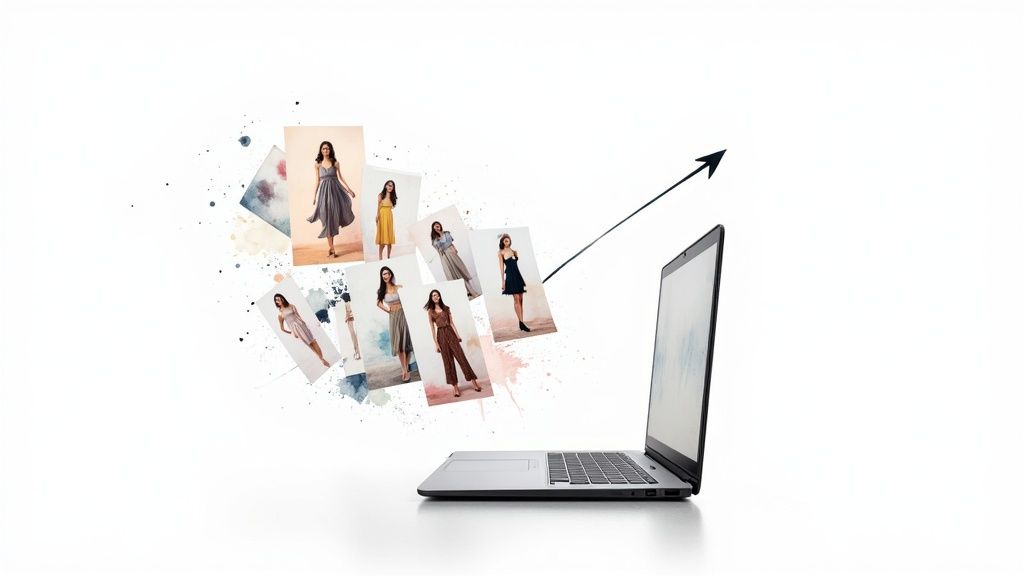
Sure, the technology is cool. But the real story here is how an AI outfit generator can actually deliver tangible results for a business. For companies on the front foot, this isn't just a fun creative tool—it's a serious engine for growth, efficiency, and carving out a competitive edge. The applications are already spreading across e-commerce, marketing, and content creation, with each one offering a clear path to a real return on investment.
And the market is definitely paying attention. The generative AI in fashion space is on an absolute tear, projected to balloon to $2.23 billion by 2032. This incredible growth is being driven by AI's power to boost operating profits—potentially by up to $275 billion for apparel and luxury brands in the next few years—by optimizing everything from initial designs to personalized customer experiences.
This isn't just hype. It's built on practical, high-impact uses that solve some of the fashion industry's oldest headaches.
Supercharge Your E-Commerce Visuals
For anyone selling clothes online, the grind is real: how do you show off your products in a way that's fresh, diverse, and actually gets people to click "buy"? Traditional photoshoots are a nightmare of logistics, expenses, and time. An AI outfit generator cuts right through that mess, letting brands create endless on-model product shots without ever touching a camera.
Picture this: you're launching a new collection of 50 different blouses. Instead of orchestrating a massive, multi-day photoshoot, you could:
- Whip up photorealistic images of every single blouse on a whole range of virtual models, showcasing different body types, ethnicities, and ages.
- Instantly create fully styled outfits around each blouse, pairing it with different pants, skirts, and accessories to show customers just how versatile it is.
- Power a virtual try-on feature where a customer can upload their own photo and see how the shirt looks on them—a proven way to boost conversion rates.
This approach doesn't just slash your production budget. It explodes the sheer volume and variety of your visual assets, making your online store more inclusive and engaging for every single person who visits.
By separating product photography from physical photoshoots, e-commerce brands can hit a speed and scale that was previously unthinkable. You can refresh entire catalogs and marketing campaigns in hours, not weeks.
Scale Your Marketing and Ad Content
Marketing teams are always under the gun to produce a constant stream of fresh, high-performing creative for social media, email newsletters, and paid ads. An AI outfit generator is like having an inexhaustible well of visual content, letting you test, learn, and personalize at a dizzying speed.
Think about a social media campaign for a new line of sneakers. A marketing team can use the AI to instantly churn out a massive library of creative.
Example Campaign Assets:
- For Instagram: Generate dozens of unique lifestyle shots featuring the sneakers in "street style" or "athleisure" looks, worn by virtual influencers in different city backdrops.
- For Facebook Ads: Create countless A/B testing variations with different model demographics and outfit styles to pinpoint exactly what resonates with each target audience.
- For Pinterest: Produce a whole series of "Get the Look" style guides, all centered around your new sneakers.
The ability to create tailored content at this scale is a game-changer. If you’re a smaller player, understanding how AI for small business marketing can fuel growth is critical for keeping up.
Empower Content Creators and Stylists
This technology isn't just for big brands. It's a massive unlock for individual creators, stylists, and fashion bloggers, too. In the past, creating a professional-looking style guide or lookbook meant having access to a huge wardrobe, models, and a photographer—a barrier that kept many talented people out.
An AI outfit generator blows those doors wide open. Now, a content creator can produce a stunning, high-quality "Fall Fashion Guide" without owning a single piece from the collection. They can use simple text prompts or a few reference images to generate a whole series of on-trend outfits, complete with virtual models, to share with their audience.
It lets them focus purely on the creative and curation part of their job, helping them produce more content, faster, and for a fraction of the cost. From global retail giants to independent stylists, the AI outfit generator is quickly becoming an essential tool for anyone who wants to create amazing fashion content with speed and efficiency.
Integrating an AI Outfit Generator into Your Workflow
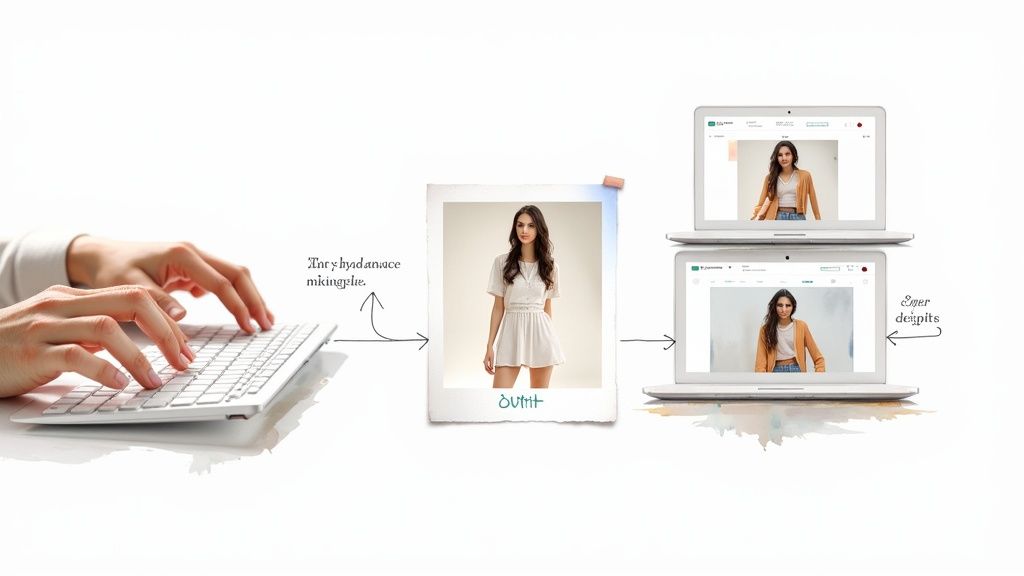
Bringing an AI outfit generator into your business isn’t about ripping everything out and starting over. Think of it as plugging a powerful new tool into your existing process to make your content creation faster, smarter, and way more scalable. No matter if you're a small boutique or a massive brand, there’s a clear way to get started.
The first move is figuring out where to plug it in. For most businesses, especially smaller ones, the easiest entry point is a Software-as-a-Service (SaaS) platform. These are ready-to-go, web-based tools that don't require any coding. You just log in and start creating incredible fashion visuals with simple text prompts or by uploading an image.
On the other end of the spectrum, larger companies with in-house tech teams might go for a direct API (Application Programming Interface) integration. This approach weaves the AI's capabilities right into your own e-commerce site, mobile app, or internal content system. It gives you maximum control and creates a totally seamless experience for your customers.
Choosing Your Integration Path
So, do you go with a simple SaaS tool or a full-blown API integration? The right answer comes down to your team's resources, technical chops, and what you’re trying to achieve. One isn't automatically better than the other; they just solve different problems.
A marketing team might just need a standalone platform to quickly mock up social media assets. An e-commerce giant, however, will probably want to embed virtual try-on features directly onto its product pages. This choice shapes everything from your upfront costs to how much you can grow down the line.
The stakes are pretty high. The market for AI-generated fashion photography—a key output of these tools—is expected to leap from $1.51 billion to $2.01 billion in just one year. Why the explosion? This tech can slash traditional photoshoot costs by a staggering 50-70% while letting brands produce a massive volume of content. You can read more about these market projections and see just how big the impact of AI on fashion photography is becoming. Picking the right integration is your ticket to capturing a piece of that value.
To help you decide, here’s a quick look at how the different integration methods stack up, tailored for various needs and resources.
Comparison of AI Outfit Generator Integration Methods
Ultimately, the best path depends on your immediate needs and long-term vision. Start simple with a SaaS tool to test the waters, or dive into an API integration if you're ready to make AI a core part of your customer experience.
Automating Content from Text to Video
One of the coolest things you can do with an AI outfit generator is plug it into a fully automated content pipeline. When you connect it to other systems, you can create a workflow that turns a simple idea into a polished marketing asset with almost zero human effort. This is where platforms like Aeon shine, helping to transform static AI-generated images into dynamic video content automatically.
The ultimate goal is to build a "content factory" where a single input, like a product description, can trigger a chain reaction that produces a dozen different marketing assets tailored for various channels.
Imagine a workflow that takes a basic product description and spins it into a gorgeous video lookbook. This "Text-to-Outfit-to-Video" process is a perfect example of how different technologies can team up to create content at a scale that would be impossible to do by hand.
Here’s how a sample automated workflow might look:
-
The Trigger (Text Input): It all starts when a new product description is added to your e-commerce platform. For instance: "Women's silk midi skirt in emerald green, perfect for summer evenings."
-
Outfit Generation (AI Styling): That text prompt is automatically fired off to the AI outfit generator via an API. The AI then dreams up several styled looks featuring the skirt, pairing it with different tops, shoes, and accessories on a variety of virtual models.
-
Visual Asset Creation (Image Output): The generator then produces a set of high-resolution, photorealistic images for each outfit. These images are automatically saved to a central digital asset management (DAM) system.
-
Video Assembly (Automated Production): A video creation platform like Aeon keeps an eye on the DAM for new images. The moment the skirt outfits appear, it grabs them and slots them into a pre-designed video template. It adds motion, text overlays with the product name and price, background music, and a call-to-action.
-
Distribution (Final Output): The finished video is then automatically pushed out to your brand's social media channels, embedded on the product page, and dropped into programmatic ad campaigns.
This entire sequence—from a single line of text to a shareable video—can happen in minutes. It’s a total shift in how content gets made, moving away from slow, manual projects toward an automated, always-on system that pumps out relevant, high-quality visuals at machine speed.
How to Choose the Right AI Outfit Generator
Picking the right AI outfit generator isn't like choosing just another software tool. Think of it as bringing on a new strategic partner, one that can either supercharge your brand's content or leave you with a mess of uncanny-looking visuals and wasted cash. With so many options out there, all shouting about their features, it’s easy to get lost.
The trick is to look past the shiny sales pitches and really dig into what makes a difference for your business. From the quality of the AI model to how quickly the vendor answers a support ticket, every little detail adds up.
Evaluate the Core Technology First
Everything starts with the tech under the hood. The absolute first thing to look at is model realism. Do the generated images actually look human, or do they have that weird, slightly-off vibe that screams "AI"? Zoom in on the details—skin texture, how fabric drapes and folds, and the way light and shadow play across the clothes.
Next, how much control do you really have? A good platform lets you dial in the specifics to match your brand's unique style. This is all about the depth of customization. Can you dictate the model's exact pose, swap out the background, and set the overall mood of the shot? The more levers you can pull, the better you can align the final images with your creative vision.
Finally, you have to ask about the data that’s feeding the AI.
- Training Data Diversity: Ask any potential vendor about the diversity of their training data. If a system was only trained on a narrow set of images, it's going to spit out repetitive, often biased, results. You need a tool that can create models reflecting a huge range of body types, skin tones, and ethnicities to truly resonate with a global audience.
- Artistic Versatility: Can the AI only do one thing well, like clean e-commerce shots on a white background? Or can it switch gears and produce moody, dynamic, editorial-style visuals for a campaign? Test its range.
A powerful AI outfit generator should feel like an extension of your creative team, not some rigid tool that forces you to work within its limits. The quality and flexibility of its core model are completely non-negotiable.
Assess Scalability and Vendor Reliability
Okay, so the tech looks solid. Now, can it keep up with your business as you grow? Scalability is a huge deal. If you’re running an e-commerce brand, you'll need a system that can pump out thousands of images without breaking a sweat, especially when you're heading into the holiday season. Always ask about the platform’s capacity and if there are any caps on how many images you can generate.
Just as critical is the API reliability and documentation. If you're planning on plugging the generator directly into your website or app, a clunky or poorly documented API will become your worst nightmare. It can turn what should be a straightforward integration into months of frustrating back-and-forth with your developers.
Beyond the tech specs, you need to vet the company itself. What’s their customer support like? Because something will inevitably go wrong, and when it does, you need a responsive team that can jump in and help you figure it out fast. Also, ask about their product roadmap. You want to partner with a company that’s constantly innovating and adding new features, not one that’s standing still.
To get a better handle on this, learning more about artificial intelligence personalization and its underlying principles can give you a solid framework for seeing how these tools fit into your bigger business goals.
Navigating the Ethical Side of AI Fashion
While AI outfit generators unlock some incredible creative doors, they also crack open a whole new set of ethical and legal questions for the fashion world. With this kind of power comes the responsibility to use it wisely, making sure our drive for innovation doesn't steamroll fairness, transparency, or trust.
One of the biggest red flags is algorithmic bias. AI models are only as good as the data they learn from. If you train an AI on a dataset that mostly shows thin, light-skinned models, its "creativity" will be stuck in that same narrow box. It will struggle to generate realistic or inclusive outfits for people of different body types and ethnicities.
This isn't just a technical glitch; it can accidentally reinforce harmful stereotypes and push away huge chunks of your customer base. It's a serious issue that both brands and tech vendors need to tackle head-on.
Fostering Transparency and Trust
Then there's the thorny issue of who owns what. When an algorithm spits out a truly unique design, who holds the copyright? Is it the user who wrote the prompt? The company that built the AI? Or does it belong to no one at all? The legal system is still playing catch-up, which means you have to read the fine print on any AI tool you use.
If you want to build a brand that lasts, being transparent is non-negotiable.
- Perform Bias Audits: Regularly put your AI models to the test to find and fix any built-in biases in their outputs.
- Clearly Label AI Content: Don't try to fool your customers. Be upfront when an image or model is AI-generated. It’s all about maintaining trust.
- Ensure Data Privacy: Let people know exactly how you're using and protecting their data, especially personal photos for things like virtual try-ons.
Proactively addressing these ethical issues isn't just about avoiding a lawsuit; it's about building a brand that people actually feel good about supporting. Responsible innovation is the only way forward.
The ethics of AI also ripple out into how the entire industry operates. For a closer look at how AI is shaking up business models, you can learn more about the disruption of fast fashion by AI and what it means for everyone. By putting ethics on the same level as innovation, companies can lead the future of fashion the right way.
Common Questions About AI Outfit Generators
As you start digging into the world of AI-powered fashion, a few questions always seem to pop up. Let's tackle them head-on to clear up any confusion and build on what we've covered.
Can AI Create Clothes That Can Actually Be Manufactured?
Absolutely. While some AI tools are all about creating mood boards and inspiration, the more advanced platforms are built with the factory floor in mind. They do more than just whip up a pretty picture; they can generate the technical files needed to actually make the clothes, like flat sketches or pattern markers that plug right into the manufacturing pipeline.
Think about it this way: these systems are trained on data from real-world garments. That means you can set them up to follow specific production rules from the get-go. This is a huge deal because it closes the gap between a cool creative idea and a physical product, helping brands get designs to market way faster than before.
How Much Does an AI Outfit Generator Service Cost?
There's no single price tag—it really depends on the provider and how you plan to use it. The costs can vary quite a bit.
- For individuals or small businesses, you'll typically find subscription plans. These usually start with a reasonable monthly fee that gives you a certain number of image generations.
- For larger enterprises, the pricing is almost always custom. If a company needs API access to bake the tool into their e-commerce site or marketing automations, the cost will be based on how much they use it, the specific features they need, and the level of support required.
Some vendors even offer flexible pay-as-you-go options, which are perfect for businesses whose creative needs change from month to month.
The main takeaway is that this technology is built to scale. Whether you're a one-person shop or a global brand, there’s a pricing model out there that will fit your budget.
Do I Need Technical Skills to Use This Technology?
Not usually, no. The market is full of solutions designed for all kinds of users. Many ai outfit generator platforms have clean, intuitive interfaces that let anyone create amazing visuals just by typing in a few words or uploading a reference image. No coding required.
Of course, if you want to do something more complex—like integrating a generator into your own app using its API—then some development skills will come in handy. But for the most common, high-impact uses, the barrier to entry is incredibly low. This makes the tech a fantastic tool for marketing and creative teams of any size.
How Do AI Generators Handle Inclusivity and Diversity?
This is a massive—and critically important—question. It's also one of the biggest differentiators between a good vendor and a great one. The best solutions are intentionally built on diverse training data that represents a broad spectrum of body types, skin tones, and cultural styles.
The top-tier platforms don't stop there. They also give users specific controls to generate models and outfits that reflect this diversity. When you're looking at different vendors, make sure to ask them where their data comes from and what they're doing to reduce bias. It's the only way to ensure the tool will help you create content that truly connects with your entire audience.
Ready to transform your content strategy with automated video creation? Aeon turns your product descriptions and AI-generated visuals into compelling videos at scale. Discover how you can streamline your workflow and drive engagement by visiting https://www.project-aeon.com.