So, what exactly is Fashion GPS? First off, let's clear up a common misconception. It has nothing to do with a wearable tracker you’d clip onto a model. Instead, it’s a powerful B2B software platform—a digital command center for a brand’s most valuable physical assets.
Think of it as a specialized logistics system built from the ground up to track high-value designer samples as they jet between showrooms, media outlets, and celebrity stylists.
What Is Fashion GPS And How Does It Work
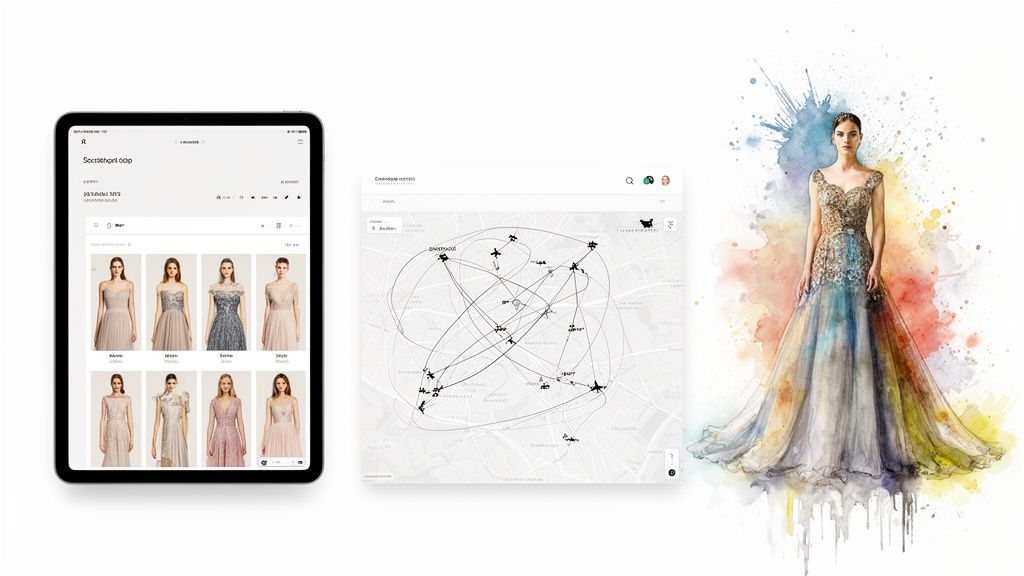
Imagine trying to direct dozens of airplanes using nothing but phone calls and spreadsheets. It’d be absolute chaos. Before platforms like Fashion GPS came along, the world of high-fashion PR operated in a similarly frantic way, managing priceless, one-of-a-kind garments with little more than manual logs.
This old-school approach created massive logistical headaches. We're talking lost samples, damaged goods, and the ultimate nightmare: double-booking a gown for two different A-listers on the same major red-carpet night.
Fashion GPS was born to solve this exact problem.
Think of it as an air traffic control system for couture. Its core function is sample trafficking—the digital process of checking out, tracking, and checking in physical clothing and accessories. This ensures a brand's most valuable pieces are always accounted for, no matter where they are in the world.
The Central Hub For Fashion PR
At its heart, the platform creates a centralized, digital inventory of every single sample a brand owns. Each garment or accessory gets its own profile, complete with high-res images, detailed descriptions, and a unique barcode for foolproof tracking.
When a stylist or editor requests an item for a photoshoot, the PR team manages the entire loan process right inside the system. No more frantic emails or "who has the blue dress?" chaos. This workflow provides a single source of truth for everyone involved, bringing much-needed clarity and control to a brand’s physical inventory.
Core Capabilities Of The Platform
But the system does a lot more than just play gatekeeper for pretty dresses. It’s a multi-faceted tool built to handle the unique demands of fashion communications. Here’s a look at what these platforms typically manage.
To really grasp how these platforms work, let's break down their main functions. The table below outlines the key tasks that tools like Fashion GPS handle, turning logistical chaos into a controlled, digital workflow.
Core Functions Of Fashion GPS Platforms
Essentially, each feature is designed to professionalize a critical backend process in fashion PR.
By digitizing these workflows, Fashion GPS lets PR teams spend less time chasing down samples and more time doing what they do best: building high-impact media coverage and strengthening brand presence. It brought order to the high-stakes, fast-paced world of fashion logistics.
The Rise Of Fashion Forward Wearable Tech
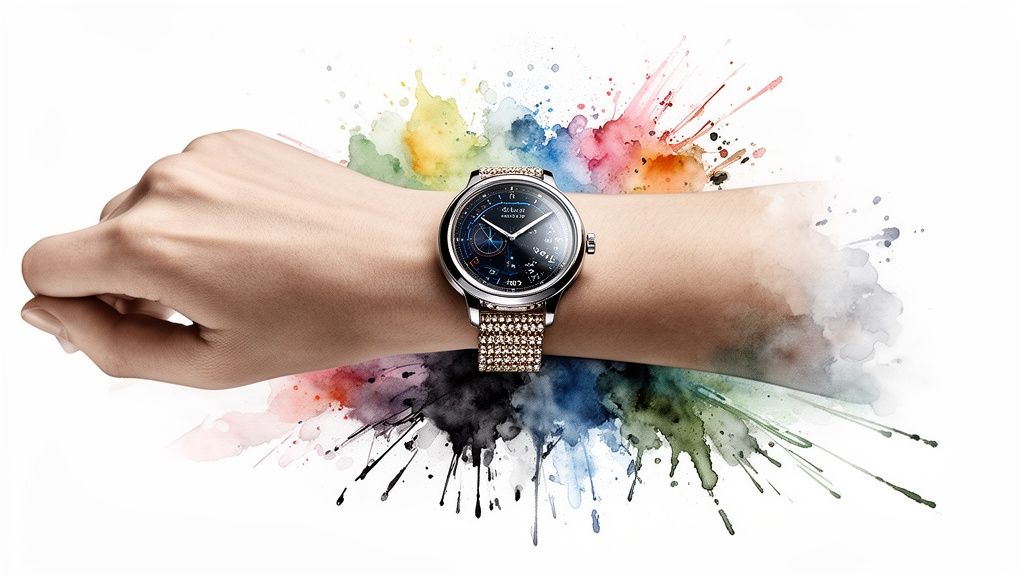
While the B2B software Fashion GPS is all about organizing the industry's backend, the name itself happens to perfectly capture a huge consumer trend. We're talking about the very literal blend of high fashion with personal GPS technology, a movement that's completely changing what we expect from our accessories. Wearable tech has officially stepped off the treadmill and onto the runway.
What started out as chunky fitness trackers and purely functional smartwatches has bloomed into a legitimate fashion category. People now want devices that do more than just count steps or get notifications—they need to be genuine style statements. This is a big deal. Aesthetics are no longer just a nice-to-have; for many, they're the main reason to buy.
From Gadget To Status Symbol
You can see the evolution pretty clearly. The first wave of wearables was often clunky, rubberized things you’d wear to the gym, not to a formal dinner. Fast forward to today, and you’ll find luxury brands and tech giants falling over each other to create devices made with premium materials, elegant designs, and slick, customizable interfaces.
The modern smartwatch is essentially the new luxury timepiece. It's a beautiful piece of jewelry that also happens to navigate your commute, check your heart rate, and field your messages. This mashup of good looks and genuine utility has set a completely new bar for personal tech.
Consumers no longer have to choose between a beautiful accessory and a smart device. The expectation is that one product should deliver both, seamlessly blending into their personal style while offering powerful technological capabilities.
This consumer hunger for style has lit a fire under the market. The fusion of fashion and GPS has transformed how we think about personal expression and function. In fact, market analysis from The Insight Partners projects the global GPS watches market will grow at a massive CAGR of 15.9% between 2025 and 2031, mostly because of these fashion-forward designs that appeal to way more than just fitness buffs.
Connecting Industry Operations To Consumer Desires
This trend creates a direct line between the operational world of B2B platforms like Fashion GPS and what real people actually want to buy. The very products that brands are showcasing and tracking with these systems are the same ones becoming more tech-savvy and style-focused. The desire for a fashion GPS watch or ring is almost always sparked by seeing it in aspirational, beautifully shot content.
For brands playing in this space, the pressure to produce stunning, high-quality imagery is higher than ever. It's not enough to rattle off a list of features; you have to sell a lifestyle. The visual story needs to scream both technological innovation and undeniable style, making the product a must-have accessory. This is where the slick efficiency of backend operations has to meet the creative fire of modern marketing.
A Day In The Life Of A PR Pro Using Fashion GPS
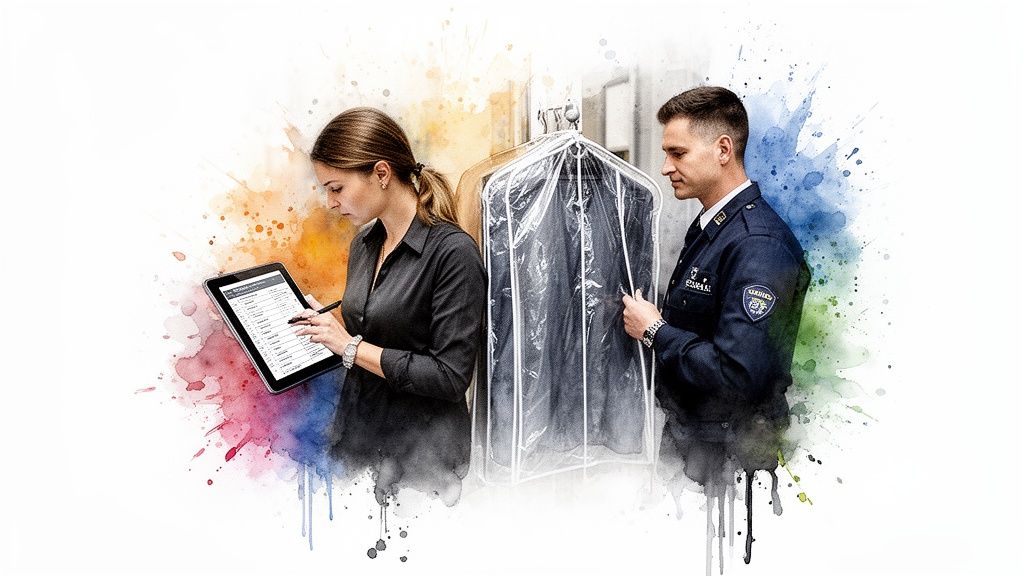
To really get what a fashion gps platform does, let's follow Maria, a PR coordinator neck-deep in the beautiful chaos of Fashion Week. Her day is a high-stakes ballet of logistics, and her most trusted partner is the dashboard that keeps track of her brand's entire physical collection.
It’s 9:00 AM. An urgent email hits her inbox. It’s a stylist from a top-tier magazine, and they need that sequined gown from the new collection for a last-minute cover shoot with an A-lister. The deadline is insane: they need the dress on set by noon.
In the old days, this kind of request would have kicked off a storm of panicked calls, frantic showroom searches, and pure guesswork. For PR pros, juggling hundreds of physical samples has always demanded some seriously efficient inventory management strategies, but Fashion GPS turns that manual headache into a digital process.
The Digital Pull Begins
Maria logs into her dashboard. Instead of making a mad dash for the racks, she confirms the gown's availability with a few quick clicks. She can see it was just returned from a press preview and is ready for its next close-up.
Next, she zips a private digital lookbook link over to the stylist. The stylist immediately adds the sequined gown and a couple of backup blazer options to a digital "pull list" right inside the platform. No confusion, no back-and-forth emails.
Maria gets the finalized request instantly. From there, she generates a digital loan agreement and a shipping label directly from the platform. The system automatically tags the gown's status as "On Loan," taking it out of circulation so no one else can request it.
From Showroom To Photoshoot
With the digital side sorted, Maria’s team gets the gown packaged. They scan its unique barcode one last time, officially checking it out. That simple scan connects the physical dress to its digital paper trail, giving everyone end-to-end visibility.
A courier, booked right through an integration on the platform, swings by for pickup. Once the package is on its way, both Maria and the stylist can track its journey across the city in real-time. This isn't just a nice-to-have; it's a vital tool for managing expectations and preventing a very expensive loss.
The real magic of Fashion GPS in this whole scenario is certainty. It swaps out guesswork for hard data, so every single person—from the PR team to the stylist—knows exactly where a priceless piece is at any given moment. That level of control is non-negotiable in an industry where timing is everything.
The gown arrives on set at 11:45 AM, right on schedule. The platform fires off an automated delivery confirmation to both Maria and the stylist. When the shoot wraps, the whole process just runs in reverse for a secure, fully documented return.
This whole workflow is a perfect example of how a fashion GPS system takes what could be a frantic, messy process and turns it into a controlled, professional operation. It’s the invisible engine that keeps the industry's glamorous facade running smoothly.
To help paint a clearer picture, here’s a breakdown of the key stages in this workflow:
Key Fashion GPS Workflow Stages
This table shows just how structured the process becomes. It’s a well-oiled machine.
But while this system is a godsend for PR, its focus on physical logistics reveals a workflow built for a pre-digital content world. It often can't keep up with the speed today's marketing teams need. For them, getting digital assets out the door is paramount, which is why knowing how to create a media kit with expert tips is such a critical skill for fast-moving content distribution.
Of course. Here is the rewritten section, designed to sound completely human-written and natural, following the style of the provided examples.
Where Traditional PR Tools Fall Short For Content Teams
For all its logistical genius, a tool like Fashion GPS was perfected for a media world that doesn't really exist anymore—an era of long-lead monthly magazines and exclusive, high-stakes red-carpet moments.
Today, content isn’t a monthly event; it’s an hourly demand. And this is precisely where the friction starts for modern marketing and e-commerce teams trying to keep up.
The whole system is built around the slow, careful movement of physical objects. While that's brilliant for tracking a priceless gown on its way to a cover shoot, it creates a massive bottleneck for digital-first teams who need high-quality visuals now, not next week. The simple truth is that the speed of shipping a box will never match the speed of digital commerce.
The Content Creation Bottleneck
At its core, the problem is that physical logistics are inherently slow, expensive, and a nightmare to scale. Every single sample request kicks off a chain reaction of real-world tasks—packing, shipping, insuring, tracking—that burn through time and money. For a fast-moving marketing team, the whole process feels completely out of sync with reality.
This old-school process creates some very real headaches for content teams:
- Shipping Delays: An entire campaign calendar can get thrown off schedule just waiting for one product to be shipped across the country for a quick social media shoot. The pace of content creation is held hostage by the pace of a courier service.
- High Costs: The expenses pile up fast. You've got courier fees, hefty insurance policies for high-value items, and the staff hours needed to manage it all. A single photoshoot involving physical samples can quickly become a very costly affair.
- Risk of Damage: Every trip a one-of-a-kind sample takes is a gamble. A minor coffee spill or a tear during a photoshoot can take a key piece out of rotation for good, killing future opportunities.
- Inability to Scale: This is probably the biggest roadblock. You simply can't shoot your entire new collection on ten different models in five global locations in a single afternoon. The laws of physics just won’t allow it.
It all comes down to a fundamental conflict: PR tools like Fashion GPS are designed to manage scarcity and control access to physical things. Modern content marketing, on the other hand, is built on abundance and the constant need for a high volume of diverse visual assets.
A System Built for a Different Problem
Look, these platforms are fantastic at what they were originally designed to do: manage the meticulous, high-stakes logistics of public relations and celebrity dressing. They bring a necessary order to the chaos of sample trafficking, making sure a brand’s most valuable physical assets are always protected and accounted for.
But in solving that problem so well, they inadvertently create another one for creative and commerce teams. The very system that protects a brand’s physical inventory becomes the thing that restricts its ability to create the digital assets needed to actually sell it.
This operational gap shows why a new approach is needed—one that decouples content creation from the slow, linear process of shipping boxes back and forth. For marketing teams today, the goal isn't just to track a product; it's to showcase it to the world in a thousand different ways, instantly.
How AI Fills The Gaps In The Modern Fashion Workflow
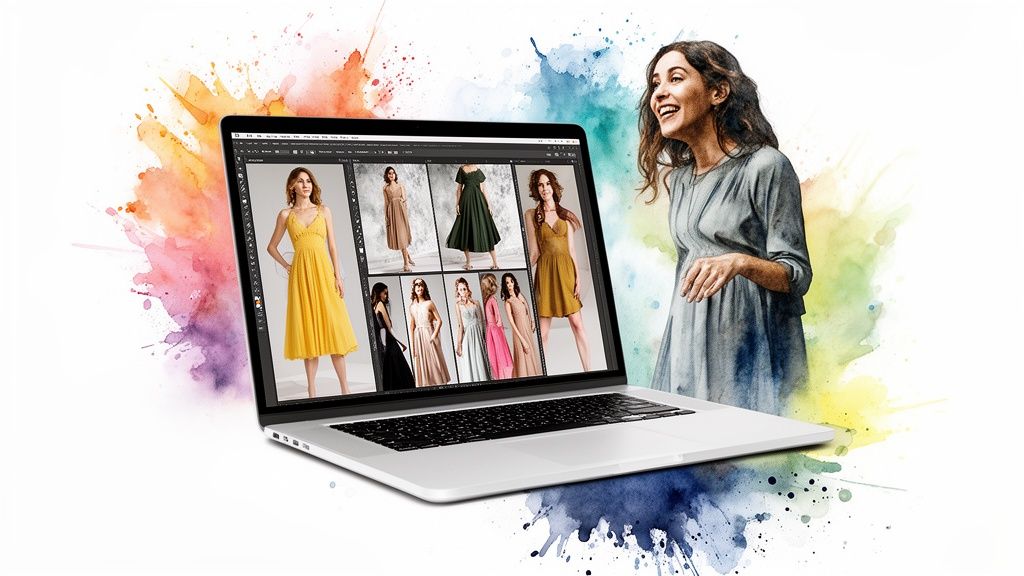
The friction point for modern brands is clear: the slow, physical logistics of a fashion GPS platform simply can't keep up with the insatiable appetite of digital marketing. This isn't just a minor headache; it's a real strategic vulnerability in a world that moves at the speed of a scroll.
This is exactly where AI-powered platforms come in, not to replace the critical work of PR logistics, but to act as a massive accelerator for creative and commerce teams.
AI tools directly attack the content bottleneck by severing the link between visual creation and physical inventory. Think about it: instead of waiting weeks to ship a sample, prep it, and schedule a shoot, a marketing team can now generate a virtually infinite number of photorealistic images of that exact product. On any model, in any location, in minutes.
The entire creative conversation changes. It's no longer, "How do we get the sample to the shoot on time?" but "What's the most powerful story we can tell with this product, right now?"
From Physical Shipments To Instant Visuals
AI content generation completely collapses the creative timeline. What used to take weeks now takes minutes, offering a level of speed and scale that physical workflows were never designed to handle. And we’re not talking about clunky, fake-looking images. We’re talking about high-fidelity, commercially viable assets that actually drive sales.
Just look at the explosion in tech-integrated accessories. The demand for GPS-integrated wearables is totally reshaping the smartwatch market. In fact, the global GPS smartwatch market is projected to hit around $25 billion by 2025, with a 15% CAGR through 2033. You can dive deeper into that trend by checking out the full GPS smartwatch report on datainsightsmarket.com. For these kinds of products, AI lets brands show them off in countless lifestyle scenarios without ever booking a single photoshoot.
The real benefit here is liberation. Creative teams are suddenly freed from the old-world constraints of time, budget, and physical location. An idea that pops up during a morning meeting can become a fully-realized visual campaign by the afternoon, ready to A/B test across a dozen channels.
This agility is everything. Instead of pouring the entire budget into one big, expensive hero campaign, brands can generate hundreds of variations tailored to different audiences, platforms, and markets all at once.
Practical AI Use Cases For Fashion Brands
This isn't some far-off, futuristic concept. It's a practical toolkit that's already here, and brands are using it to leapfrog the old logistical hurdles and get incredible results.
Here are just a few concrete ways AI is filling the gaps:
- Virtual Photoshoots: You can create entire campaigns without a studio, a photographer, or a single shipping label. Generate on-model imagery for every SKU in a new collection, locking in a consistent, professional look across your entire e-commerce site.
- Hyper-Localization: Need to resonate with global markets? No problem. An AI platform like Aeon can put a new winter coat in a snowy Aspen backdrop for your North American audience and, at the same time, place it on a model in a trendy Tokyo street scene for the Asian market. All from the same original product shot.
- Endless Creative Iteration: Test-drive dozens of concepts with zero risk. Ever wonder how that new handbag would look in a flat lay, on a celebrity lookalike, or in some wild, artistic composition? AI gives you the power to explore every creative whim affordably and instantly.
For any brand serious about scaling its visual content, understanding what’s possible with artificial intelligence clothing generation is the first step toward a smarter, more agile marketing strategy. By embracing these tools, your teams can finally move at the speed of digital culture, not the speed of a courier.
The Future Is Instant: From Physical Samples To AI Campaigns
Looking back, the journey from the meticulous, physical world of sample trafficking to today’s fluid, digital-first marketing reality shows just how much the industry has transformed. Platforms like Fashion GPS were indispensable, creating the professional backbone that brought order to the beautiful chaos of PR logistics. They absolutely mastered the art of managing physical assets, a crucial function that defined an entire era of fashion.
But today's landscape demands more than just control. It demands speed, scale, and a kind of boundless creativity that physical logistics just can't keep up with. This is where the whole paradigm shifts. Innovations like the potential of mass AI image generation tools like Midjourney are completely rewriting the rules of content creation, accelerating the move away from old-school methods.
The future of fashion marketing isn't about shipping a single gown across the country for one perfect shot. It’s about generating a thousand perfect shots in an instant, each one tailored to a specific audience, market, or social media platform.
The New Competitive Edge Is Agility
The business impact of this evolution isn’t some far-off concept—it’s immediate and significant. By swapping physical photoshoots for AI-generated campaigns, brands can slash production costs tied to studio rentals, photographer fees, and sample shipping. More importantly, they can shrink their time-to-market from weeks or even months down to a matter of days, letting them jump on cultural moments as they happen.
This newfound agility frees creative teams from the old physical constraints. An idea dreamed up in a morning meeting can be a live, global campaign by the afternoon. That’s not just a minor operational improvement; it's a fundamental competitive advantage.
The core change is moving from a reactive workflow, held back by physical logistics, to a proactive one, powered by pure imagination. AI gives teams the power to execute ideas at the speed of thought, creating a continuous flow of diverse, hyper-personalized visual content at scale.
Embracing The AI-Powered Workflow
We're already seeing this shift mirrored in consumer products, where technology is seamlessly embedded into style. Smart clothing and wearables with built-in GPS for fitness tracking are dominating the fashion tech space, set to command a 37.6% market share in 2025. This is happening within a sector expected to balloon from $255.99 billion to $393.65 billion by 2032. As you can read more about the latest fashion tech market findings, the exploding demand for tech-infused apparel highlights the need for marketing visuals that are just as advanced.
Ultimately, the path forward is crystal clear. The old principles of tracking valuable assets still hold, but the assets themselves are expanding from purely physical samples to a vast, ever-growing library of digital visuals. Embracing an AI-powered workflow is no longer a futuristic option—it’s a present-day necessity for any brand that wants to lead in a fast-moving, visually saturated market.
Ready to move at the speed of culture? With Aeon, your team can ideate, create, and launch production-grade campaigns in minutes, not months. Stop waiting for samples and start creating instantly by visiting https://www.project-aeon.com.