
Ever wondered how some videos get that perfect, human-sounding female voiceover? It's not always a person in a recording booth. More often than not, it’s a female voice emulator—a powerful piece of tech that turns written words into incredibly realistic speech.
Think of it as a digital voice actor on standby, ready to read any script you throw at it. This isn't just for audiobooks; it's for marketing videos, virtual assistants, accessibility features, and so much more.
What Exactly Is a Female Voice Emulator?

At its core, a female voice emulator is a highly advanced text-to-speech (TTS) system built specifically to generate natural-sounding female voices. Forget those robotic, monotone voices from a decade ago. Today's emulators use artificial intelligence to capture all the little things that make speech sound human—subtle shifts in pitch, pacing, tone, and even emotion.
It’s a simple but game-changing process. You have a script, and instead of the whole song and dance of hiring a voice actor and booking studio time, you just plug the text into the emulator. The software then analyzes the context and synthesizes a high-quality audio file that sounds like a real person speaking.
To really get what these tools can do, it helps to think of them as a modern AI voice actor. They aren’t just reading words; they’re performing them, using punctuation and sentence structure as cues for lifelike expression.
The Core Components of Voice Emulation
So, how does a machine learn to talk with such genuine human flair? It’s not one single trick but a combination of sophisticated technologies working together. The whole process is a bit like how a person learns a new language: by listening, mimicking, and practicing until the rhythm and pronunciation feel completely natural.
Three key ingredients make it all happen:
- Text-to-Speech (TTS) Engines: This is the base layer, the fundamental tech that turns text into sound. While early TTS was clunky, AI has pushed its quality into a whole new league.
- Neural Networks: These are complex algorithms, inspired by the human brain, that learn from massive datasets. They're trained on thousands of hours of recorded female speech to pick up on the patterns of pronunciation, intonation, and flow.
- Voice Cloning: This is where things get really interesting. Voice cloning lets the software replicate a specific person's voice. Feed it a short audio sample, and the AI can learn its unique vocal signature to generate brand-new speech in that exact voice.
Together, these components create a voice that’s not just understandable but genuinely engaging.
A key breakthrough was moving from concatenative synthesis (stitching pre-recorded words together) to neural synthesis, where the AI generates the sound wave from scratch. This allows for far more fluid and emotionally resonant speech.
Beyond Basic Text-to-Speech
A top-tier female voice emulator is much more than a simple dictation tool. It's a creative suite, giving you granular control over the final audio. This is what separates a professional-grade tool from a basic app you'd find on your phone.
You can tweak all sorts of vocal parameters to get the perfect delivery for your project. Maybe you need a warm, reassuring tone for an e-learning course or a high-energy, upbeat voice for a commercial. Being able to fine-tune these details is what makes the content truly connect with an audience.
Some of the most common customization features include:
- Pitch and Speed Control: Adjusting how high or low the voice is and how fast it speaks.
- Emotional Styles: Choosing from a menu of emotional outputs, like happy, sad, angry, or professional.
- Pauses and Emphasis: Adding strategic silences or stressing certain words to boost clarity and impact.
By mastering these controls, you can turn a plain text script into a powerful vocal performance. It makes the technology a massive asset for anyone creating digital content, from solo producers to entire marketing departments. The end goal is always the same: to produce audio that's indistinguishable from a human speaker, perfectly tailored to your message.
The Technology That Powers Realistic Voices
Think of how an artist learns to paint. They don't just memorize a color wheel; they study thousands of masterpieces to understand light, shadow, composition, and texture. The AI behind a female voice emulator works in much the same way—its art form is the human voice, and its gallery is a massive collection of audio data.
This learning process starts with voice datasets. These are enormous, carefully curated libraries containing thousands of hours of recorded speech. Each audio file is meticulously transcribed and labeled, teaching the AI the fundamental connection between written words and their spoken sounds. The more diverse and high-quality this data is, the more nuanced and believable the final voice will be.
From this data, a type of AI called a neural network begins to recognize the subtle patterns of human speech—the natural rise and fall of intonation, the specific rhythm of a sentence, and the unique cadence that makes a voice feel real. It's this deep learning that separates today's sophisticated AI voices from the flat, robotic ones of the past.
The Building Blocks of an AI Voice
A high-quality female voice emulator isn't just one piece of tech; it's a stack of interconnected systems working together. Each layer adds a new dimension of realism and control, turning simple text into a rich, auditory experience.
Let’s break down the core technologies that make this happen. Each plays a distinct but crucial role in creating a natural-sounding voice.
By combining these building blocks, developers can create incredibly convincing synthetic voices. It’s this technological fusion that's fueling a massive market expansion. The global AI voice generator industry is projected to hit $5.15 billion by 2029, a huge leap from just over $2 billion a few years ago. This explosive growth, detailed in a report on Research and Markets, shows just how much demand there is for realistic voice solutions.
How We Measure Vocal Quality
With so many options out there, how do you tell if a voice emulator is genuinely any good? The industry uses objective metrics to measure something as subjective as the quality of a voice. The most important one is the Mean Opinion Score (MOS).
The Mean Opinion Score (MOS) is a standardized quality rating where human listeners score a synthetic voice on a scale of 1 (bad) to 5 (excellent/indistinguishable from human). A score above 4.0 is generally considered high-quality and natural-sounding.
The MOS is so critical because it centers on the listener's actual perception. It answers the only question that really matters: "Does this sound like a real person?" A high MOS score means the AI has successfully captured the subtle imperfections and emotional undertones that define human speech. If you want to dive deeper, you can explore how text-to-speech emotion enhances digital voices.
Beyond MOS, here are a few other key metrics for evaluating a female voice emulator:
- Clarity: Is every word easy to understand, or is the speech muffled and unclear?
- Naturalness: Does the speech flow smoothly, or does it sound choppy and disjointed?
- Emotional Range: Can the voice convincingly express different feelings like happiness, excitement, or seriousness?
Platforms like Aeon are built with these metrics in mind, ensuring the voices we generate are not only crystal clear but also engaging and perfectly suited to the context of your video. Understanding these technological foundations helps you appreciate the true power behind modern voice emulation.
Navigating the Ethics of Voice Emulation
The power to whip up a realistic female voice emulator is a game-changer, but it also throws a whole host of ethical questions into the mix. While the technology unlocks some incredible creative doors, we can't just ignore its potential for misuse. Being a responsible innovator means tackling these challenges head-on and setting clear ground rules.
At the very heart of this conversation is one simple word: consent. Think about it like this: a photographer needs a model release to use someone's picture. It’s the exact same principle for voices. You absolutely must have explicit permission before cloning a specific person’s voice. Without that crucial step, the tech can easily slide from a helpful tool into an instrument for manipulation or worse.
The stakes are incredibly high. Using someone's voice without their say-so can lead to deepfakes, the spread of lies, or do serious damage to their reputation. That’s why a consent-first approach isn't just a "nice-to-have"—it's the non-negotiable foundation for any ethical voice project.
The Core Principles of Responsible Use
To use a female voice emulator the right way, you need more than good intentions; you need a solid framework. This means getting real about the potential risks and actively working to shut them down. It's all about building trust, both with the person lending their voice and with your audience.
Here are the key pillars to build on:
- Unambiguous Consent: Always get clear, written permission from the voice donor. This agreement needs to spell out exactly how their cloned voice can and cannot be used. No gray areas.
- Complete Transparency: Be upfront about when you’re using a synthetic voice. Clearly labeling AI-generated audio helps avoid deception and keeps your audience's trust intact.
- Preventing Misuse: Put safeguards in place to make sure the technology can't be used for malicious stuff, like creating fraudulent messages or spreading fake news.
This diagram helps visualize how the whole AI voice process works, from the initial data going in to the quality audio coming out.
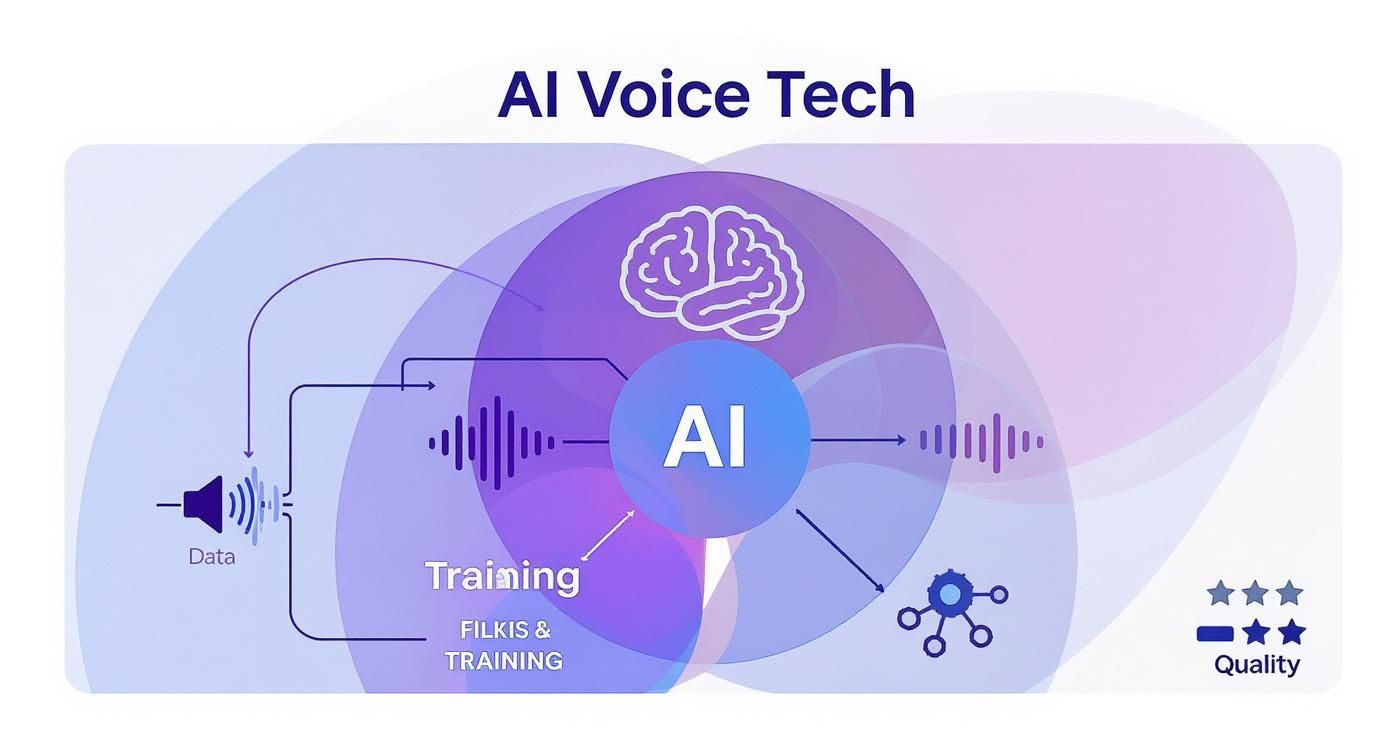
You can see why consent is so critical—that initial data, the sound wave, is someone's personal biometric signature.
Copyright and Who Owns a Synthetic Voice
The ownership question is one of the trickiest legal knots in voice emulation. Who actually owns the rights to a synthetic voice? Is it the person whose voice was cloned? The company that built the AI? Or the user who typed in the script? The courts are still figuring this out, but a few key ideas are starting to take shape.
Generally, the original voice actor keeps the rights to their unique vocal identity. The AI-generated voice is usually seen as a derivative work, meaning the ownership and usage rights are all laid out in the licensing agreement between the voice donor and the tech provider.
Key Takeaway: A rock-solid legal agreement is your best friend here. It should clearly define licensing terms, how royalties work, and any restrictions on use. This protects everyone and ensures the voice is used exactly as intended.
Getting this wrong can lead to some serious legal and financial pain. And with the AI voice market exploding, these legal precedents matter more than ever. Forecasts show the US AI voice cloning market, currently at $860 million, is set to blast off to $6.55 billion by 2033. The broader AI voice generator market is projected to hit $20.4 billion by 2030.
Avoiding the Pitfalls of Deepfakes and Misinformation
The biggest, scariest risk tied to voice emulation is its role in creating synthetic media, what most of us know as deepfakes. These are audio or video clips that have been digitally manipulated to make it seem like someone said or did something they never did. The potential for harm is massive, from personal attacks to full-blown political disinformation campaigns.
Platforms like Aeon are built with brand safety baked in from the start, with features designed to stop the creation of harmful or deceptive content. The goal is to give creators powerful tools for expression while maintaining a secure environment that puts ethics first. For a deeper dive, you can learn more about what synthetic media is in our detailed article.
By staying on top of these ethical issues, you can use a female voice emulator not just effectively, but responsibly—building your projects on a foundation of respect and integrity.
Real-World Applications Across Industries

The theory behind voice emulation is one thing, but where the rubber really meets the road is in its practical application. All across the business world, companies are finding smart, profitable ways to use a female voice emulator to solve genuine problems—from making content more accessible to building unforgettable brand experiences. This isn't just a fun new toy; it's quickly becoming a core piece of modern digital strategy.
By moving beyond the limitations of human-only narration, businesses can now pump out audio content at a scale and speed that was just a pipe dream a few years ago. This shift is unlocking new revenue streams, smoothing out customer interactions, and opening up information to a much broader audience.
Let's dive into a few specific examples of how this tech is being used right now.
Transforming Media and Publishing
For digital publishers, the hunger for audio content is insatiable. A female voice emulator lets them take a written article and, almost instantly, turn it into a narrated audio version. Suddenly, their audience can consume content during a commute, at the gym, or any other time their eyes are busy. It's a huge win for engagement and a game-changer for users with visual impairments.
This kind of automated narration brings some serious advantages to the table:
- Scalability: Publishers can convert their entire backlog of articles into audio without the logistical nightmare of hiring and managing a team of voice actors.
- Consistency: A single AI voice ensures every audio article has a uniform tone and quality, which helps solidify the brand's identity.
- Speed to Market: A breaking news story can be turned into an audio piece and published in minutes, keeping pace with the 24/7 news cycle.
Crafting Sonic Identities in Advertising
In a marketplace packed with noise, a unique brand voice can cut through the clutter. Advertisers are now using custom-cloned female voices to forge a distinct sonic identity that clicks with their target demographic. This AI-generated brand voice can be deployed consistently across every channel, from video ads and social media clips to podcast spots.
A consistent and recognizable voice builds trust and familiarity with consumers. By using a custom female voice emulator, brands can create an auditory signature that is as unique and memorable as their visual logo.
This approach means every piece of audio content feels like it comes from the same place. A custom voice can be fine-tuned to project specific brand traits—warmth, authority, youthful energy, you name it—forging a deeper emotional bond with listeners. A brand could use a warm, empathetic voice for its customer tutorials and then switch to a more buttoned-up, professional tone for corporate announcements. It’s all about precise messaging, delivered at scale.
Revolutionizing Customer Support and E-Commerce
Customer service is another area getting a major facelift from voice emulation. Companies are rolling out AI-powered virtual agents with natural-sounding female voices to handle customer questions, walk users through troubleshooting, and offer 24/7 support. These AI agents can juggle a high volume of calls at once, slashing wait times and making for a much better customer experience.
Over in e-commerce, these voices are doing everything from narrating product description videos to acting as interactive shopping assistants. An engaging AI voice can guide a customer through a product’s features, answer common questions, and even offer personalized recommendations, making online shopping feel more dynamic and genuinely helpful.
Powering Creative Content at Scale
Creative fields, especially gaming and audiobook production, have gone all-in on female voice emulators. In video games, developers use AI voices to bring non-player characters (NPCs) to life in massive open worlds, adding a layer of realism without the staggering cost of recording thousands of individual lines.
The audiobook industry is where you can really see the economic impact. AI narration can slash production costs by up to 90% compared to hiring human talent, shrinking timelines from months down to a few days. With a global market size already topping $6.2 billion, AI-narrated audiobooks—many featuring female voices—now account for 23% of all new releases. It's a clear sign of how AI is making massive content creation possible. You can get more data on the rise of AI in audio content on elevenlabs.io.
As you can see, the applications are broad and impactful. Here’s a quick breakdown of how different sectors are putting this technology to work.
Use Cases for Female Voice Emulators
An overview of how different industries are leveraging female voice emulation technology for various applications.
This is just scratching the surface. As the technology continues to get better, we can expect to see even more creative and practical uses pop up across every industry imaginable.
How to Choose the Right Voice Emulator
Jumping into the world of voice emulation can feel like a lot, especially with so many tools out there. But picking the right one isn't about grabbing the platform with the longest feature list. It's about finding the perfect fit for your specific project.
Get this part right, and your final audio will sound professional, connect with your audience, and slide right into your existing workflow.
The trick is to look past the flashy marketing and focus on what really matters for quality and usability. Think of it like test-driving a car. You wouldn't buy one without checking the engine, feeling the handling, and making sure it's comfortable. You need to put a potential female voice emulator through its paces before you commit.
Your Core Evaluation Checklist
When you're comparing platforms, it's easy to get lost in all the technical jargon. To cut through the noise, just zero in on these four make-or-break areas. These are the things that will directly impact your audio quality and how efficiently you can work.
- Vocal Realism and Naturalness: Does it actually sound human? Listen closely for those tiny imperfections, the sound of a natural breath, and a smooth flow between words. A high Mean Opinion Score (MOS) is a good sign, but your own ears are the final judge.
- Emotional Range and Control: Can the voice actually perform? A great emulator lets you dial in specific styles like happy, empathetic, or authoritative. You need fine-grained control over pitch, speed, and emphasis to really craft a compelling narrative.
- Customization and Cloning Options: Are you stuck with a stock library, or can you create a truly unique voice? For brands, the ability to clone a specific voice to maintain consistency is a game-changing feature you'll find in more advanced platforms.
- Integration and API Access: How well does it play with your other tools? For developers and larger teams, a solid, well-documented API is non-negotiable for automating audio production and embedding the voice generator into your own apps.
For a deeper dive into tools built for professional results, checking out the top AI voiceover tools for marketing videos is a great next step.
Assessing Language and Accent Support
Your message only lands if your audience understands it perfectly. Before you settle on a female voice emulator, you have to double-check its language and accent capabilities. Does it support the specific regional dialects you need?
A tool might say it has "Spanish," but that could mean Castilian Spanish from Spain, Mexican Spanish, or one of a dozen other variants. You need to be precise. For any global brand, strong multi-language support is an absolute must to make sure your content feels local and authentic, no matter where it's being heard.
Pro Tip: Generate a few short audio clips in your target accents and get them in front of native speakers. They'll instantly catch any awkward phrasing or unnatural tones that an automated system might miss, ensuring your message hits the mark.
The Standard Workflow From Script to Final Audio
Once you’ve picked your tool, the process of actually creating the audio is usually pretty straightforward. While the details might differ a bit between platforms like Aeon, most follow a similar path to get you from a text document to a polished voiceover.
Here’s a quick look at the typical steps:
- Prepare Your Script: Write it out with clear punctuation. Things like commas, periods, and question marks are your signals to the AI, telling it where to add natural pauses and the right intonation.
- Select Your Voice and Style: Pick a female voice from the library or load up your own custom-cloned voice. Then, match the emotional style to the script's tone—maybe "conversational" for a podcast or "energetic" for an ad.
- Generate and Preview the Audio: Just paste your script into the editor and hit generate. Listen back carefully to the preview to catch any weird pronunciations or pacing issues.
- Fine-Tune the Performance: This is where the magic happens. Use the platform’s tools to tweak the timing, add emphasis to certain words, or adjust the pitch. It's an iterative process that lets you truly shape the performance.
- Export and Integrate: Download the final audio file (usually an MP3 or WAV) and drop it right into your video editor, e-learning course, or whatever project you're working on.
By following this simple evaluation and workflow, you can confidently choose and use the right female voice emulator for any project. If you're a publisher looking to compare specific options, our guide on the 12 best AI voice clone tools for publishers in 2025 breaks down the top players in the market today.
Got Questions About Voice Emulators? We've Got Answers
Jumping into any new technology, especially one as powerful as voice emulation, always comes with a few questions. If you're a creator, developer, or just curious about how it all works, getting straight answers is the first step to using these tools the right way.
We hear a lot of the same questions, so we've rounded them all up here. Think of this as your practical guide to the world of synthetic voices, covering everything from the fine print to the final product.
Is It Legal to Use a Female Voice Emulator?
This is usually the first question on everyone's mind, and the answer is a clear yes, it's legal—as long as you use it responsibly. The legality really boils down to how you're using the tech. Grabbing a generic, AI-generated female voice from a platform’s library to narrate your next video? You're in the clear.
Things get tricky, and legally risky, when you step into voice cloning. It is absolutely illegal to clone someone's voice without their direct, informed consent. Trying to do so could land you in serious hot water, facing lawsuits for violating what’s known as personality rights.
Let's make this simple: consent is the golden rule. Ethical use is all about respecting the person behind the voice and giving them complete control over how their vocal identity is used. No exceptions.
Can AI Voices Really Sound Human?
The gap between artificial and human voices is shrinking faster than you might think. We all remember the clunky, robotic sound of early text-to-speech, but today’s platforms can generate audio that’s often indistinguishable from a real person, especially for straightforward narration.
The magic is in the tiny details. The best emulators have learned to mimic the subtle cues of human speech:
- Intonation: The natural rise and fall in pitch that gives sentences meaning.
- Cadence: The rhythm and pacing that makes speech feel conversational, not scripted.
- Breaths and Pauses: Those small, realistic breaks that make a voice feel alive.
That said, replicating the raw emotion of a dramatic film performance is still a major hurdle. But for most marketing, educational, or informational content, modern AI voices are more than up to the task of delivering a natural, convincing performance.
How Much Does a Voice Emulator Cost?
The price tag on a female voice emulator can be anything from completely free to thousands of dollars a month. What you'll pay depends on your needs—how much audio you're creating, the quality you're after, and how much customization you require.
Here’s a quick look at the common pricing models you’ll run into:
- Free Tiers: Most services have a free plan with basic features and a monthly character limit. These are perfect for testing the waters or for small personal projects.
- Subscription Plans: This is the go-to for professionals. For a monthly or annual fee, you get a much larger character allowance, access to premium voices, and advanced tools like an API. Prices typically run from $10 to over $300 per month.
- Pay-As-You-Go: Some platforms let you buy a block of character credits to use as you need them. This is a great fit if your audio needs are sporadic or project-based.
- Enterprise Solutions: For big operations that need custom voice clones, massive-scale audio generation, and white-glove support, enterprise plans offer tailored pricing.
Can I Create a Voice in Any Language or Accent?
Absolutely. The ability to generate a female voice emulator in different languages and accents is one of its biggest strengths for anyone creating global content. Most top-tier platforms have a huge library, covering dozens of languages and all sorts of regional accents.
This is a game-changer for making content that feels authentic and local to different markets. You could, for instance, generate a voiceover in American, British, or Australian English, each with its own distinct sound. Or you could just as easily create content in Spanish, French, Japanese, or countless other languages.
One word of advice: before you commit to a platform, double-check its language and accent list to make sure it covers your target audiences. The quality can sometimes vary from one language to another, so it’s always a good idea to run a few test samples first.
Ready to see how a high-quality female voice emulator can transform your content workflow? At Aeon, we provide the tools to create professional, engaging video content with AI-powered voices that captivate your audience.