Lip sync AI is the secret sauce that makes dubbed video content look right.It’s a technology that intelligently changes a speaker's mouth movements in a video to perfectly match a completely new audio track, making any video feel native in any language.
What Is Lip Sync AI and Why It Matters Now
Ever watched a training video from your company’s CEO, originally filmed in English, but dubbed into Japanese? In the past, you’d see that classic, awkward mismatch between the sound and the speaker's lips. Today, you might see the CEO’s lips moving perfectly in sync with every Japanese syllable. That’s not a reshoot or some expensive movie magic—it's lip sync AI at work.
Think of it as a digital puppeteer for video. The AI analyzes an audio file, like a translated voiceover, and the corresponding video. It then meticulously redraws the speaker’s mouth, frame by frame, to mirror the sounds of the new dialogue. The entire goal is to close that jarring gap between what we hear and what we see, creating a final video that feels completely authentic to the viewer.
Beyond Traditional Dubbing
For decades, dubbing was the go-to solution for localizing video, but it always came with a glaring flaw: the visuals never quite matched the new audio. This disconnect can be distracting, pulling viewers out of the experience and weakening the impact of the message. Lip sync AI directly solves this age-old problem.
- It creates believability. When mouth movements align with the audio, the visual distraction vanishes. Audiences can stop noticing the "dub" and start focusing on the message.
- It builds authenticity. Seeing a speaker appear to genuinely speak the local language forges a much stronger, more personal connection with the audience.
- It polishes the user experience. Seamless synchronization just looks more professional. It elevates the content, improving viewer engagement and making the information more memorable.
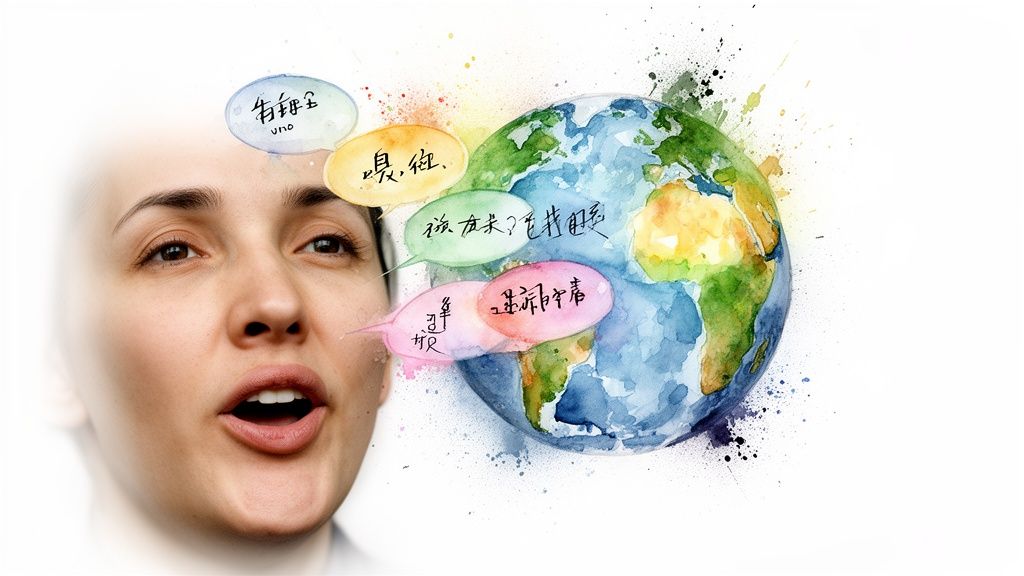
This isn't just a niche tool for filmmakers anymore. It's a game-changing asset for global business communication, allowing a single video to speak authentically to dozens of international markets without the huge costs and logistical headaches of refilming.
A Market Poised for Growth
Demand is absolutely surging. The global market for lip-sync technology, valued at USD 1.12 billion, is on a trajectory to hit an incredible USD 5.76 billion by 2034. That’s not just hype; it reflects a real and growing need for immersive digital content across marketing, entertainment, and even virtual reality.
And the technology is getting good. So good, in fact, that it’s often indistinguishable from the real thing. Recent studies show that 75% of viewers can't spot the difference between AI-synchronized footage and an original recording in a typical business video. You can dive deeper into these lip-sync technology market trends.
How AI Learns to Speak Visually
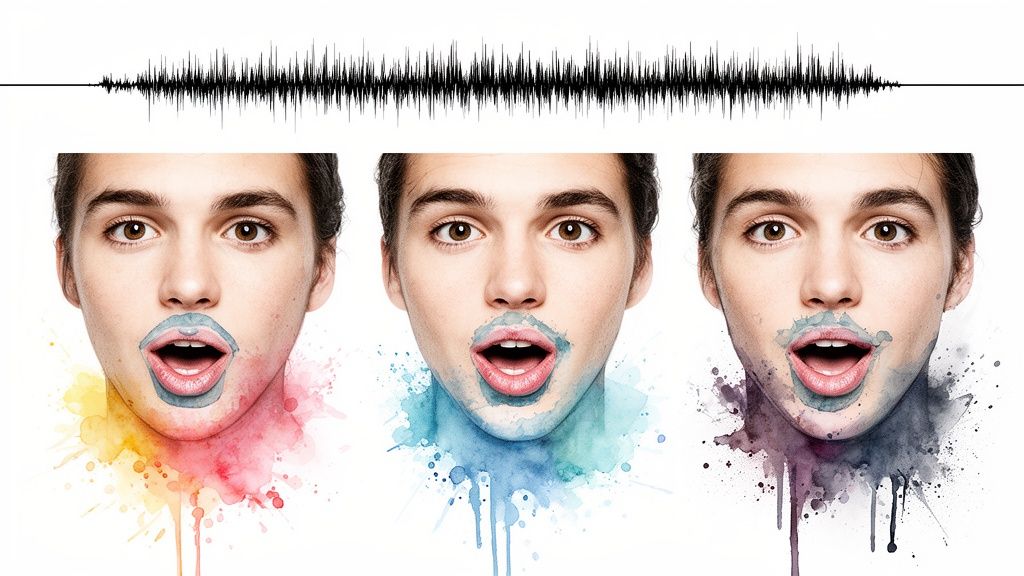
To really get how a lip sync AI works, you have to think like you're teaching a machine to read lips. You wouldn't start with whole sentences. You’d break it all the way down to the most basic, individual sounds—the "p," "b," and "sh" sounds that form our words. That's exactly where the AI begins.
The AI isn't actually hearing words at all. It's listening for phonemes, which are the smallest units of sound that differentiate one word from another. Take the word "cat." It’s built from three phonemes: "c," "a," and "t." The AI's first job is to chop up any piece of audio into this universal phonetic script.
This turns a messy, complex audio stream into a clean, structured sequence of sounds. From there, the AI can get down to the real work: figuring out what those sounds look like on a human face.
From Sounds to Shapes
Once the AI has its phonetic roadmap, it needs a visual dictionary to go with it. This is where visemes come in. Simply put, a viseme is the mouth shape that corresponds to a particular phoneme. It's the visual twin of the sound.
Think about the sounds "p," "b," and "m." To our ears, they're distinct. But watch someone say them, and you'll see the starting mouth shape—lips pressed together—is almost identical. These three different phonemes all map to a single viseme. The AI learns this by crunching through massive libraries of video footage of people talking.
This phoneme-to-viseme mapping is the bedrock of most lip-sync systems. It’s a bit like a high-tech translation service:
- Input: The audio track has an "f" sound.
- Process: The AI searches its database for the matching viseme.
- Output: It generates a mouth shape with the top teeth resting on the bottom lip.
This is a logical, rules-based way to get the job done. But let's be honest, the results can be a little stiff. That's why the best systems today have moved way beyond this basic technique.
"The magic of modern lip sync AI isn't just in matching sounds to shapes; it's in understanding the rhythm, emotion, and subtle nuances of human speech. The goal is to create a performance, not just a technical synchronization."
Neural Networks as Digital Artists
The most sophisticated models now use something called neural audio-to-video synthesis. Forget the simple dictionary lookup; this is more like a digital artist who listens to a voice and then "paints" the right facial movements onto a video.
This "artist" is a neural network that has been trained on thousands upon thousands of hours of video. It learns more than just the basic visemes. It starts to pick up on the subtle dance between audio cues and facial expressions—how a louder, more forceful sound might mean a wider mouth opening and more tension around the jaw.
It also gets the hang of coarticulation. This is how surrounding sounds influence each other. The way your mouth forms the "t" in "tea" is different from the "t" in "true" because your brain is already getting your lips ready for the next vowel. These advanced models capture those fluid, natural transitions that simpler systems just can't replicate.
The Training Process in Action
Training a high-quality lip sync AI is a marathon, not a sprint. Developers feed the model a constant stream of paired data: a video of someone speaking and the perfectly matched, clean audio.
- Data Ingestion: The model pores over countless examples, learning the exact timing between every single sound and every pixel change around the speaker's mouth.
- Pattern Recognition: Over time, it develops an incredibly deep understanding of how jaw movements, lip puckering, and even tiny cheek twitches correlate with specific audio frequencies and phonemes.
- Predictive Generation: Finally, when you give it a new audio file and a target video, the AI draws on everything it's learned to predict the most realistic sequence of mouth movements and generates the new video frames.
This grueling training is what allows the AI to create results that aren't just technically accurate, but feel genuinely human and emotionally connected to the audio.
How to Spot High-Quality Lip Sync AI
Not all lip sync AI is created equal. The tech is impressive, but the results can swing wildly from incredibly lifelike to distractingly robotic. To pick the right tool, you need to develop a critical eye—moving past a simple "does it work?" to spotting the subtle details that separate professional-grade output from the amateur stuff.
Think of it like being a judge at a figure skating competition. You’re not just watching to see if the skater stays on their feet. You're scoring their technical precision, artistic flair, and how seamlessly the whole performance flows together. Evaluating AI video requires a similar instinct, focusing on how well the technology marries technical accuracy with natural, human expression.
The Core Pillars of Quality
To get started, it helps to break your evaluation down into three key areas. These pillars give you a solid framework for judging any lip sync AI, no matter which platform you’re testing.
-
Temporal Accuracy: This is the absolute baseline. Are the mouth movements happening at the exact right time? Great AI nails this, making sure lip movements start and stop precisely with the corresponding sounds. Bad timing, even if it's off by just a few milliseconds, is a dead giveaway and instantly shatters the illusion.
-
Phonetic Realism: This goes a level deeper. Do the shapes the mouth makes actually match the sounds being produced? A sophisticated lip sync AI knows the visual difference between a lip-puckering "oo" and a wide-mouthed "ah." When these mouth shapes (known as visemes) are wrong, the speaker looks like they're mumbling or slurring their words, even if the timing is perfect.
-
Emotional Coherence: Here’s the trickiest part, and where most tools fall short. Does the entire face—not just the mouth—reflect the emotion in the audio? If the voice sounds excited and passionate but the AI-generated face is flat and lifeless, the result is just plain creepy. It plunges straight into the "uncanny valley."
Spotting Common Red Flags
Once you know what to look for, the flaws in lower-quality AI become glaringly obvious. When you're testing a tool, keep an eye out for these tell-tale signs of a subpar model. Understanding how to approach fixing common lip-sync errors can also sharpen your ability to spot high-quality work from the outset.
The real test for any lip sync AI is whether you completely forget you're watching it. Any glitch, artifact, or unnatural movement that pulls you out of the moment is a sign the tech isn't quite there yet.
A simple checklist is one of the best ways to structure your evaluation. The table below breaks down what to look for, what good output looks like, and the red flags that should give you pause.
Lip Sync AI Quality Evaluation Checklist
Use this checklist to systematically review the output from different lip sync tools. It will help you and your team make more objective, side-by-side comparisons.
By using a framework like this, you can shift from being a passive viewer to an active, informed evaluator. You'll be able to confidently size up different lip sync AI tools, pinpoint their strengths and weaknesses, and ultimately choose the one that delivers the professional, believable results your content deserves.
Where Lip-Sync AI Is Making a Real-World Impact
The true value of lip-sync AI isn't just in the tech specs; it’s in how it solves real problems for businesses and creators. This isn't some niche tool anymore. It's becoming a go-to solution for breaking down communication barriers and streamlining production, delivering tangible results that make content more personal, scalable, and engaging.
Think about any company with an international footprint, from e-commerce brands to corporate training teams. They’ve always struggled with video localization. It was slow, wildly expensive, and the final product often felt… off. Lip-sync AI is finally smoothing out that friction, letting brands connect with global audiences in a way that feels authentic, not just translated.
Fuelling Global E-commerce and Marketing
Let’s say you’re marketing a complex piece of software. Your product demo is everything. In the past, you had two bad options for reaching a new market: add subtitles that most people ignore, or create a clumsy dub that doesn't match the speaker's mouth. Both create a jarring experience that can kill credibility.
Now, with lip-sync AI, that same demo can be perfectly adapted for Japan, Germany, and Brazil. The AI makes the presenter on screen look like they’re speaking fluent Japanese, German, and Portuguese, matching the dubbed audio with natural mouth movements. It sounds like a small detail, but the impact is massive.
- Higher Conversion Rates: When a video feels genuinely local, it builds trust. Viewers understand the product better, and that leads directly to more sales.
- Stronger Brand Perception: Seamless, professional localization tells international customers you’re serious about their market and you’ve invested in communicating with them properly.
- Scalable Ad Creative: Marketing teams can finally spin up and test ad variations for dozens of regions without ever stepping foot on a film set.
Reinventing Corporate Training and Education
Global companies have a persistent headache: how do you deliver consistent, high-quality training to a workforce scattered across different continents and languages? A CEO's town hall or a critical compliance video needs to land with the same clarity and impact in Dallas as it does in Dubai.
Lip-sync AI is the key to making that happen. An expert can record a training module in English, and the system can generate perfectly synced versions for all your international teams. Every employee gets the same clear, engaging instruction straight from the source. It fosters a more unified company culture and, just as importantly, helps people actually remember what they learned.
By getting rid of the visual distraction of bad dubbing, lip-sync AI keeps the focus where it belongs: on the message. That’s absolutely crucial for keeping people engaged in a learning environment.
Powering a New Generation of Content and Entertainment
The entertainment world, unsurprisingly, has jumped on this technology. One of the most interesting trends is the explosion of creators looking to make money on YouTube without showing your face—a space where lip-sync AI is perfect for animating digital avatars and V-tubers.
Virtual influencers, animated characters, and even digital news anchors can now "speak" any language, connecting with a global fanbase without that awkward visual disconnect. It’s cracking open a whole new world of creative possibilities for storytellers and media companies.
And it’s not just for avatars. Manual lip-sync correction in film and music videos used to be a painstaking process, sometimes taking hours for every minute of footage. AI-assisted tools can now get it done in a fraction of the time, completely changing the economics of video production and making high-quality results more accessible than ever.
Integrating Lip Sync AI Into Your Content Workflow
Knowing what good lip-sync AI looks like is one thing. Actually putting it to work is a whole different ballgame.
Getting this technology into your content pipeline isn't just about uploading a file and hitting "generate." It's about building a smart workflow, one that starts with careful preparation and ends with a sharp eye for quality. This is how you make sure the final video meets professional standards.
When you treat AI as a core part of your production process, you can sidestep the common headaches and really squeeze the most value out of it. It stops being just a cool tool and becomes a reliable, scalable asset for taking your content global.
Preparing Your Source Files for Success
There’s an old saying in computing: "garbage in, garbage out." It’s never been more true than with AI. The quality of your final, synchronized video is almost entirely dependent on the quality of the video and audio files you feed the machine. So, before you even open your AI platform, get your assets in order.
Let's start with the video. The AI needs a clean, unobstructed look at the speaker's mouth and lower face to work its magic.
- Optimal Framing: Use footage where the speaker is mostly facing the camera. A slight angle is fine, but extreme profiles or shots where the speaker keeps turning away will only confuse the model.
- Good Lighting: Make sure the speaker’s face is well-lit. You want to avoid harsh shadows falling across the mouth area, as the AI needs to see those visual details clearly.
- No Obstructions: This one’s a biggie. Be mindful of hands, microphones, or anything else that might cover the mouth. A clear line of sight is absolutely critical.
Your audio file needs the same level of care. Think of it as the blueprint the AI uses to build the new mouth movements.
- Isolate the Dialogue: Your audio track should contain only the spoken dialogue. Background music, sound effects, and even heavy ambient noise can throw the AI off its game.
- High Fidelity: A crisp, clear recording is essential. The cleaner the audio, the more accurately the AI can map the sounds (phonemes) to the right mouth shapes (visemes).
The Step-by-Step Integration Process
Once your files are prepped and ready, the workflow itself is pretty straightforward. Platforms like Aeon are designed to be intuitive, but knowing what’s happening at each stage helps you stay in control.
- Upload Assets: First, upload your high-quality source video and the target audio track—the new language you're dubbing into.
- Initiate AI Processing: This is where the lip-sync AI gets to work. It meticulously analyzes the new audio, breaking it down into phonemes and mapping them to the speaker's face in your video.
- Review and Refine: The platform will spit out a preview. This is your most important checkpoint. Watch it closely. Does the timing feel right? Is it realistic? Does the emotion carry through?
- Final Export: When you're happy with what you see, you can export the final video in your preferred format and resolution.
This whole process dramatically simplifies a task that used to be incredibly manual and expensive. The financial upside is huge, with the technology cutting video localization costs by 70-90% compared to traditional methods. For a marketing team, that means turning around localized content in minutes, not weeks, making global campaigns more nimble and affordable.
The goal is to make the AI a seamless part of your post-production checklist, just like color grading or audio mixing. It's a specialized tool that, when used correctly, elevates the final product from good to globally accessible.
Final Quality Assurance and Best Practices
The AI does the heavy lifting, but a human should always have the final say. A dedicated quality assurance (QA) step isn't just a good idea—it's non-negotiable for professional content.
During this final review, watch the entire video as if you were a native speaker of the target language. Listen for any subtle weirdness in the rhythm or emphasis that the AI might have missed. Sometimes a tiny tweak can make all the difference.
As you get comfortable with the workflow, check out our guide on how to create AI video for more advanced tips. By locking in a solid process from prep to final review, your team can consistently churn out high-quality, believable localized content that truly connects with audiences anywhere.
Navigating the Ethical Landscape of AI Video
The ability of lip-sync AI to make anyone appear to say anything is a genuinely powerful tool. But with that power comes a Pandora's box of ethical questions we can't ignore. This technology doesn't exist in a bubble; it hands a significant amount of responsibility to the creators and marketers who use it. Getting this right means tackling the ethics head-on to sidestep legal pitfalls and protect your reputation.
At the end of the day, the core issue is the potential for misuse. The exact same tech that can localize a corporate training video can also be used to create convincing deepfakes built to spread misinformation. For any business, the line between authentic marketing and deceptive manipulation has to be drawn in permanent ink.
Consent and Intellectual Property
Before you touch a single frame of video, the first question should always be: do you have the right to do this?
Using someone’s likeness and voice without their explicit, informed consent is a massive ethical and legal overstep. This isn't a gray area. It’s a hard line, whether you're working with a celebrity influencer or your own company's CEO.
The same goes for intellectual property. Modifying copyrighted video content without permission is a fast track to legal trouble. Always make sure you have a clear chain of ownership or the right licenses for any footage before you even think about applying lip-sync AI.
- Explicit Consent: Get it in writing. This isn't a handshake deal. The consent form needs to spell out exactly how an individual's image and voice will be modified and where it will be used.
- Copyright Clearance: You need to either own the rights to the source video or have a license that specifically allows for creating derivative works. No exceptions.
Transparency Builds Trust
We live in an age of skepticism. Audiences are savvy, and if they suspect they're being misled, they lose trust—fast. That’s why being transparent about using AI isn't just good practice; it’s a core part of a smart strategy.
Responsible use of lip-sync AI means being upfront with your audience. A simple, clear disclosure that a video has been AI-altered can prevent backlash and reinforce your brand’s commitment to honesty and ethical communication.
It doesn't have to be complicated. A small, non-intrusive label like "AI-enhanced translation" or a quick note in the video description can make all the difference. This approach respects your viewers and helps normalize the ethical use of synthetic media. You can dive deeper into this topic in our detailed guide on what is synthetic media.
By embracing transparency, you not only protect your brand but also help build a more responsible digital ecosystem for everyone.
Frequently Asked Questions About Lip Sync AI
Even once you've wrapped your head around the tech, a lot of practical questions pop up when you start thinking about actually using lip-sync AI. We get it. Here are some of the most common ones we hear from creators and marketers, with straight-to-the-point answers.
How Does Lip Sync AI Handle Different Languages and Accents?
You’d be surprised how well it does, actually. The really good models are trained on massive, global datasets that are packed with speakers from all over the world. This is how they learn the specific mouth shapes (visemes) that match the unique sounds (phonemes) of different languages.
It's why you can take a video of someone speaking English and generate incredibly accurate lip movements for a new audio track in Japanese, Spanish, or French.
The best tools even pick up on the subtle differences in regional accents, which is key to making the final video feel authentic to a local audience. When you're kicking the tires on a new platform, always double-check what languages and accents it supports to make sure it'll work for your project.
Can Lip Sync AI Work on Any Video?
The short answer is no. While the technology is incredibly powerful, it's not magic—the quality of your source video matters. A lot. For the best results, you need a clear, well-lit video where the speaker is mostly facing the camera.
Here are the usual suspects that can trip up the AI:
- Obstructions: Anything covering the mouth—a hand, a microphone, you name it—can completely confuse the model.
- Bad Lighting: If the face is full of heavy shadows or the lighting keeps changing, the AI can't see the details it needs to work properly.
- Weird Angles: Extreme profile shots or videos where the speaker is constantly turning their head make it a nightmare for the AI to map new mouth movements cleanly.
If you’re shooting content specifically for marketing and know it's going to be localized, just plan ahead. A simple, unobstructed shot of the speaker's mouth will save you a ton of headaches later.
What Is the Difference Between AI Dubbing and Lip Sync AI?
This is a great question. Think of them as two sides of the same coin, both essential for a truly localized video.
AI dubbing is the audio piece of the puzzle. It handles translating the original dialogue into a new language. The smart ones even use AI voice cloning to keep the speaker's original tone and rhythm, which is a huge plus.
Lip-sync AI is the visual part that follows. It takes that brand-new dubbed audio and meticulously changes the speaker's mouth movements in the video to match it perfectly. They have to work together to create a believable final product. You can definitely have AI dubbing without the lip-sync, but you can't have lip-sync without a new audio track to sync to.
Ready to create perfectly localized video content that connects with global audiences? The Aeon platform integrates production-grade AI tools to help you generate high-quality, believable lip-synced videos in minutes, not weeks. Start your trial today and see how easy it is to scale your content. Explore Aeon's AI video tools.