Product videos are your secret weapon in marketing. They’re dynamic, visual sales pitches that show off a product’s features, benefits, and how it works in the real world, all in a way that hooks customers and drives sales. Think of them as transforming a flat, static product page into a living, breathing sales experience—your own digital salesperson, working 24/7 to build trust and boost conversions.
Why Product Videos Are Your Strongest Sales Tool
Imagine your very best salesperson working around the clock, perfectly pitching your products on every single page of your website. That’s exactly what a good product video does. It goes way beyond static images and long-winded descriptions to give customers what they actually want: a clear, engaging, and honest look at what they’re about to buy.
This shift from just telling to actually showing is what makes product videos so powerful. They close the gap between the online and offline worlds, letting a potential buyer see a product in motion, understand its true size, and appreciate its quality in a way that words alone just can't match.
Building Trust and Boosting Confidence
In a crowded market, trust is everything. Product videos are phenomenal trust-builders because they’re all about transparency. When a customer can see exactly how a product works, they feel a whole lot more confident about hitting that "buy" button. And that clarity has a direct, measurable impact on your bottom line.
The data backs this up again and again. For instance, product pages with videos see a 47% higher engagement rate than those without. Even better, demo and explainer videos can slash product returns by an impressive 35%, simply because buyers know precisely what they're getting.
The connection between watching and buying is undeniable. A staggering 87% of users who watch a product demo video ultimately make a purchase, highlighting a direct path from viewing to conversion.
Driving Measurable Business Results
The benefits don't stop at engagement. Weaving video into your e-commerce strategy directly pumps up the key performance indicators that really matter to your business's growth. To dive deeper, check out our guide on creating a product video for ecommerce that actually converts.
Here’s a quick look at the positive ripple effect product videos create across your entire marketing funnel:
- Increased Conversion Rates: Videos make complex information simple and forge an emotional connection, making it much easier for shoppers to click "add to cart."
- Higher Average Order Value (AOV): By showing off complementary products or cool advanced features, videos can be a natural way to upsell and cross-sell, nudging customers toward larger purchases.
- Improved SEO Rankings: Pages with video tend to keep people around longer. This increased session duration is a huge signal to search engines that your content is valuable, which can give your search rankings a nice boost.
The table below breaks down exactly how product videos can reshape the metrics that drive revenue and growth.
Key Business Metrics Transformed by Product Videos
Ultimately, these numbers aren't just abstract data points—they represent more engaged customers, stronger brand loyalty, and a healthier bottom line.
Choosing the Right Product Video for Every Goal
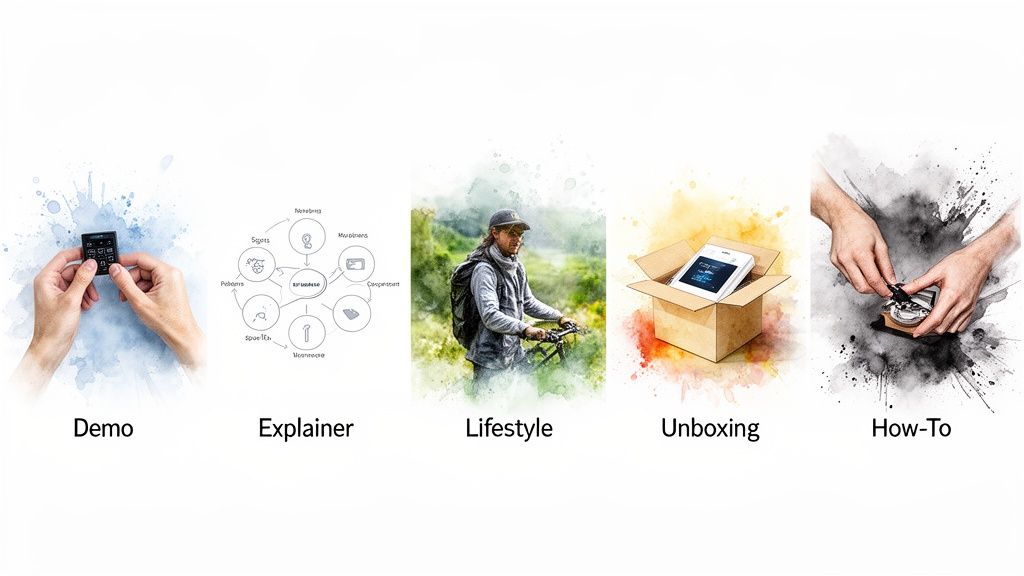
Not all product videos are created equal. Think of it like a toolbox: you wouldn't use a hammer on a screw. Picking the right video format for the right marketing goal is just as important.
Matching your video type to a specific business objective is what separates a forgettable clip from a high-impact product videos for marketing strategy. This is how you make sure your message hits home at every single stage of the customer journey, from that first spark of awareness all the way to post-purchase loyalty.
Let's break down the essential video types that should be in every marketer's arsenal.
Explainer Videos Demystify Complexity
Got a product that's a little complex or maybe introduces a totally new idea? An explainer video is your best friend. It acts as a friendly guide, boiling down the "what" and "why" into a simple, easy-to-follow story.
These are often animated, focusing on a clear problem and positioning your product as the perfect solution. Their job is to educate. In fact, an incredible 91% of people have watched an explainer video to learn more about a product. They’re masters at turning confusion into clarity, making them perfect for the top of your marketing funnel.
Product Demo Videos Build Purchase Confidence
While explainers tackle the "why," demos nail the "how." A good demo is the digital version of an in-store, hands-on experience. It shows your product in action, walking through its key features and answering all the practical questions a potential buyer is thinking about.
This is where you knock down those last-minute purchase barriers. By showing exactly how your product works, you build a massive amount of confidence in your audience.
The impact here is huge. Studies have found that 87% of people have bought a product after watching a demo video. Demos are absolute powerhouses for the consideration stage, nudging interested prospects right over the finish line.
Lifestyle Videos Sell an Experience
Lifestyle videos flip the script. They don't focus on what the product does; they focus on what it enables. Instead of a boring feature list, you're selling an aspirational experience and connecting your product to a feeling or identity people want.
It's less about the technical specs and all about the emotional connection. Think of a fancy blender ad that isn't just about making smoothies—it's about being part of a vibrant, healthy morning routine. These videos are brilliant for building brand affinity and crushing it on social media.
Unboxing Videos Create Authentic Buzz
There's a special kind of thrill in opening something new, and unboxing videos capture that raw, unfiltered excitement. They are often created by influencers or real customers, giving an authentic first-person look at receiving and opening your product.
This approach leans heavily on user-generated content (UGC), which shoppers trust way more than slick corporate ads. The data backs this up, with 60% of consumers saying that UGC is the most genuine form of advertising out there. Unboxing videos are fantastic for generating social proof and real buzz around a product launch.
How-To Videos Drive Loyalty and Retention
The relationship with your customer doesn't stop once they click "buy." How-to videos and tutorials are all about supporting them after the sale. They offer practical guidance to help users get the most out of your product, ensuring they have a great experience.
This kind of post-purchase support is what builds real, long-term loyalty. It turns one-time buyers into repeat customers and, eventually, brand advocates. Plus, it can seriously cut down on customer support tickets and helps build a strong community around your product.
Optimizing Videos for Every Platform and Audience
So you've created a brilliant product video. That's a huge win, but it’s only half the battle. If that video isn’t formatted correctly for the specific platform where your audience finds it, its impact will completely fizzle out.
Think of it like a key: a perfectly cut key is useless if you try to jam it into the wrong lock. The same exact principle applies when you're distributing your product videos for marketing.
A one-size-fits-all strategy is just a recipe for a wasted budget and missed connections. Every platform, from your own e-commerce site to the endless scroll of a social media feed, has its own unique rules of engagement. Nailing these little details is the real secret to maximizing your reach, sending engagement through the roof, and actually seeing a solid return on your investment.
Tailoring Content for Different Digital Stages
The mindset of your audience shifts dramatically depending on where they encounter your video. Someone actively shopping on your product page is looking for something very different than a person casually browsing TikTok. You have to optimize for this context.
-
On Your E-commerce Site: This is your digital storefront, your home turf. Videos here need to be detailed, high-quality, and laser-focused on building the confidence someone needs to make a purchase. Think crystal-clear product demos, 360-degree views, and helpful how-to guides that answer those last-minute questions and nudge visitors toward the "add to cart" button.
-
On Social Media Feeds (Instagram, TikTok): Out here, you’re fighting for every second of attention in an incredibly fast-paced environment. Your videos must be short, visually stunning, and designed to work without sound. Vertical aspect ratios (9:16) are an absolute must for platforms like Reels and TikTok. The goal is simple: stop the scroll, entertain, and build brand awareness fast.
-
On Search-Driven Platforms (YouTube): Viewers on YouTube are often on a mission—they’re looking for solutions or deep-dive information. This is the perfect spot for your longer-form content, like detailed tutorials, in-depth product comparisons, or authentic influencer reviews. SEO is everything here, so craft descriptive titles, keyword-rich descriptions, and relevant tags to pull in that valuable search traffic.
A foundational tactic for maximizing impact is understanding the process of converting video to text, which significantly boosts SEO and content repurposing opportunities. This makes your video content discoverable on search platforms and accessible to a wider audience.
The Technical Rules of Engagement
Beyond just the creative approach, each platform has a set of technical specs that directly impact how your video performs. If you ignore them, your masterpiece might get awkwardly cropped, displayed in grainy low resolution, or just completely overlooked. A video that looks incredible on a desktop can be totally unwatchable on a phone if it isn't optimized properly.
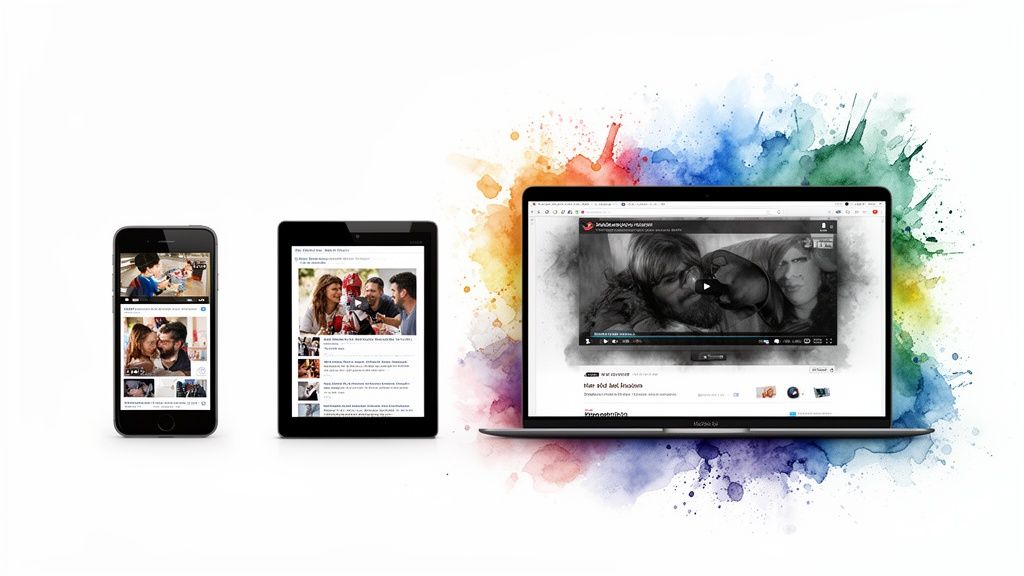
This screenshot from Aeon's homepage shows exactly how a modern brand presents content across multiple device formats, ensuring a consistent and engaging user experience no matter where someone is watching.
The key takeaway here is the seamless adaptation. Great video strategy isn't just about the content itself; it's about making sure that content fits perfectly onto every screen it appears on.
Mastering Mobile-First and Silent Viewing
The way people watch videos has fundamentally changed. Your strategy has to adapt to a world where most viewing happens on a mobile device, often without any sound at all.
This mobile-first reality has massive implications. For instance, a staggering 85% of mobile videos are watched silently, which means clear, easy-to-read captions are absolutely non-negotiable.
To win in this environment, you have to follow a few essential guidelines:
- Prioritize Vertical Video: Always create a 9:16 version for mobile-first platforms like Instagram Stories, Reels, and TikTok. It's not optional anymore.
- Add Captions Everywhere: Use burned-in captions so your message always gets through, even when the sound is off.
- Hook Viewers Immediately: You have about three seconds to grab someone's attention. Start with your most compelling visuals or a bold opening statement.
- Keep it Concise: On social feeds, shorter is almost always better. An overwhelming 83% of consumers say they prefer watching clips that are under a minute.
Building Your Scalable Video Production Workflow
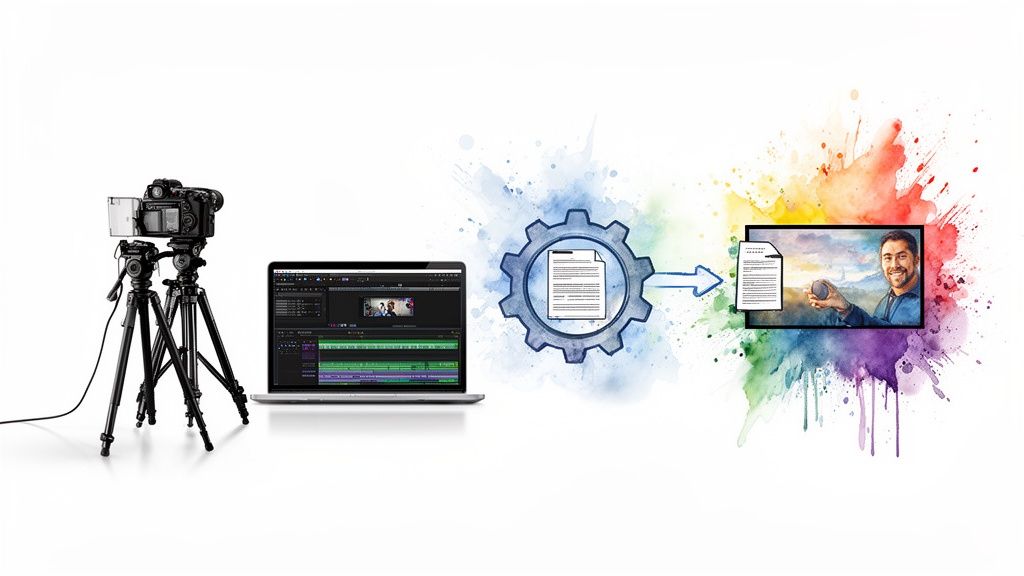
Let's be honest: creating high-impact product videos for marketing can feel like an expensive, time-consuming mountain to climb. But it absolutely doesn't have to be.
The secret isn't a Hollywood-sized budget. It's a smart, repeatable workflow that turns video creation from a huge one-off project into a streamlined, predictable process.
Think of it like this: a traditional video production workflow is like building a custom car by hand. It’s meticulous and the result is beautiful, but it’s painfully slow and impossible to scale. A modern, scalable workflow is more like a modern assembly line, where every single stage is optimized for efficiency and consistency. This lets you produce high-quality videos at a much, much faster pace.
That shift in mindset—from one-off projects to a continuous production system—is what allows marketing teams to finally keep up with the relentless demand for fresh video content.
So, let's break down how to build one.
The Three Pillars of Video Production
Every single video, whether it's a 15-second TikTok clip or an in-depth product demo, goes through three fundamental phases. Nailing these stages is the first step toward building a process you can actually manage and scale.
-
Pre-Production: The Blueprint This is where you lay all the groundwork. It's everything that happens before the camera starts rolling: scripting, storyboarding, planning the shot list, and scheduling. A solid pre-production phase prevents costly, time-wasting mistakes down the line.
-
Production: The Build This is the action phase. It’s when you capture all your raw footage and audio. You're setting up lighting, shooting from different angles, and making sure the sound quality is crisp and clear.
-
Post-Production: The Polish Here, you transform all those raw clips into a finished, polished product. This bucket includes editing the footage, adding graphics and music, color correcting, and mastering the final audio. This is almost always the most time-intensive part of the entire process.
For a deeper dive into building out these kinds of processes, many enterprise teams follow a detailed guide. You can find some fantastic insights in this Video Production Workflow for Enterprise Teams, which really breaks down the process for larger organizations.
Overcoming Traditional Production Bottlenecks
The biggest hurdles in traditional video production are almost always time and money. It's just not practical for most teams to shoot brand-new footage for every single product variation or social media post.
This is where automation and smart content repurposing change the game.
Modern production workflows are built around creating a library of assets—product shots, screen recordings, lifestyle clips—that can be mixed, matched, and repurposed on demand. This asset-first approach finally breaks the cycle of starting from scratch every single time.
Think of it less like a linear, one-and-done task and more like building with LEGO bricks. Your asset library is your collection of bricks, and your workflow is the set of instructions for quickly assembling them into new and exciting creations.
This modular approach is the absolute key to scalability. It allows you to create dozens of video variations from a single set of core assets, saving an immense amount of time and budget while keeping your brand consistent.
Embracing AI for True Scalability
The real game-changer for blowing up your video output is AI-driven automation. Platforms like Aeon are designed to be the engine of your modern production workflow, taking the manual labor out of the most demanding and repetitive tasks.
Instead of your team sinking hours into complex editing software, AI can do the heavy lifting. This tech can transform existing assets you already have—like product descriptions, blog posts, or even customer reviews—into polished, on-brand videos in minutes. Our guide on mastering scalable video production with AI explores this concept in much more detail.
AI-powered systems can handle the tasks that were once major bottlenecks:
- Automated Editing: Instantly assembling clips based on a script or a pre-set template.
- AI Voiceovers: Generating high-quality narration directly from a text script.
- Branding and Graphics: Automatically applying your brand’s logos, fonts, and colors across every video.
- Platform Reformatting: Instantly resizing a single video for every social media channel’s unique specs.
By integrating these tools, you shift your team’s focus from tedious technical tasks to high-level strategy and creativity. This is how you move from asking why you need more video to finally having a system for how to produce it at scale. Right now.
Measuring Video Performance and Proving ROI
So you’ve created a fantastic product video. That's a huge first step. But pretty soon, someone in a corner office is going to ask the inevitable question: "Is it actually working?"
To answer that, you have to look past the flashy view counts and dig into the data that shows how your video efforts are impacting the bottom line. Proving return on investment (ROI) is all about connecting the dots between someone watching your video and making a purchase. You need a solid framework to track what's successful, justify your budget, and confidently show that your videos are making you money.
Moving Beyond Vanity Metrics
A video with a million views but zero sales isn't a marketing asset—it's a missed opportunity. While big numbers look good for social proof, they don't pay the bills. The real story is in the metrics that reveal what your audience is doing.
These are the key performance indicators (KPIs) that really matter:
- Watch Time and Audience Retention: This tells you how long people are sticking around. A high retention rate means your content is genuinely engaging. If you see a massive drop-off in the first few seconds, you know right away that your intro needs a rethink.
- Engagement Rate (Likes, Comments, Shares): This is the pulse of your video. High engagement shows you’re not just broadcasting a message; you're building a community around content people feel connected to.
- Click-Through Rate (CTR): This is the percentage of viewers who clicked on your call-to-action (CTA), like a link to your product page. A strong CTR is a direct signal that your video is successfully nudging people to take the next step.
- Conversion Rate: Here it is—the ultimate metric. This tracks how many viewers actually completed the desired action, like buying something, after watching. This is the clearest measure of ROI you can get.
The link between smart video investment and real results is undeniable. We're seeing brands report up to 12x higher conversion rates with well-tuned video strategies, drawing a straight line from views to revenue.
This kind of bottom-line impact is why global spending on video ads is on track to blow past $190 billion in 2025. It's also why 93% of marketers consider video an absolutely essential part of their strategy. You can discover more insights about video marketing ROI to see just how dominant this medium has become.
Connecting Views to Sales
To truly prove ROI, you need the right tools to follow the customer from the moment they hit "play" to the moment they check out. This usually means combining the analytics baked into your social platforms with more powerful tracking software.
Start with what the platforms give you. YouTube, Instagram, and TikTok all offer a goldmine of data on audience demographics, watch time, and engagement. But to see the whole journey, you have to connect that information back to what’s happening on your own website.
This is where a tool like Google Analytics becomes your best friend. By using UTM parameters—which are just special codes you add to the end of your video links—you can track exactly how much traffic and how many sales are coming directly from specific video campaigns. This lets you put a real dollar value on your video marketing efforts.
A simple report that actually means something could look like this:
When you present data this way, you change the conversation from "how many people watched it?" to "how much revenue did it generate?" This is how you prove the immense value of product videos for marketing and get the green light for your next big campaign.
The Future of Automated Video Creation with AI
While traditional video production still has its place, the future of creating high-impact product videos for marketing at scale is all about automation. Let’s be honest: the old, project-by-project approach just can’t keep up with the relentless demand for fresh content across countless platforms.
AI-powered video creation is the engine driving this new reality. Think of it as moving from painstaking manual craftsmanship to a sophisticated, high-speed assembly line. This modern approach pumps out high-quality, customized content at a speed and cost that was previously unimaginable, finally making scalable video a real possibility for teams of any size.
From Manual Labor to Intelligent Automation
The core challenge has always been the immense time and resources sunk into post-production. AI tackles this bottleneck head-on by automating the most grueling, labor-intensive tasks. This allows marketing teams to shift their focus from tedious technical work to high-level creative strategy.
This automation isn’t about replacing creativity; it’s about amplifying it. Platforms like Aeon act as a strategic partner, handling the heavy lifting while you maintain complete brand and editorial control over the final cut.
Here are a few of the game-changing features that are completely redefining video workflows:
- Text-to-Video Conversion: Instantly turn blog posts, product descriptions, or even customer reviews into polished, engaging videos.
- AI-Generated Voiceovers: Create crisp, clear narration directly from a script in minutes, cutting out the need for expensive voice talent and recording sessions.
- Automated Social Formatting: A single master video can be automatically resized and reformatted for every social media channel, from YouTube to TikTok Reels.
By taking over the repetitive tasks, AI frees up human creatives to do what they do best: tell compelling stories that connect with an audience. It’s about working smarter, not harder, to get better results.
The Strategic Advantage of AI-Powered Video
Bringing AI into your video workflow is more than just an efficiency boost—it's a profound strategic advantage. It lets you test more creative concepts, personalize content for different audience segments, and react to market trends in real-time instead of waiting weeks or months.
For example, an e-commerce brand can automatically generate a unique video for every single product in its catalog just by feeding product page data into an AI system. This level of personalization and speed is simply out of reach with traditional methods.
Key Capabilities Unlocked by AI
The true power of these systems lies in their ability to handle complex jobs that were once major production headaches. Today, 18% of brands are already using AI for video creation, with many more scrambling to catch up.
Here’s a look at how they’re putting this technology to work:
- Generating Captions: 59% are using AI to create accurate, synchronized captions for silent viewing on social feeds.
- Ideation and Scripting: 50% use it to brainstorm ideas and generate first-draft scripts.
- Asset Creation: 35% rely on it to generate unique visuals and background music.
This shift marks a new era for content creation. For anyone looking to get ahead, exploring the landscape of modern AI video creation tools is the first step toward building a truly dominant, video-first marketing strategy that drives serious growth.
Got Questions About Product Videos? We’ve Got Answers.
Even the best-laid plans run into a few questions. When it comes to building a video strategy, a few common ones always seem to pop up for marketing and e-commerce teams. Let's tackle them head-on so you can move forward with total confidence.
Think of this as a cheat sheet to reinforce the big ideas we’ve covered, making sure your video efforts hit the mark and drive your business forward.
How Long Should a Product Video Be?
It all comes down to the platform and what you’re trying to achieve. On fast-scrolling social feeds like Instagram or TikTok, you have to be quick. Aim for under 60 seconds. In fact, a whopping 83% of consumers say they prefer videos that are less than a minute long.
But on your own product page or YouTube, you can breathe a little. A detailed demo might run for 2-3 minutes, while an in-depth tutorial could go even longer. The golden rule? Be as long as you need to be to show the value, but as short as you possibly can to keep people watching.
Your first three seconds are everything. You absolutely have to nail the hook to stop the scroll on social or convince a visitor on your site to stick around.
How Much Does It Cost to Make a Product Video?
The budget can swing wildly, from practically zero to tens of thousands of dollars. A simple, authentic video shot on a smartphone for social media might only cost you your time. On the other end, a professionally produced explainer with custom animation and actors is a serious investment.
The average price tag for a polished one-minute explainer video often hovers around $5,400. But here's the good news: AI-powered platforms are completely changing the game. Tools like Aeon can slash this cost, letting you spin your existing assets into high-quality, branded videos for a tiny fraction of what traditional production costs. This makes scaling up your video creation a real possibility, no matter your budget.
Can I Make Product Videos Myself?
Absolutely. And you probably should. With the tech in our pockets today, DIY video is more accessible than ever. A good quality smartphone, some decent lighting (a window works great), and a clear microphone are often all it takes to create content that feels genuine and gets results, especially for social media.
Just focus on two things: clear audio and a steady shot. Honestly, authenticity often connects with audiences far better than a slick, overproduced video, particularly for formats like unboxing or behind-the-scenes clips.
What Is the Most Important Type of Product Video?
If you can only make one video, make it a product demo or an explainer video. No question. These two formats get straight to the heart of what a potential customer wants to know: "What does this thing do?" and "How will it work for me?"
The numbers don't lie—they are massive conversion drivers. A stunning 87% of people report buying a product after watching a demo video. This kind of content builds trust and systematically breaks down the barriers that stop someone from clicking "buy." It's the highest-impact place to start any video marketing strategy because it makes the buying decision feel easy and obvious.
Ready to put your video creation on autopilot and scale your marketing without the headache? With Aeon, you can transform your existing content into stunning, on-brand videos in minutes. Discover how Aeon can change your video workflow today.