Think of social ecommerce platforms as digital marketplaces that live right inside your favorite social media apps. It’s a simple but powerful idea: instead of just scrolling through your feed, you can discover, browse, and buy products without ever having to leave the app. This completely changes the game, turning passive scrolling into active shopping.
What Are Social Ecommerce Platforms
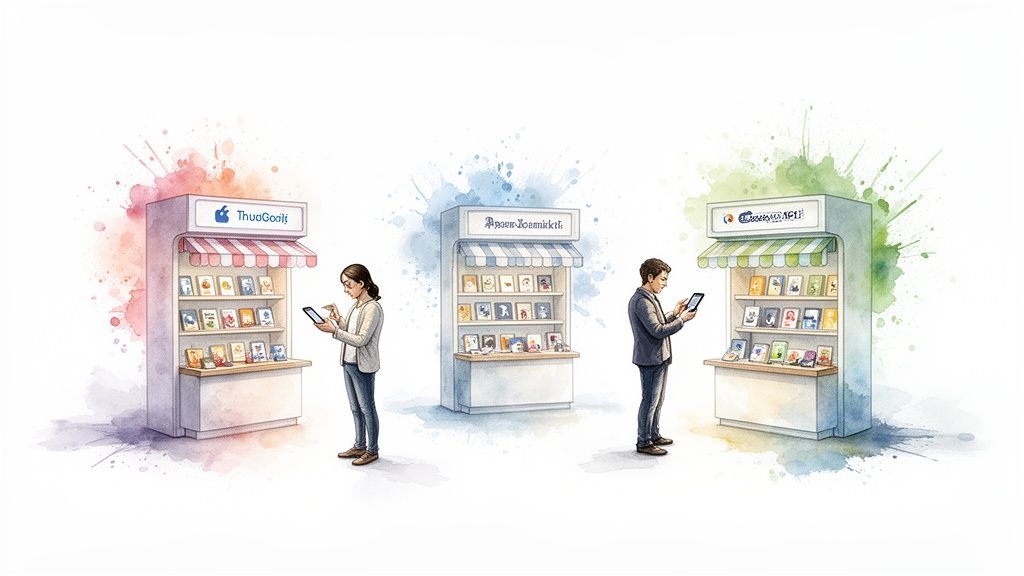
Imagine a classic, bustling town square. You’ve got vendors with their stalls, shoppers milling about, and conversations that naturally lead to a sale. Social ecommerce platforms are just the digital version of that, bringing the marketplace directly into apps like Instagram, TikTok, and Facebook.
Brands can set up their digital stalls, chat with potential customers, and ring up sales—all in one place. It’s a huge leap from how e-commerce has traditionally worked.
In the old model, you'd see an ad on social media, click it, and get whisked away to a separate website. That little jump creates friction and plenty of opportunities for potential buyers to drop off. Social commerce closes that gap between seeing something you love and actually buying it.
Ultimately, the magic here is meeting customers exactly where they are. It’s less about just selling and more about building a thriving e-commerce community that turns real engagement into revenue.
Social Commerce vs. Traditional Ecommerce
The biggest difference comes down to the customer's journey. Social commerce brings the store directly to the shopper. Traditional e-commerce makes the shopper travel to the store. That one distinction creates two completely different experiences and opens up new strategies for brands.
This integrated approach makes shopping feel like a natural part of just hanging out online. Someone might see a cool jacket in an influencer’s video, tap a tag to get the details, and check out in a matter of seconds. This kind of frictionless experience is often powered by features like shoppable video, a topic we dive into in our complete guide to shoppable video platforms.
Social commerce isn't just about adding a 'buy' button to a post. It's about creating a holistic, engaging, and convenient shopping journey that begins and ends within a social ecosystem, fundamentally reducing the friction between inspiration and transaction.
Social Commerce vs Traditional Ecommerce at a Glance
To make it even clearer, let's break down the core differences between these two models. The following table highlights where each approach shines and how they fundamentally differ in their approach to online selling.
As you can see, social commerce is built for a world of spontaneous discovery and community interaction, while traditional e-commerce serves a more direct, destination-based shopping mission. Both have their place, but the former is undeniably where the momentum is headed.
Understanding the Explosive Growth of Social Commerce
The explosion of social ecommerce platforms isn’t just some passing trend. It's a massive shift in how people shop, driven by a new generation of consumers who expect a whole lot more from their online experience.
At the center of it all are Millennials and Gen Z. They aren't just looking to buy things; they want to discover them through content that feels real, chat with brands on the fly, and hit "buy" without any friction. This hunger for a seamless, engaging shopping journey has transformed social networks from places we share photos into powerful storefronts.
These platforms have come a long way from just being a place for casual scrolling. They're now packed with sophisticated features designed to close the gap between seeing something you love and actually owning it.
The Forces Driving the Boom
So, what's pouring fuel on this fire? A few key forces are working together, creating the perfect storm for social commerce to take off. If you’re a brand looking to get in on the action, you need to understand what’s happening under the hood.
- Seamless In-App Experiences: Features like native checkout mean a customer never has to leave Instagram or TikTok to make a purchase. This is huge for reducing cart abandonment.
- Rise of the Creator Economy: Influencers and creators have become trusted friends whose recommendations feel more genuine than any traditional ad ever could.
- Authenticity and Community: People want connection. They want to see real people using products and jump into conversations about them—something social media was built for.
This powerful mix of convenience, trust, and community is completely redrawing the map for retail.
The global social commerce market is absolutely exploding. Projections show it rocketing up to $1.63 trillion in sales by 2025. That’s not a typo. This massive growth is happening at a compound annual growth rate (CAGR) of 30.71% through 2030, which just shows its immense power. By 2025, social commerce will account for over 17% of all online sales, making it a critical way to reach the 3 billion people shopping online worldwide. You can find more ecommerce platform statistics at SQ Magazine.
From Social Networks to Commercial Engines
This didn't happen by accident. The big social platforms quickly realized they were ground zero for product discovery. Why send users away to another site when you can build commerce tools right into the app and capture that value yourself?
Interactive formats like live stream shopping are now at the heart of this strategy. These live events create a buzz and a sense of community that a standard e-commerce site just can't match. It's part entertainment, part Q&A, and part sales pitch, all rolled into one powerful event that can drive serious revenue in a very short time. If you want to dive deeper, our guide breaks down the reasons why livestream shopping is so popular.
Ultimately, this shift represents a game-changing opportunity. The old model of driving traffic to a website is becoming obsolete. The future is about meeting your customers where they already are, making the shopping experience as natural and social as the platforms they use every single day.
Choosing the Right Platforms for Your Brand
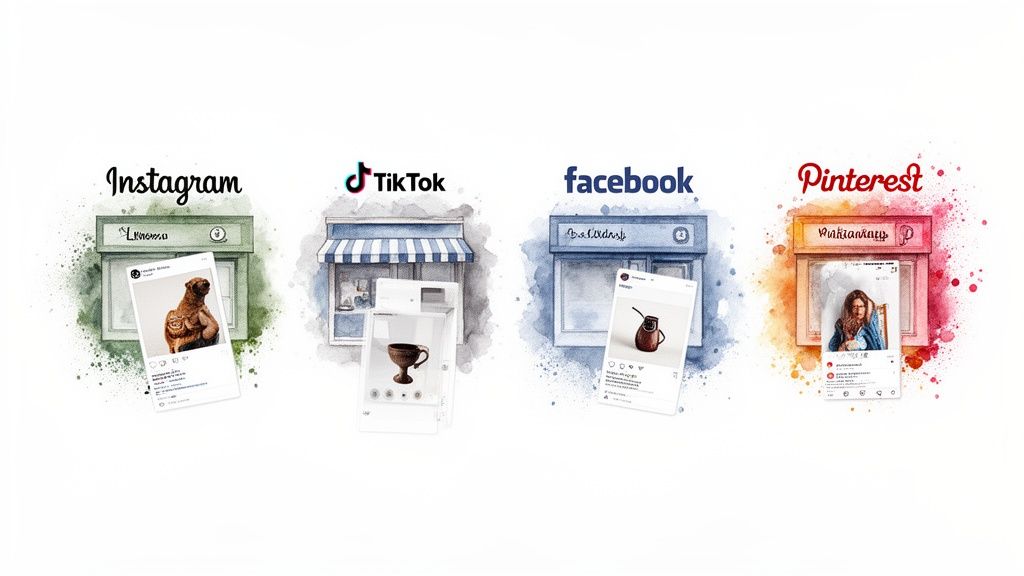
Jumping into social commerce without a plan is like setting up a market stall in a random neighborhood. Sure, you might get lucky, but you'll get far better results by picking a spot where your ideal customers already hang out. Each of the big social ecommerce platforms has its own vibe, its own crowd, and its own set of selling tools.
Success isn't about being everywhere at once. It’s about being smart and putting your resources where they’ll actually make a difference. The first step is getting to know the unique environments of platforms like TikTok, Instagram, Facebook, and Pinterest so you can match your products with the right people.
This has never been more important, especially with the demographic shifts reshaping the market. Millennials are driving 33% of all social commerce spending, and Gen Z is right behind them at 29%. That spending is concentrated on just a few key platforms: Facebook still leads with a 46% purchase share, but TikTok (26%) and Instagram (21%) are catching up fast. You can dig into more of these numbers and ecommerce statistics and trends on Flowlu.
Aligning Platform with Audience and Product
To make the right call, you need to look past simple follower counts and really think about how people use each platform. What kills it for a fast-fashion brand targeting Gen Z on TikTok will almost certainly fall flat for a luxury home decor brand trying to reach high-income Millennials on Pinterest.
Here’s a quick breakdown:
- TikTok Shop for Impulse and Entertainment: TikTok’s algorithm is an absolute beast for discovery. Its short-form video format is built for viral trends and impulse buys, making it a powerhouse for products with strong visual appeal that can be shown off in a fun, creative way.
- Instagram Shopping for Visual Storytelling: Instagram is all about aspirational lifestyles and beautiful aesthetics. It's the perfect home for brands in fashion, beauty, and wellness that can build a compelling visual story through high-quality photos, Reels, and influencer partnerships.
- Facebook Shops for Community and Trust: With its broader and slightly older user base, Facebook is fantastic for brands looking to build a real community. The Shops feature offers a more traditional catalog feel, and its tight integration with Groups and Messenger allows for much deeper customer conversations.
- Pinterest for Inspiration and Planning: People go to Pinterest to plan things—weddings, home renovations, new recipes, you name it. This makes it an incredibly powerful platform for products with a longer buying cycle, as you can get in front of customers right at the very beginning of their journey.
The real secret is understanding not just who is on each platform, but why they are there. Someone scrolling TikTok is in pure entertainment mode. Someone searching on Pinterest is in planning mode. Your content and how you sell have to respect that context.
Making the Final Decision
Ultimately, choosing the right platform boils down to answering three key questions:
- Where does my target audience really spend their time? Use the data to find where your ideal customers are most concentrated.
- Which platform best fits my product? Does your product shine in a quick, entertaining video or a beautifully curated image?
- What am I trying to achieve? Are you going for quick impulse sales or building long-term brand loyalty?
Answering these questions will help you move beyond a scattergun approach. You can then pick the social ecommerce platforms that will truly move the needle for your business and start turning all those passive scrollers into loyal customers.
Mastering a Video-First Content Strategy

In the buzzing world of social ecommerce platforms, let's be clear: video isn't just part of the plan. It is the plan.
Sure, static images still have their place. But video is the real engine driving everything—engagement, community, and turning casual scrollers into actual customers. To win here, you have to move past basic product shots and adopt a full-on video-first mindset.
This means you stop just pushing products and start telling stories. It’s about building a narrative around your brand that actually connects with people. You need to show, not just tell, why your products matter and how they fit into a customer's life.
This shift demands a new playbook. You can't just post a video and hope for the best. You need to think like a creator, zeroing in on authenticity and interaction to cut through the noise of a crowded feed.
Core Pillars of a Winning Video Strategy
To really get video right, you need to lean into the formats that feel native to social media—the ones that satisfy our craving for genuine, unpolished connection. These pillars are the foundation of a strategy that doesn't just rack up views, but builds a loyal community that actually buys from you.
- Authentic User-Generated Content (UGC): Get videos from your real customers and put them front and center. This kind of social proof is pure gold. In fact, a staggering 74% of shoppers make buying decisions based on suggestions from other users or influencers.
- Compelling Influencer Collaborations: Find creators who are a genuine match for your brand's vibe. Their authentic endorsement is a powerful shortcut to introducing your products to a new, highly engaged audience that already trusts their taste.
- Interactive Live Shopping Events: Go live! Host sessions where you can demo products, answer questions on the fly, and build a bit of FOMO. This format brilliantly mixes entertainment with commerce, turning shopping from a chore into an exciting, shared experience.
The first three seconds of any social video are everything. If you don't hook them immediately—with a striking visual, a provocative question, or an interesting problem—they're gone. Just keep scrolling.
Optimizing and Scaling Your Video Production
Every social platform speaks its own video language. A snappy, vertical clip that kills it on TikTok or Instagram Reels is going to fall completely flat as a long-form YouTube video. You absolutely have to optimize your content for each platform’s unique format if you want to maximize your reach.
But here’s the catch: the demand for a constant flood of high-quality, platform-specific video is enough to overwhelm any team. Consistently pumping out great content at scale is one of the toughest challenges in social marketing today.
This is where automation becomes your secret weapon.
Automated video creation tools can step in and solve this massive headache. They can take existing assets you already have—like product catalog data or even old blog posts—and spin them into dozens of video variations. By leaning on technology, teams can produce a ton more content, A/B test different creative ideas, and keep everything on-brand without completely burning out their creative staff.
For a deeper dive, you can explore some powerful strategies for producing compelling social marketing videos that get real results.
How Automation Powers Scalable Growth
Let's be honest: trying to manually create enough high-quality video to feed a winning social commerce strategy is a recipe for burnout. The sheer volume needed to stay relevant across multiple social ecommerce platforms can quickly overwhelm even the most dedicated creative teams.
This is where automation stops being a "nice-to-have" and becomes the engine for real, scalable growth.
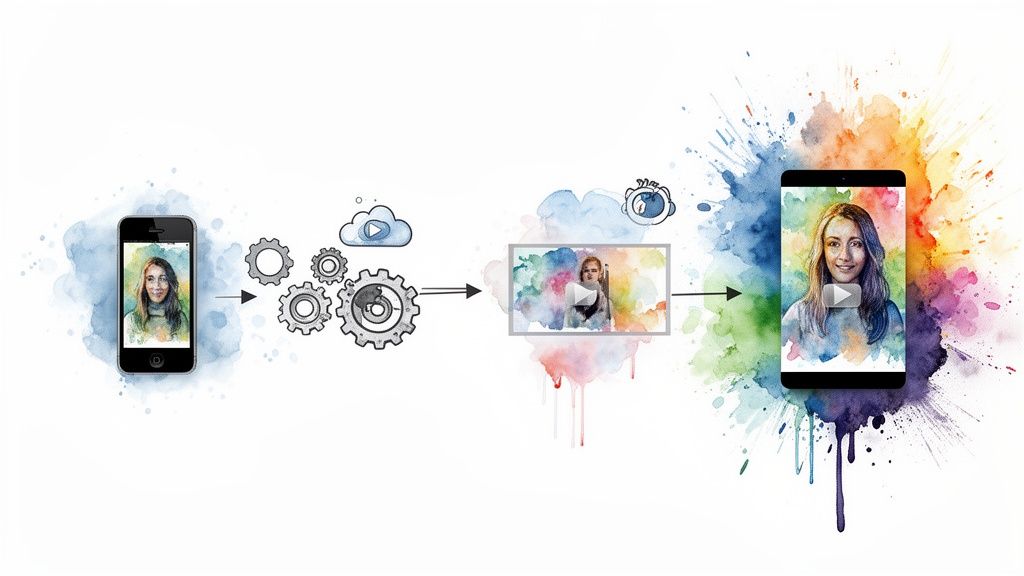
Picture your product catalog not as a static spreadsheet, but as a living, breathing source of video content. Automation tools can plug directly into your product feeds, taking your existing product images, descriptions, and pricing and transforming them into an endless stream of engaging, shoppable videos.
This automated workflow is the secret to unlocking massive efficiency. Instead of painstakingly building every single video from the ground up, your team simply sets the creative vision and brand rules. The technology then handles all the heavy lifting of production.
Streamlining the Content-to-Commerce Workflow
Plugging in an automated content pipeline completely changes how your team operates. It pulls them out of the weeds of repetitive tasks and frees them up to focus on what humans do best: strategy and creativity. The impact is immediate.
Here’s what that looks like in practice:
- Serious Efficiency Gains: You can slash video production time from hours or even days down to minutes. This means your team can pump out more content and test different versions for various audiences without needing to hire more people.
- Lower Production Costs: The cost per video plummets. Suddenly, creating custom content for niche products or flash sales—things that were once too expensive to justify—becomes totally feasible.
- Rock-Solid Brand Consistency: Automated templates are your secret weapon for consistency. Every video automatically follows your brand guidelines, ensuring a cohesive look and feel across every single social channel, every single time.
By automating the creation of shoppable videos, you're not just making content faster. You're building a system that can adapt and scale with your business, letting you test more ideas and react to market trends in a heartbeat.
The Power of Dynamic Video Ads
One of the most potent uses for automation is in creating dynamic video ads. These aren't your standard, one-and-done videos. They are intelligent, living assets that are always current.
Because these ads pull data directly from your product feed, they automatically update to show real-time pricing and inventory levels. This simple connection has a massive impact.
It guarantees that a customer never clicks an ad only to find the product is sold out or the price has changed. That builds trust and creates a frictionless path to purchase, which is exactly what you want for your conversion rates and customer loyalty.
At the end of the day, automation is about empowering your team to achieve more with the resources they already have. By turning your existing product data into a constant flow of fresh video content, you can drive more sales and build a much stronger brand presence on social ecommerce platforms. For a deeper dive on using tech for efficiency, seeing how an AI automation agency operates can offer some great insights.
Measuring What Matters for Real Success
A winning social commerce strategy is one you can actually measure. It’s easy to get caught up chasing high follower counts or the next viral video, but those "vanity metrics" often don't tell you the whole story. Success isn't just about likes; it's about sales.
To get a real picture of what’s working, you need to tie your social activity directly to revenue. That means shifting your focus from surface-level engagement to the numbers that show real business impact.
Moving Beyond Vanity Metrics
The true story of your success is written in the data that shows how well your content turns viewers into customers. It's time to stop counting likes and start tracking the numbers that actually hit your bottom line.
Here are the core KPIs that should be on your dashboard:
- Conversion Rate from Social: This is the big one. It tells you exactly what percentage of visitors from a social channel end up making a purchase.
- Average Order Value (AOV): Are your social customers buying big-ticket items or just small add-ons? AOV helps you understand the quality of the traffic you're driving.
- Click-Through Rate (CTR) on Shoppable Content: This shows how many people who see your shoppable video actually click on a product tag. A high CTR means your content and product are hitting the mark.
Your goal isn't just to be popular on social media; it's to be profitable. Prioritizing metrics like conversion rate and AOV ensures your efforts are directly contributing to business growth, not just online noise.
A Framework for Optimization
Once you know what to measure, you can start making it better. The best way to do this is through consistent A/B testing, where small, data-driven tweaks can lead to some seriously significant gains over time.
Don't just guess what works—prove it. Set up simple experiments to test different parts of your video strategy. For instance, you could pit a user-generated video against a polished, studio-shot video for the same exact product.
Then, check the results against your core KPIs. Did one format drive a higher conversion rate? Did a different call-to-action bump up the AOV? This constant cycle of testing, measuring, and refining is what separates the brands that win from those just hoping for a lucky break. By digging into platform-native analytics and making decisions backed by data, you can systematically improve your strategy and prove a clear return on your investment.
A Couple of Common Questions
What's the Real Difference Between Social Commerce and Social Media Marketing?
It's a common point of confusion, but the distinction is actually pretty simple.
Social commerce is about creating a complete, end-to-end shopping experience inside the social media app. Think of it like setting up a full-blown boutique right on Instagram or TikTok—customers can discover, browse, and buy without ever leaving.
Social media marketing, on the other hand, uses those same platforms to grab attention and direct people to an external website to make the purchase. So, one sells on social, while the other sells from social.
Are There Certain Products That Just Work Better for This?
Absolutely. Products that are highly visual and easy to show off in a compelling way tend to be home runs for social commerce.
We see fantastic results in categories like fashion, beauty, home decor, and unique gadgets. Why? Because they're perfect for video demos, stunning user-generated content, and influencer shout-outs that really bring the product to life. If you can tell a great story with it, you can sell it.
Ready to scale your video content for social commerce? Aeon automates video creation directly from your product catalog, helping you produce more content, faster. Discover how Aeon can transform your strategy.