In a world absolutely flooded with content, a great story in video isn't just another marketing asset—it's your most direct line to an audience's emotions. It's how you create a genuine connection that a static ad or a simple blog post just can't replicate. You're not just pushing a product; you're inviting people into a narrative, turning them from passive viewers into loyal followers.
Why a Story in Video Is Your Strongest Marketing Asset

Let's be honest, audiences today are tired of the hard sell. They crave stories, not just pitches. A powerful narrative immediately cuts through all that digital noise by shifting the focus from "what you sell" to "why it matters." This isn't just a hunch; it's rooted in how we're wired. Our brains latch onto stories far more effectively than they do a list of facts or figures. When you tell a story, you're building a world your customer can actually see themselves in.
This isn't a fleeting trend. It’s a fundamental shift in how people consume media. You see it everywhere, from TikTok to LinkedIn, where algorithms are literally designed to reward content that tells a story because it keeps people hooked longer. A well-crafted story in a video can tick off several major business goals all at once.
- Builds Authentic Trust: Stories foster empathy. They let people connect with your brand on a human level.
- Boosts Message Recall: A narrative framework makes information 22 times more memorable than facts alone. That's a staggering difference.
- Drives Deeper Engagement: Viewers are far more likely to watch to the end, share, and comment on something that tells a compelling story.
The Power of Narrative in a Short-Form World
Even with our shrinking attention spans, the demand for storytelling is stronger than ever. Just look at YouTube Shorts, which now racks up over 70 billion daily views. What makes it work? Quick, punchy, narrative-driven clips that have become a global phenomenon.
A great story doesn't need a long runtime. It just needs a clear beginning, middle, and end that resonates emotionally. The goal is to make the viewer feel something—inspiration, humor, relief, anything.
And this stuff translates directly into business success. A mind-boggling 91% of businesses now use video as a core part of their marketing, and 93% of marketers say it delivers a strong ROI.
For content teams, the real game-changer has been AI. Businesses that fold AI into their video marketing see an 82% increase in ROI over those that don't. Think about that. AI-powered product demos can lift conversion rates by as much as 40%. You can dig deeper into these powerful video marketing statistics to see just how much of an impact this is having for brands.
Making Cinematic Storytelling Accessible
Not too long ago, creating a quality video story was a massive undertaking. You needed expensive cameras, specialized crews, and a whole lot of time. This barrier kept smaller teams and publishers from even trying to compete.
That's just not the reality anymore.
Modern AI tools have completely leveled the playing field. Platforms like Aeon empower teams of any size to produce cinematic-quality stories without the old-school overhead. By automating the heavy lifting—like animation, audio syncing, and visual generation—these tools tear down the technical barriers. They free you up to focus on what really matters: the story you want to tell. It means your team can finally scale its video strategy, turning great ideas into professional, on-brand content faster than you ever thought possible.
Crafting Your Core Video Narrative
 An unforgettable video story isn't born from a lucky moment of inspiration; it’s built on a solid foundation, planned long before you ever hit record. It’s all about creating a deliberate narrative structure that actually connects with your audience, turning a simple marketing message into something they’ll remember.
The blueprint for this connection is your script. A powerful script for advertising is the real secret sauce for ads that don't just get views—they get results. This goes way beyond dialogue; it's about mapping out the emotional journey your viewer is about to take.
Adapting The Three-Act Structure For Modern Video
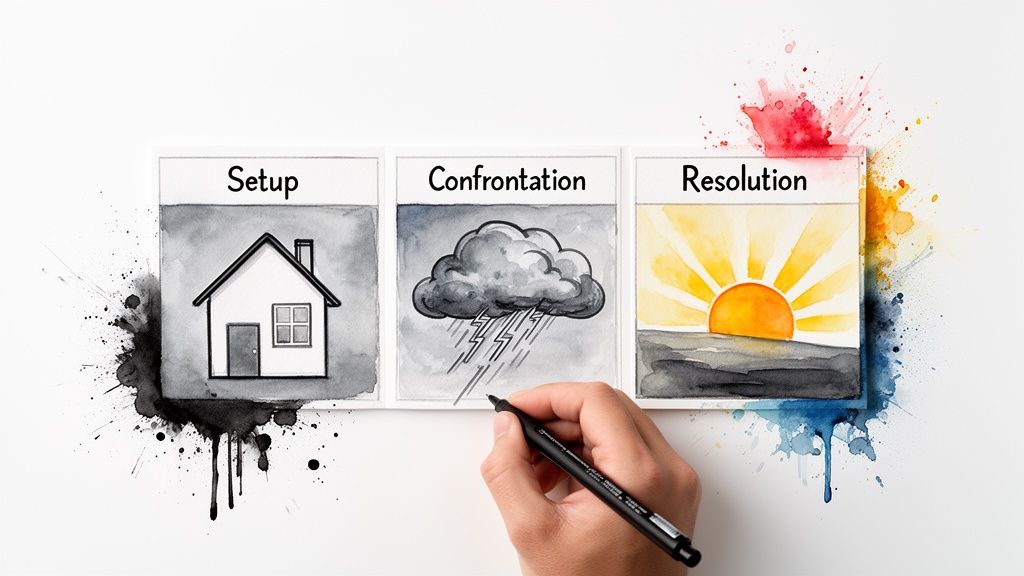
There's a reason the classic three-act structure—Setup, Confrontation, and Resolution—has stuck around forever: it just works. It perfectly mirrors how we naturally process stories and experience change. For marketing videos, this isn't some dusty old theory; it’s a practical tool for making an impact, even if you only have 15 seconds for a social ad.
Here’s how you can put it to work for your content:
-
Act I: The Setup: This is where you introduce your main character (who is always your customer) and their world. The most critical piece here is to establish the problem or the "itch" they can't scratch. What’s their pain point? What are they really struggling with? This opening has to be relatable, hooking the viewer by showing them a reality they immediately recognize.
-
Act II: The Confrontation: Now, the problem gets worse. The character tries to solve it, but they keep hitting roadblocks. This is where you build tension and, more importantly, empathy. Your product or service isn't the hero yet; the struggle is the entire focus. You need to show the frustrations and challenges, not just talk about them.
-
Act III: The Resolution: Finally, your brand enters the picture. But it's not the hero. It's the guide, the tool, the secret weapon that helps the real hero (your customer) overcome their obstacle. The resolution isn't about your product's features; it’s about the transformation your customer experiences. The story ends by showing their "new normal"—a better, more successful, or happier state of being.
By framing your story this way, the narrative becomes about the customer's success, not your brand's greatness. This simple shift is the key to creating a story in video that feels authentic and persuasive rather than just another sales pitch.
Making Your Customer The Hero Of The Story
The single most common mistake I see in video marketing is brands making themselves the hero. Don't do it. Your brand is the wise guide, the powerful tool, the mentor—think Yoda, not Luke Skywalker. The customer must always be the protagonist on a journey.
This approach ensures the viewer sees themselves in the narrative. They aren't just watching a commercial; they are seeing a reflection of their own challenges and aspirations.
Take a launch video for a new productivity app, for instance. Instead of rattling off features, the story could open with a freelancer totally overwhelmed by deadlines and messy files (The Setup). They try different methods, but nothing works, just leading to more stress (The Confrontation). Finally, they discover the app, which helps them effortlessly organize their workflow, leading to a successful project and a palpable sense of calm (The Resolution).
The app didn't save the day on its own; it empowered the freelancer to become the hero of their own work life. If you need more practical guidance on structuring these narratives, our comprehensive guide on writing compelling video scripts offers deeper insights and templates.
To really nail this, you have to break down the core components of your narrative.
Core Narrative Elements for Marketing Videos A breakdown of the essential storytelling components and how to apply them to your video content for maximum impact.
Mapping out your video with this table in mind ensures your customer remains the central focus from start to finish.
Defining Your One Core Message
Every truly great video story is built around a single, powerful idea. Trying to cram too much in at once just dilutes your message and confuses your audience.
Before you write a single word of the script, you have to be able to answer this question: "What is the one thing we want our audience to feel or believe after watching this?"
This core message becomes your North Star. It guides every single decision you make, from the script to the visuals to the music. It provides clarity and focus, ensuring your final video delivers a narrative that's not only cohesive but genuinely impactful. This discipline is what stops your story from becoming a cluttered list of benefits and keeps it centered on a singular, resonant emotional truth.
Using Visuals and Audio to Drive Emotion
Alright, your script is locked in. Now comes the fun part: bringing that story to life with visuals and audio. This is where you trade the blueprint for the camera and microphone, making the creative calls that will hook your audience and make them feel something.
This isn't just about adding pretty pictures and a background track. The visuals and audio are easily 50% of the experience. Every choice you make, from a subtle sound effect to a dramatic color grade, shapes how your story lands. Even on a shoestring budget, a few smart decisions here can make a world of difference.
Selecting Visuals That Match Your Story's Mood
The first thing your audience will see is your visuals, and they set the tone instantly. It doesn't matter if you're using custom-shot footage, stock clips, or AI-generated imagery; what matters is that it feels consistent with your brand and the emotional arc of your story.
Imagine a sleek product launch video. You’d probably go for clean lines, minimalist backgrounds, and a cool, modern color palette. Now, picture a fundraising video for a non-profit. That calls for warmer tones, intimate close-ups, and maybe even some handheld shots to build a sense of raw, human connection.
The most effective visuals don't just show what's happening; they make the audience feel what's happening. A shot of a rain-streaked window isn't just about the weather; it's about conveying a mood of melancholy or contemplation.
This is where AI image generation has really changed the game. Tools like Aeon let you create studio-quality visuals from simple text prompts, giving you precise control over the style, composition, and even logo placement. It means your team can produce custom imagery that’s a perfect match for your narrative, all without the cost and logistics of a full photoshoot.
Using Pacing and Editing to Build Momentum
Editing is where your story finds its rhythm. The pacing of your cuts is a powerful tool for guiding your viewer's emotional journey—you can build tension, create a burst of excitement, or just let a powerful moment breathe.
- Fast Cuts: Quick, snappy cuts are your go-to for creating a sense of urgency and energy. Think action sequences, exciting product reveals, or montages showing rapid progress.
- Slow Pacing: Letting your shots linger gives the audience time to take in the scene and connect with the characters. This works wonders for emotional moments, introspective scenes, or when you’re trying to build suspense.
Think about a B2B tech video. During the "Confrontation" part of the story, where the customer is struggling with their old, clunky system, you could use jarring, quick cuts to mirror their frustration. Then, as you hit the "Resolution" and they're using your new software, the pacing slows down. The shots become smooth and deliberate, conveying a sense of calm and control.
The Immense Power of Audio in Storytelling
Audio is the unsung hero of video. Seriously. A viewer might forgive a slightly grainy image, but they will click away in a heartbeat if the sound is bad. Your audio strategy needs to be just as intentional as your visual one.
It’s about so much more than just picking a background track. Your audio landscape has three key components, and they all need to work together to support the story.
Three Pillars of an Effective Audio Mix
High-quality AI voiceovers have become a fantastic option for teams that need consistent, professional narration without the time and expense of hiring voice actors for every single project. You get a huge range of tones and styles, so you can always find the perfect voice to represent your brand's personality.
Ultimately, every sound should have a purpose. If a music cue or sound effect isn't actively making your story better, it's just noise. When you get the audio and visuals perfectly aligned, your story in video becomes a truly immersive experience. For a closer look at the technical side, learning how to perfectly sync audio to video can make a huge impact on your final cut.
How to Scale Video Storytelling with AI

Making one incredible video is an achievement. But consistently producing hundreds of them? That's a real competitive advantage. This is where scaling your strategy is non-negotiable, shifting from one-off wins to a predictable, high-volume production engine. For most teams, this is also where the manual process completely falls apart.
The good news is that modern AI platforms have changed the game. They provide a direct path to operationalizing your video strategy, giving your team the ability to create on-brand, professional content faster and more affordably than ever. This isn't about replacing creators; it's about giving them superpowers.
From a Single Prompt to a Polished Video
The old workflow was a long chain of dependencies: brainstorming, scripting, storyboarding, shooting, editing. It could take weeks. AI has condensed that entire process down to minutes. Imagine turning a simple text prompt into a polished, high-converting ad in the time it takes to drink your morning coffee.
This is the core idea behind platforms like Aeon. You can feed it a core message, define your audience, and select a tone, and the system generates a complete video story. It handles the heavy lifting automatically:
- Script Generation: It writes a narrative-driven script based on your input.
- Visual Creation: It produces studio-quality images or video clips that perfectly match the script’s mood.
- Audio Syncing: It generates a professional voiceover and syncs it flawlessly with the visuals, layering in background music and sound effects.
This approach absolutely slashes the production cycle. An idea that comes up in a morning meeting can be a finished video ready for review by the afternoon. That kind of speed lets you test and iterate quickly, helping you find what truly connects with your audience in a fraction of the time.
Real-World Application for E-commerce Teams
E-commerce is one area where scaling video storytelling delivers immediate, measurable results. Product catalogs are massive. Creating unique videos for every single item with traditional methods just isn't realistic. AI presents a practical solution.
Think about a fashion brand dropping hundreds of new arrivals each season. Instead of organizing expensive photoshoots for every garment, they can use technology like Virtual Try-On. This lets them repurpose existing model photos, digitally dressing them in new items to create dynamic product videos on the fly.
It's more than just a cost-saving trick; it’s about telling a better story in video for each product. A customer can actually see how a dress moves and fits from different angles, which is a far richer and more convincing experience than a static photo could ever be.
This capability goes way beyond fashion. A furniture company can showcase an entire collection in various room settings. A consumer electronics brand can create detailed, animated demos for every product variant—all without a single physical production.
The massive growth in on-demand content consumption shows just how critical this efficiency is. The global video streaming market is projected to skyrocket from USD 246.9 billion to USD 787 billion by 2035, and video is on track to account for nearly 82% of all internet traffic. With 63% of marketers already using AI for video creation, the shift to story-focused, automated production is clearly underway.
Automating the Complexities of Production
Beyond just generating the content, AI is brilliant at handling the technical details that so often bog teams down. Powerful engines can automate sophisticated tasks, ensuring a professional finish on every video, no matter who on your team clicks "create."
For instance, animating a static image to bring it to life used to require specialized software and a lot of skill. Now, AI can do it seamlessly. Another complex editing task, preserving the exact first and last frames of a clip to create smooth, cinematic transitions, can also be automated. This guarantees a high-quality look and feel across all your content.
This kind of automation is what builds brand consistency at scale. No matter how many videos your team cranks out, they all adhere to the same quality standards. To truly take your video storytelling to the next level, using an AI Video Generator is essential for producing engaging content efficiently.
By removing these technical headaches, you free up your creative team to focus on the narrative. They can spend their time refining the core message and building compelling story arcs, knowing the technical execution is taken care of. If you're looking for more ways to integrate these technologies, check out our guide on other powerful AI video generation tools and how to best use them. This shift lets you build a true video production pipeline that turns great ideas into impactful stories without the friction of a traditional workflow.
Optimizing Your Video for Every Platform
A great story only makes an impact if it actually reaches your audience in a way they’ll appreciate. You can spend weeks crafting the perfect narrative, but if you don't stick the landing on distribution, all that hard work goes to waste.
Let's be clear: a one-size-fits-all approach to video is dead. You can't just upload the same file everywhere and expect results.
The way someone mindlessly scrolls through YouTube Shorts is worlds apart from how they engage with a deep-dive on your main channel or a professional update on LinkedIn. To get real traction, your story in video has to be molded to fit the unique culture, technical specs, and user habits of each platform.
Tailoring Your Story for Short-Form Video
Platforms like Instagram Reels and YouTube Shorts are all about instant gratification. Your audience is in a rapid-fire scrolling mode, and you have literally seconds to hook them before they swipe on. This environment requires a total rethink of your narrative structure.
Your hook can't wait. It needs to hit within the first 1-2 seconds. Forget the slow, cinematic build-up; you need to lead with your most compelling visual or the core of the conflict right away. The traditional three-act structure is basically squashed into a few moments, getting to the payoff as fast as humanly possible.
Here’s how to nail your short-form content:
- Aspect Ratio is Non-Negotiable: Vertical 9:16 is the only way to go. Anything else gets awkwardly boxed in, screams "I didn't make this for you," and gets skipped.
- Captions Are Mandatory: A massive number of people watch these videos with the sound off. If you don't have burned-in, dynamic captions, your message is lost. Keep them big, bold, and brief.
- Keep it Short: Even though the platforms allow for longer videos, the engagement sweet spot is usually between 15 and 30 seconds. Your story needs to be ruthlessly concise.
One of the biggest mistakes I see is when teams just crop a horizontal video into a vertical frame. It almost never works. The framing is off, the story feels broken, and it looks cheap. You have to re-edit with the vertical format in mind, focusing on a single, punchy idea.
Optimizing for YouTube and LinkedIn
While short-form is about quick hits, platforms like your main YouTube channel and LinkedIn give your story more room to breathe. Here, you can lean into a more traditional narrative arc, building out the context and adding layers of depth.
On your primary YouTube channel, 16:9 horizontal is still king. This is the home for your longer-form brand stories, in-depth tutorials, or detailed customer testimonials. Viewers come here ready to invest a few minutes, as long as the story delivers on its promise.
LinkedIn is its own unique beast. It supports standard video formats, but square (1:1) videos consistently perform better in the feed because they simply take up more screen real estate on mobile. The content needs a professional, value-driven angle, but it still has to tell a story—think a quick case study, a behind-the-scenes look at a project, or a micro-lesson from an expert.
Your Pre-Launch Distribution Checklist
Before you ever hit "publish," a quick final check can be the difference between a video that flies and one that flops. Don't let a great story fall flat because of a sloppy launch.
- Create a Compelling Thumbnail: This is your video's front door. It needs a high-quality, expressive image with bold, minimal text that makes someone need to click.
- Write an SEO-Friendly Title and Description: Think like your audience. What would they search for? Weave those keywords in naturally. For YouTube, a detailed description is crucial for helping the algorithm understand and recommend your content.
- Use Strategic Hashtags: On platforms like Instagram and LinkedIn, a smart mix of broad and niche hashtags is your ticket to reaching people beyond your existing followers.
- Choose the Right Time to Post: Dive into your analytics. Find out when your audience is most active and schedule your posts to land right in that sweet spot for maximum engagement.
- Prepare a Call-to-Action (CTA): What’s the next step? Don’t leave your viewer hanging. Tell them exactly what you want them to do, whether it's visiting your site, subscribing to your channel, or dropping a comment.
So, you’ve poured your heart and soul into creating a fantastic video. But how do you really know if the story connected with your audience? Creating a compelling story in video is just step one. Step two is figuring out if it actually worked, and that means looking at the right data.
It's easy to get caught up in chasing big, flashy numbers like view counts. But the real story of your video's success is found in the metrics that tie directly back to your business goals.
The question you need to ask isn't "how many people saw it?" but "what did they do next?" This shift in focus is what separates a good video strategy from a great one, pushing you toward numbers that show real engagement and influence.
Looking Past the View Count: Your Core Performance Indicators
Instead of obsessing over raw views, let's dig into the metrics that truly tell you how your narrative is landing.
-
Audience Retention: This is probably the most honest feedback you'll ever get. Your retention graph, especially on platforms like YouTube, is a goldmine. It shows you the exact moment people get bored and click away. A massive drop-off in the first 5-10 seconds? Your hook isn't strong enough. A slow, gentle decline? You're doing a good job of keeping people invested in the story.
-
Click-Through Rate (CTR): Think of your call-to-action (CTA) as the grand finale of your story. A high CTR is a clear sign that your narrative did its job—it motivated someone enough to take that next step. Whether you asked them to check out a product or sign up for a newsletter, a click means your message was persuasive.
-
Conversion Rate: This one is the bottom line. Did your video lead to a sale, a download, or a qualified lead for your sales team? This metric cuts through the noise and tells you if your story isn't just entertaining, but is actually driving tangible results.
Your ultimate goal here is to create a data-driven feedback loop. You take what you learn from one video's performance and use those insights to make the next one even better. This is how you continuously sharpen your narrative hooks, visual style, and CTAs over time.
By pinpointing where you lose your audience, you can start experimenting. Try A/B testing different intros, a clearer call-to-action, or even a completely different emotional tone. When you do this, measurement stops being a report card and becomes your most powerful tool for getting better.
Of course. Here is the rewritten section, crafted to sound like an experienced human expert, following all the provided guidelines.
A Few Common Questions We Get About Video Storytelling
When teams first start making video a core part of their strategy, a few questions always seem to surface. We've heard them all, from the nitty-gritty technical stuff to the bigger creative picture. Let's dig into some of the most frequent ones we see from digital and marketing teams.
How Long Should My Video Story Be?
Ah, the million-dollar question. The honest answer? It completely depends on the platform and what you’re trying to achieve. There’s no magic number.
If you're aiming to catch someone's attention on a fast-moving social feed like Instagram Reels or TikTok, you’ve got to make an impact fast. Think short and punchy. Keeping your story under 30 seconds is a really solid strategy here.
But for your own turf—like your primary YouTube channel or website—you've earned a bit more of your audience's time. A detailed brand story or an in-depth customer testimonial can easily run 2-5 minutes, as long as every second of the narrative pulls its weight. The best way to know for sure is to dive into your analytics. Your audience retention data is pure gold; it will show you the exact moment viewer attention starts to wane.
What If I Don't Have a Big Production Budget?
This is easily the most common hurdle we hear about, but it's genuinely not the barrier it used to be. A high-end look and feel no longer requires a massive crew and eye-watering gear rentals. Today's tools put incredible quality within reach for just about any team.
Here's how you can get that polished feel without breaking the bank:
- Lean on High-Quality Stock Footage: You can find millions of professional, cinematic clips on various platforms. When you weave them into a strong narrative, they look seamless.
- Embrace AI Generation: This is a game-changer. Modern tools can spin up custom visuals, slick animations, and even professional-grade voiceovers from a simple text script, slashing production costs.
- Never, Ever Skimp on Audio: This is non-negotiable. Great audio is literally 50% of the experience. A crisp, clear voiceover paired with the right music can elevate a simple video into something that feels incredibly professional.
The most important part of any video story is the story itself. A powerful, emotionally resonant narrative shot on a smartphone will always outperform a beautifully shot, expensive video that has nothing to say.
At the end of the day, your story's impact comes from its authenticity and the connection it makes with your audience, not from the size of your budget.
Ready to scale your video storytelling without all the cost and complexity? Aeon gives your team the power to turn simple ideas into professional, on-brand videos in minutes.