A video subtitles translator is pretty much what it sounds like: a tool or service that takes the text from your video's captions and swaps it into another language. But it's more than just a simple word-for-word swap. The real power comes from combining AI-powered workflows and human expertise to open up your content to global audiences, breaking down language barriers to find new markets and drive growth.
Why Subtitle Translation Is Your Next Growth Lever

If you're only thinking about subtitle translation as an accessibility checkbox, you're missing the bigger picture. It's actually a powerful engine for international expansion.
When your content only exists in one language, you're actively choosing to ignore a massive slice of the potential global audience. The business case for using a video subtitles translator isn't about compliance—it's about making a strategic move into new markets.
Let's be real: manual, one-off translation projects just don't cut it anymore. They're slow, costly, and impossible to scale in a world that craves constant content.
Imagine your marketing team is cranking out a new product demo every single week. If you have to send it out for manual translation into five different languages each time, you're creating a huge bottleneck. Your global campaigns get delayed by weeks, maybe even months. That friction kills momentum and leaves you trailing behind competitors.
The Shift to Scalable Workflows
This is where automated, AI-driven workflows completely change the game.
By building a smart translation system directly into your production pipeline, you can slash turnaround times from weeks down to a matter of hours. It means your content can be truly global the moment it goes live, not as a belated afterthought. This isn't just a technical tweak; it's a core growth strategy.
The market numbers back this up. The global video subtitle translation service market was valued at USD 1.75 billion in 2023 and is projected to hit USD 3.95 billion by 2032. That growth is being driven by businesses that see the immense value in reaching international audiences.
By treating subtitle translation as a strategic growth lever, you transform a cost center into a revenue generator. The initial investment in an efficient workflow pays for itself through increased global reach, higher engagement rates, and access to previously untapped customer bases.
More Than Just Translation
A solid global video strategy also means understanding the platforms where your content actually lives.
Beyond just the translation itself, knowing how to implement features like closed captioning is a powerful way to boost your channel's accessibility and SEO. For anyone focused on YouTube, mastering its specific features can be a major growth lever. You can learn more by checking out a comprehensive guide to YouTube closed captioning.
When you combine accurate translation with platform-specific best practices, you create an unbeatable combination. For a deeper dive, you might find our own guide on video translation and subtitling strategies helpful.
Prepare Your Subtitle Files for Flawless Translation
Before you even think about plugging your content into a video subtitles translator, you have to get your source file right. Seriously, this is the most important part. A messy starting point guarantees a messy result, creating a domino effect of errors that are a nightmare to fix down the line.
Think of it as building a house—you wouldn't pour concrete on a cracked foundation. The goal is to have a perfectly clean, accurate, and consistently formatted subtitle file, usually in SRT (SubRip Text) or WebVTT (Web Video Text Tracks) format. Nailing this prep work is the single best thing you can do to make sure your automated translation workflow goes off without a hitch.
Verify Source Transcription and Timestamps
First things first: your original transcript needs to be rock solid. An AI-generated transcript is a fantastic first draft, but it's almost never 100% accurate. It’ll stumble over brand names, technical jargon, or speakers with accents.
You have to go through and proofread the entire thing against the actual audio. Correct every little spelling, grammar, or punctuation mistake. This isn’t just about being a perfectionist; one mistranscribed word in English will be translated incorrectly into every single target language.
Just as critical are the timestamps. If your timing is off, subtitles will pop up too early or hang around long after someone has stopped talking. It just looks unprofessional and makes for a frustrating viewing experience.
- Check Entry and Exit Points: Make sure each subtitle line appears exactly when the dialogue starts and vanishes when it ends.
- Avoid Overlap: Check that no timecodes overlap between one subtitle and the next. This is a classic mistake that causes display glitches in a lot of video players.
- Test the Flow: Pop the subtitles on and watch the video. Does the pacing feel natural? Are you forcing your audience to speed-read just to keep up?
If you want a deeper dive into the nuts and bolts of timing and placement, our guide on how to add subtitles to videos covers all the fundamentals.
Clean and Standardize Your File Formatting
Automated translation tools are smart, but they're also sensitive. Throw a file with stray code, weird formatting, or unnecessary metadata at them, and they'll get confused. This can lead to failed translations or completely garbled output.
Before you send anything off for translation, you need to "clean" the file. That means stripping out everything that isn't essential text or standard, universally recognized formatting.
Pro Tip: Ditch any non-standard HTML tags like
<font>or<span>from your file. Unless you are absolutely certain your translation software and the final video player support them, they'll just cause problems. If you need emphasis, stick to the basics like bold (<b>) and italics (<i>).
Establish a Clear Style Guide
A simple style guide is your rulebook for keeping things consistent across all languages. It doesn't have to be a 50-page document—just a clear set of guidelines for your translation engine or human post-editors to follow. This is how you make sure everything looks and feels professional and on-brand.
Your guide should cover a few key things:
- Character Limits: Set a hard limit for characters per line. A good rule of thumb is around 42 characters per line, which keeps things readable on any screen, from a phone to a TV.
- Lines Per Subtitle: Stick to a maximum of two lines per subtitle. Piling on three or more lines just clutters the screen and distracts from the actual video.
- Handling Non-Verbal Cues: Decide how you'll format sounds and stick to it. For example, always use brackets, like [applause], [music], or [laughter]. This signals to the translator that these are non-translatable elements.
- Reading Speed: Aim for a comfortable reading speed, often measured in characters per second (CPS). For most audiences, a pace between 15 and 20 CPS is the sweet spot.
When you take these steps, you're not just tidying up a file; you're setting your entire global content strategy up for success. This bit of upfront effort pays off big time, dramatically improving the quality of any video subtitles translator and saving you hours of painful post-translation editing.
Choosing Your Translation Engine: AI vs. Human Review
Deciding how to translate your video subtitles is no longer a simple choice between a machine and a person. It’s about building a smart, hybrid system that gets you the right balance of speed, cost, and quality for your specific content. The right video subtitles translator can be anything from a fully automated AI to a meticulous human-led process—and the best answer usually lies somewhere in between.
The whole decision really boils down to one question: what is this video for?
The answer tells you everything you need to know about the level of nuance, accuracy, and cultural sensitivity required. A quick internal training video just doesn't have the same demands as a high-stakes marketing campaign launching in a new country.
This is where Machine Translation Post-Editing (MTPE) comes into play. It’s a hybrid model where an AI does the initial heavy lifting, and a professional human translator then reviews, refines, and perfects the output. You get the raw speed of automation without giving up the critical thinking and cultural awareness that only a human can bring to the table.
The Rise of AI in Translation
There's no denying it: AI has completely changed the game. Raw machine translation is faster and more accessible than ever, and the quality has improved by leaps and bounds. Engines like DeepL are fantastic for producing natural-sounding, context-aware translations, especially for European languages. On the other hand, Google Translate offers an incredible breadth of language support, making it a solid choice for reaching more niche audiences.
The growth in this space is just staggering. The global AI video translation market is projected to skyrocket to USD 33.4 billion by 2034, a massive jump from its 2024 valuation of USD 2.68 billion. That kind of growth shows a huge surge in trust as more businesses realize how powerful AI can be for scaling their global communications. You can dig into the research behind these AI video translation market trends to see for yourself.
But even the most advanced AI is still just a tool. It can translate words with stunning accuracy, but it can’t grasp intent, humor, or cultural subtext. Relying on pure machine translation for sensitive content is like asking a calculator to write a poem—you might get a technically correct answer, but it will completely miss the point.
When to Use Pure Machine Translation
Despite its limits, there are definitely times when raw, unedited machine translation is the right call. The trick is to use it for content where the stakes are low and the main goal is just simple comprehension, not creating an emotional connection.
Think about these scenarios:
- Internal Training Videos: Sharing a software tutorial with your global team? Pure MT is often more than good enough. The goal is to get functional information across, and a few grammatical quirks aren't going to cause any major issues.
- User-Generated Content: If you're translating subtitles for a massive volume of customer testimonials or reviews, MT can help you gather valuable insights without needing perfectly polished prose.
- Initial Content Triage: When you’re sitting on a huge archive of video, an AI video subtitles translator can help you quickly sort through it all and pinpoint which content is actually worth investing in for a higher-quality localization effort.
When Human Review is Non-Negotiable
For any content that is customer-facing, brand-defining, or culturally sensitive, you absolutely need a human in the loop. A human post-editor does so much more than just fix grammar mistakes; they perform a crucial process called localization. This means adapting the content so it feels completely natural and resonant for the target audience.
Here are a few cases where MTPE is the only way to go:
- Marketing and Advertising: That clever slogan in English can easily become offensive or just plain nonsensical if translated literally. A human editor makes sure your brand’s voice and message land just right.
- Entertainment and Storytelling: Jokes, puns, and emotional dialogue are steeped in cultural context. A machine will almost always botch the feeling, but a skilled human translator can find a culturally appropriate equivalent that works.
- Legal or Medical Content: When accuracy is everything and one small mistake could have serious consequences, you absolutely need a human expert to verify every single word.
To help you decide, here’s a quick breakdown of how these approaches stack up.
Machine Translation vs Human Post-Editing: A Practical Comparison
This table should give you a clearer picture of which approach is best suited for your video content based on factors like speed, cost, and the level of quality you need.
Ultimately, the goal isn't just to translate—it's to connect with your audience. Choosing the right workflow is key.
Picking the right workflow really comes down to having a clear understanding of your content and your goals. If you're exploring different ways to structure these services, our guide on choosing a modern video translation service offers a much deeper dive. The end game is to create a scalable system that uses AI for efficiency while putting human expertise to work where it truly matters most.
Polishing Your AI Translations: A Practical Quality Assurance Workflow
Let's get one thing straight: an AI-generated translation file is a fantastic starting point, but it's never the finished product. Thinking you can just hit "translate" and publish is one of the quickest ways to torpedo your global content strategy.
To really connect with an international audience, you need a solid Quality Assurance (QA) workflow. This isn't just about catching errors; it's about ensuring your message lands with accuracy, technical polish, and cultural respect.
Think of the raw output from a video subtitles translator like a well-researched first draft. All the basic information is there, but it's missing the finesse and local nuance that separates amateur content from a professional production. A structured QA process is what turns that draft into something that builds trust with your viewers. Without it, you’re just asking for awkward, confusing, or even offensive translations.
First Things First: The Technical Quality Check
Before a human reviewer even looks at the language, your first stop should always be a technical check. This is where you catch all the file-level glitches that can completely ruin the viewing experience. These aren't language problems; they're formatting and timing problems.
Running this check first saves your linguistic reviewers from getting stuck on tedious technical fixes, letting them focus on what they do best: the language itself. A simple automated pass can systematically catch the most common offenders:
- Broken Timestamps: Are all the timecodes formatted correctly and in the right order? Overlapping or missing timestamps are a classic bug that makes subtitles disappear or get stuck on screen.
- Character and Line Limits: A quick scan can confirm no subtitle goes over the limits you've set—for example, a hard rule of 42 characters per line and a maximum of two lines. This is non-negotiable for readability, especially on mobile.
- Reading Speed (CPS): Calculate the characters per second for every single subtitle. You can automatically flag any that are too fast (forcing viewers to speed-read) or hang around for way too long.
- Untranslated Tags: Make sure non-verbal cues like [music] or [laughter] didn't get swept up and translated by mistake. These need to stay put.
Now for the Human Touch: The Linguistic QA Phase
Once a file is technically sound, it’s ready for the most important part of the process: a linguistic review by a native speaker. This is where the real art of localization happens. The goal isn't just to hunt for grammar mistakes but to ensure the translation feels natural, authentic, and culturally on-point.
How you brief your reviewers makes all the difference. Don't just toss a file over the fence and ask them to "check it." You need to give them context.
Your localization brief should be the reviewer's single source of truth. Make sure it includes a link to the original video, your style guide, a glossary of key brand terms, and clear notes on the desired tone. This empowers them to make smart, on-brand decisions instead of just playing grammar police.
A No-Nonsense QA Checklist for Your Reviewers
Give your native-speaking reviewers a clear, structured checklist to work from. This keeps the feedback consistent across different languages and reviewers, which makes your whole operation run smoother.
Here’s a practical model you can steal and adapt:
- Grammar and Spelling: Obvious, but essential. Is the translation 100% free of typos and grammatical errors?
- Clarity and Flow: Does the text read like a native speaker wrote it? Or does it sound clunky and "translated"?
- Tone of Voice: Does the translation hit the right note for your brand? Whether you're formal, casual, funny, or serious, the translation needs to match.
- Cultural Resonance: Are there any phrases, jokes, or references that just won't land—or worse, could be misinterpreted? A sports metaphor that works in the US might get you blank stares in Japan.
- Localization of Slang and Idioms: Have you "transcreated" colloquialisms instead of translating them literally? "Break a leg" should never, ever become "fracture a limb."
- Consistency: Are key terms and brand names used the same way throughout this video and across all your other translated content?
This two-pronged QA approach—a hard technical check followed by a deep linguistic review—is the secret to producing high-quality video translations at scale. It transforms your video subtitles translator from a simple tool into a cornerstone of a truly global communication strategy.
Embedding Translation Into Your Production Pipeline
If you want to scale your global content, treating translation as the final step is a recipe for bottlenecks. I’ve seen it happen time and again. The smartest move you can make is to stop thinking of translation as an afterthought and start baking it directly into your video production process.
This means creating a system where translation isn't a manual task you kick off at the end, but an automated step that begins the moment your source video is ready. You shift from being reactive to proactive. Instead of scrambling to get subtitles translated after a launch, you build a seamless flow where a finalized English video automatically triggers the whole translation process.
Leveraging Automation and APIs
The magic behind this integration is all about automation and APIs. Most modern translation platforms, including services like Aeon, offer APIs that can plug directly into your content management system (CMS), digital asset management (DAM), or even a simple cloud storage folder.
It's surprisingly easy to set up a "watched folder" system. When a new SRT file lands in a specific folder in your Google Drive or Dropbox, it automatically triggers the translation workflow. This simple setup gets rid of the manual back-and-forth, drastically cutting down on human error and shrinking turnaround times from days to mere hours.
This is how you get your multilingual content ready to launch simultaneously with your primary version, creating a powerful, cohesive global release right from the start.
Creating a Trigger-Based Workflow
A trigger-based workflow is how you put this automated mindset into practice. It's just a series of predefined steps that run on their own when something specific happens. For a video pipeline, it might look something like this:
- Video Upload: An editor uploads the final cut to your DAM.
- Transcription Trigger: That upload automatically kicks off an AI transcription service to create the source SRT file.
- Translation Trigger: Once the SRT is approved, moving it to a "Ready for Translation" folder fires off an API call to your translation service for all your target languages.
- QA Notification: After translation, the new language files are dropped into a "Ready for QA" folder, which automatically pings the right native-speaking reviewers.
You’re essentially creating a localization assembly line. This minimizes the manual project management headaches and ensures a consistent process every single time. And the tech behind it has gotten seriously reliable. The global subtitle generator market is projected to grow at a CAGR of 18% from 2025 to 2033, partly because AI speech recognition now hits 90-98% accuracy for clear audio. This makes that first transcription step incredibly dependable. You can dig deeper into these innovations in AI subtitle generation to see just how far the technology has come.
This simple infographic breaks down a solid review process that fits perfectly into this kind of automated pipeline.
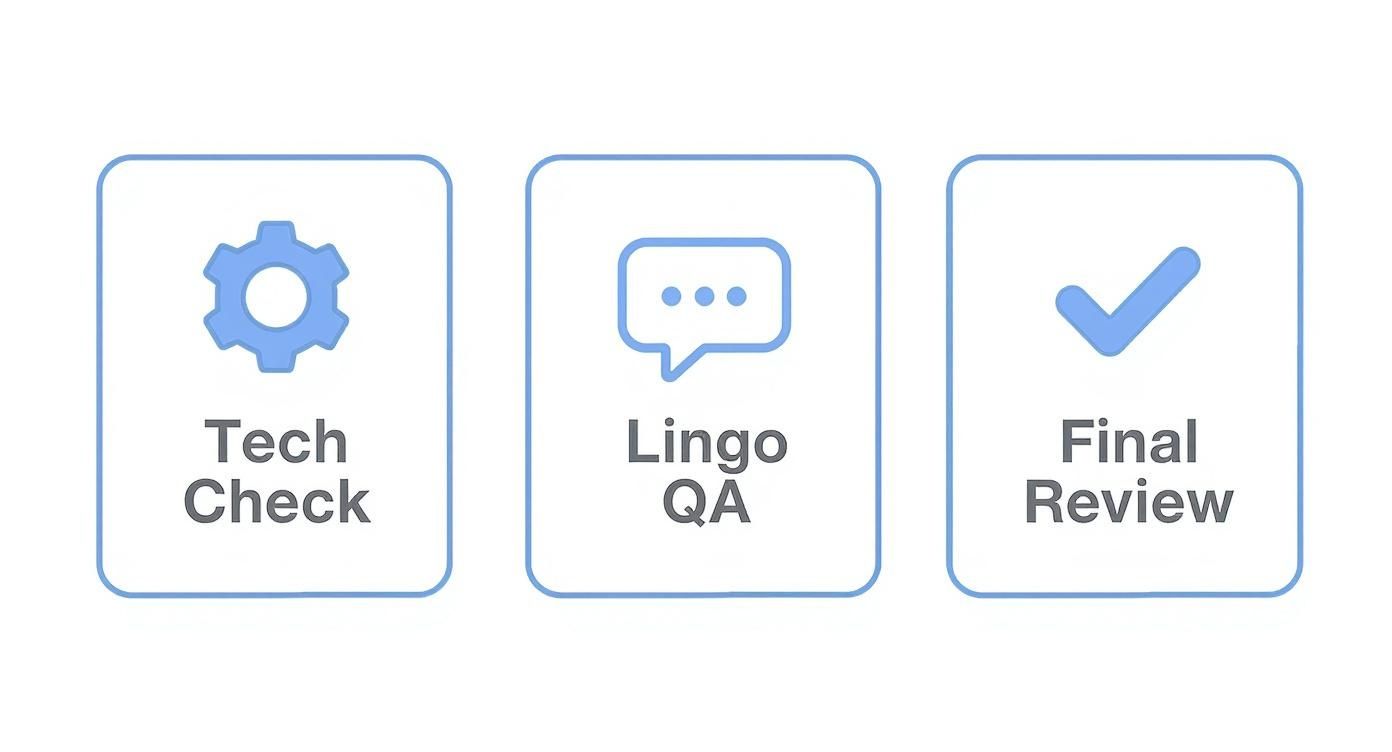
As you can see, a good workflow combines automated technical checks with that crucial human linguistic review before the final sign-off.
The Role of a Centralized Platform
Trying to connect all these moving parts is a lot easier with a centralized platform. Solutions like Aeon are built to be the hub for these automated workflows. By connecting your content creation, translation, and distribution tools into one system, you get a bird's-eye view of the entire process.
Instead of juggling multiple vendors and clunky tools, a unified platform gives you a single dashboard to track progress, manage assets, and keep your brand consistent across every language. This isn't just about being efficient; it's about maintaining control and quality when you're operating at scale.
By embedding a video subtitles translator directly into your core production pipeline, you fundamentally change what you're capable of. You go from a slow, manual slog to a fast, automated system that delivers multilingual content on day one—giving you a real competitive edge in every market you enter.
Common Questions About Video Subtitle Translators
Diving into automated translation for your videos? You're bound to have questions. As you start weaving a video subtitles translator into your production process, you'll hit specific roadblocks and forks in the road.
We’ve pulled together the most common questions we hear from creators just like you. Think of this as your practical guide for getting clear, no-nonsense answers, helping you sidestep those early pitfalls and make smarter choices from the get-go.
What Is the Most Accurate AI for Subtitle Translation?
This is the big question, but the honest answer is: there's no single "best" one. The right AI really depends on the languages you're working with and just how technical or nuanced your content is.
For example, DeepL has a fantastic reputation for its natural-sounding, context-aware translations, especially with European languages. On the other hand, Google Translate is the undisputed champion of sheer language support, making it invaluable if you're trying to reach smaller, more niche global audiences. And then you have Amazon Translate, which is a powerhouse for scalability and plugs beautifully into other cloud-based workflows.
My advice? Don't just take their word for it—run a small-scale test. Grab a representative sample of your video content, something with your unique industry jargon and brand voice, and translate it using each platform. This simple experiment will quickly show you which engine clicks with your content before you go all-in on a massive project.
How Should I Handle Idioms and Cultural References?
This is where the human touch becomes non-negotiable. This process, known as machine translation post-editing (MTPE), is absolutely critical for anything that isn't purely literal.
AI translators are notorious for taking idioms and cultural sayings at face value, which can lead to translations that are bizarre, confusing, or just plain funny. Imagine an AI literally translating "it's raining cats and dogs" into Spanish. Your audience would be completely lost.
The best way to tackle this is by creating a detailed 'localization brief' for your human editors. This document is their roadmap, flagging key cultural nuances, brand-specific terms, and any idioms from the original video that need a creative, not literal, translation.
With that brief in hand, your editors can perform transcreation. They won't just swap words; they'll find a culturally appropriate equivalent that captures the original spirit and emotional punch.
Can I Use YouTube's Automatic Translation Feature?
Let's be direct: while YouTube's built-in translation is a neat tool for casual viewers, its quality is all over the place. It's simply not reliable enough for professional or brand-centric content.
Sure, it offers a basic level of comprehension, but it’s riddled with awkward phrasing, grammatical errors, and a robotic tone that can seriously undermine your brand’s credibility.
For any marketing, educational, or official video content, you need a dedicated workflow. That means using a high-quality AI engine, getting a native speaker to meticulously review the output, and then manually uploading your polished SRT or VTT files to YouTube. It’s an extra step, but it gives you complete control over your message and ensures you look professional.
What Is the Difference Between Open and Closed Captions?
The real difference boils down to one thing: viewer control.
-
Closed Captions (CC): These are separate files (like an SRT or VTT) that are paired with your video. Viewers can choose to turn them on or off in the video player settings. This is the gold standard for platforms like YouTube and Vimeo, where user experience is key.
-
Open Captions: These are "burned" directly into the video frames themselves during editing. They become a permanent, unchangeable part of the visual. This approach has exploded in popularity on social media platforms like Instagram and TikTok, where videos often autoplay without sound.
If you want to get into the nitty-gritty, understanding what a subtitle is and its technical specs is a great foundation. Getting these basics right is crucial for deploying your translated content effectively, no matter where your audience is watching.
Ready to automate your video production and scale your content globally? Aeon transforms your existing text, audio, or video into engaging, on-brand videos with minimal effort. Discover how our platform can streamline your entire creation and localization pipeline. Explore Aeon today.