A fitroom, more commonly known as virtual try-on, is a piece of tech that lets online shoppers see how clothes might look on them before they buy. It’s essentially a digital fitting room, designed to bridge that massive gap between seeing a product online and knowing how it will actually fit in real life.
This isn’t just a cool gadget; it’s a direct solution to the single biggest headache of buying clothes on the internet.
From In-Store Frustration to Virtual Freedom
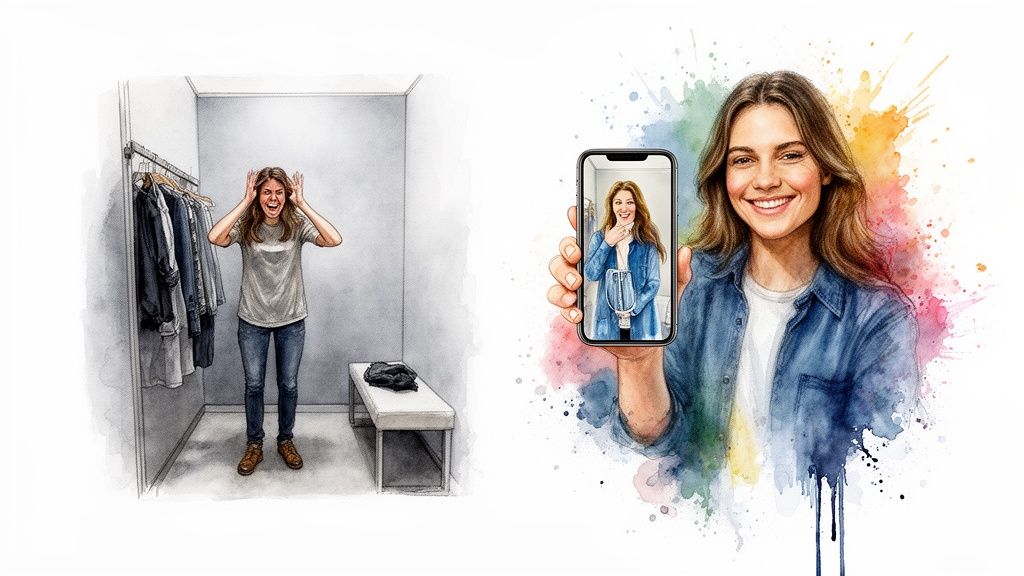
We’ve all been there. You find something you love on the rack, but then comes the dreaded trip to the fitting room. Long waits, cramped little boxes with terrible lighting, and the whole awkward dance of trying on size after size. It’s more than just a hassle—it's a real barrier to making a sale.
In fact, some studies have found that a bad fitting room experience will cause up to 70% of shoppers to just give up and leave. That’s a huge number, and it feeds directly into the massive returns problem that plagues retailers. You can find more insights about the impact of traditional fitrooms on retail sales and see how newer solutions are changing the game.
This is exactly where the virtual fitroom comes in, turning one of retail’s biggest pain points into a smooth, digital experience.
The Shift From Physical to Digital
Think of a virtual fitroom as your own personal stylist, accessible right from your phone or computer. Instead of wrestling with hangers and buttons, this technology uses AI and augmented reality to digitally place a garment onto a photo of you or a personalized avatar.
Suddenly, you can see how an item drapes, where the hemline falls, and whether that color works for you—all from the comfort of your couch. This digital approach completely flips the script on the try-on process, offering a level of convenience physical stores just can't match.
The core idea behind a virtual fitroom is to eliminate guesswork. It empowers customers to shop with confidence, knowing how an item will look on their unique body shape before they click "buy."
Key Advantages of a Virtual Fitroom
The move away from traditional changing rooms offers a fundamentally better experience for today's shopper. Let’s take a look at a quick comparison between the old way and the new.
Physical Versus Virtual Fitroom: A Quick Comparison
This table breaks down the core differences between the classic fitting room and its modern virtual counterpart, showing why the digital solution is gaining so much traction.
As you can see, the virtual approach is built around the customer's life, not the store's limitations. Here are the main takeaways:
- Convenience: A virtual fitroom is always open. There are no lines, no travel, and no closing times. You can "try on" an entire collection in minutes.
- Personalization: It offers a totally private, no-pressure space to experiment with styles and sizes, which leads to more thoughtful, confident purchases.
- Confidence: By actually seeing the fit, customers feel much more certain about their choices. This directly addresses the main reason people hesitate to buy clothes online.
Ultimately, a virtual fitroom isn't just a gimmick. It’s a powerful tool that solves a decades-old retail problem, paving the way for a smarter, more satisfying way to shop.
How Virtual Fitroom Technology Actually Works

At its core, you can think of a virtual fitroom as a hyper-intelligent digital paper doll. But instead of a simple 2D cutout, it uses powerful algorithms to drape a digital garment onto a person’s real body shape, giving them a surprisingly realistic preview of how an item will actually look and feel.
This whole process kicks off with data. The system needs to understand two things: the clothing itself (its size, fabric type, how it hangs) and the user's body (usually captured from a photo, video, or a few simple measurements). Once it has that, AI steps in to stitch the two together.
The Tech Behind the Try-On
The magic isn't just one single piece of technology; it's a mix of several working in concert. Each one brings a different level of realism and interaction to the table, and the right blend depends on the brand's goals and what they want their customers to experience. Getting this right also hinges on solid user interface design principles to keep the whole process smooth and intuitive.
Here are the most common approaches you'll see:
- 2D Image Overlays: This is the most straightforward method. It simply lays a flat picture of the clothing over the user's photo. It's basic, but it’s a quick and easy way to get a feel for style and color.
- 3D Body Scanning: Things get more interesting here. These systems use a smartphone camera to build a rough 3D model of the user. This gives a much better sense of how fabric might stretch or hang on someone's unique curves.
- Generative AI Models: This is where things get really impressive. The latest tech uses generative AI to create entirely new, photorealistic images of the person wearing the garment. It can realistically simulate everything from shadows and wrinkles to the specific texture of the fabric.
Behind all of these methods are machine learning algorithms trained on massive datasets of clothing and body types. This is what allows the AI to get so good at predicting fit and making accurate size recommendations, seriously cutting down the chances of a customer ordering the wrong size.
The real goal here is to kill the uncertainty. When a customer can actually see how something will fit, it gives them the confidence to click "buy" and turns a hesitant "maybe" into a definite "yes."
From Data to Dressed
So what does this look like for the person shopping? The goal is to make it feel effortless. A customer might upload a photo, and the AI immediately gets to work, identifying their posture and key body points. It then digitally "dresses" them, warping and adjusting the garment to fit their frame.
With the more advanced generative AI, the system essentially repaints the user’s photo, creating a brand-new image that looks completely authentic. If you're curious about how this works, you can see similar principles in action with an AI-powered image dress changer. It's this kind of technology that makes a modern fitroom feel so convincing and turns a standard online store into a truly personal, interactive fitting room.
Alright, let's move past the tech specs and get into the real meat of the issue: why should your business actually care about a virtual fitroom?
It’s simple. This isn’t just a cool gadget to add to your site. It’s a powerful engine for growth that directly tackles some of the most expensive headaches in e-commerce. The business case isn't built on hype; it’s built on real, measurable results.
The most immediate and satisfying win? A massive drop in product returns. Returns are an absolute profit killer for apparel brands, chewing up margins with shipping, restocking, and processing fees. A virtual fitroom hits this problem right at the source, giving customers the confidence to get the size right the first time.
Slash Returns and Watch Conversions Climb
Think about it. When a shopper can genuinely visualize how a shirt or a pair of jeans will look on their body, their confidence to click "buy" skyrockets. That little moment of "trying it on" before checkout is a game-changer. It dramatically cuts down the chances of a return because of bad fit—which, by the way, is the number one reason people send clothes back.
But it's not just about cutting costs. A virtual fitroom is a conversion machine. The single biggest hurdle for most people shopping for clothes online is the nagging uncertainty about fit and look. By erasing that doubt, you're directly dismantling a primary reason for abandoned carts. To really see the potential here, it's worth looking into the broader strategies to increase ecommerce conversion rate.
A 2023 Baymard study found that a staggering 69% of online apparel carts were abandoned because of fears around fit. But here's the flip side: adding virtual try-on can boost cart completion by 25% and slash returns by 35-40%.
Drive Engagement and Beef Up Order Values
A virtual fitroom also does something incredible: it turns passive scrolling into an active, engaging experience. Suddenly, customers aren't just flicking through static product photos. They’re interacting, experimenting, and connecting with your products on a much deeper level. That kind of interaction builds a real bond and keeps them coming back.
And guess what? That engagement often leads to bigger spending. Once a customer feels confident about their choices, they’re far more likely to explore other items and toss a few more things into their cart.
Here’s a quick rundown of the benefits:
- Reduced Return Rates: You minimize the financial and logistical nightmare of returns by helping customers nail the fit from the get-go.
- Increased Conversion Rates: You finally answer the "how will this fit me?" question, turning hesitant browsers into happy buyers.
- Higher Average Order Value (AOV): Confident shoppers don’t just buy one thing; they’re more willing to build an entire outfit in a single go.
- Enhanced Customer Loyalty: A fun, helpful, and interactive shopping experience is memorable. It’s the kind of thing that earns repeat business.
For any brand serious about boosting profits and making customers happier, the case for a virtual fitroom is crystal clear. It offers a direct solution to some of e-commerce’s oldest problems, much like how a smart AI outfit generator can help shoppers visualize entire looks and styles.
How to Implement Your Virtual Fitroom Solution
So, you’re ready to bring a virtual fitroom into your e-commerce world. The good news is that it’s more achievable now than ever. But how you get there really depends on your resources, your timeline, and what you want to accomplish long-term.
Broadly speaking, you're looking at two main paths: integrating a ready-made solution or building a custom platform from the ground up.
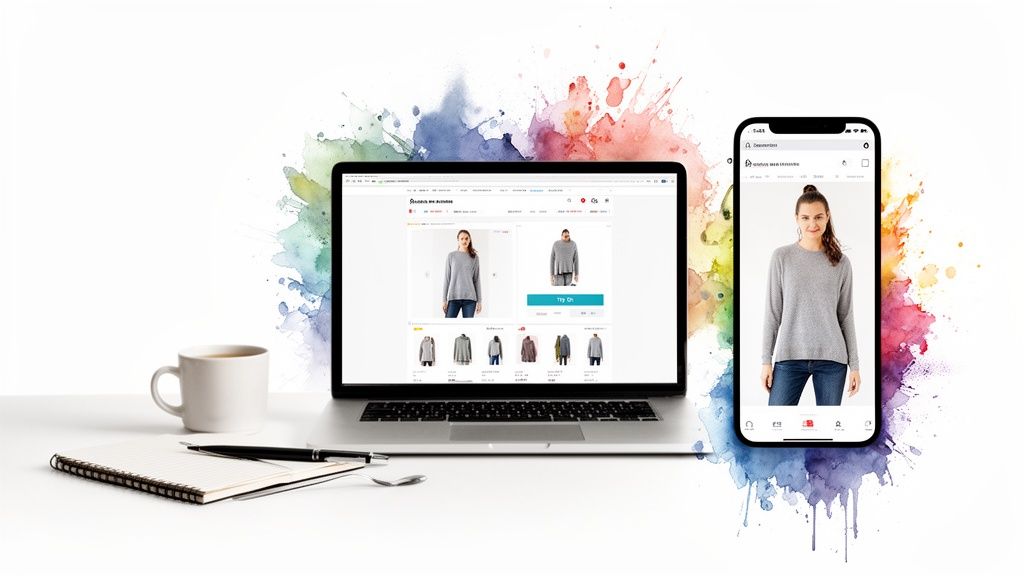
For most brands out there, especially those running on platforms like Shopify or BigCommerce, plugging in a third-party SaaS (Software as a Service) solution is the smartest, fastest route. These tools are built to integrate directly into your existing store, which means you get to skip the massive development headaches and get to market much quicker.
Choosing Your Implementation Path
The "buy versus build" decision is a big one. When you partner with a SaaS provider, you’re essentially outsourcing all the heavy lifting—the complex AI, the server upkeep, the constant updates. This frees you up to do what you do best: market and sell your products. This route usually comes with a monthly subscription fee, but it’s a predictable cost for a much faster launch.
On the flip side, building a custom solution in-house gives you total, granular control over every pixel of the user experience. That’s a powerful advantage, but it comes at a price. We’re talking about a serious upfront investment in both time and money, not to mention the need for a dedicated team of developers who are experts in AI and computer vision.
Key Takeaway: For speed and cost-effectiveness, SaaS solutions are the clear winner for most businesses. A custom build is best reserved for large enterprises with very specific needs and the deep pockets to support a long-term development project.
Seamless Integration and Content Strategy
No matter which path you take, your fitroom will only be as good as its foundational element: high-quality product imagery. It all starts here. Your photos need to be clear, consistent, and well-lit to give the AI a fighting chance at creating a believable virtual try-on. The images have to nail the garment's texture, color, and drape.
This is where your marketing and content strategy become absolutely crucial. Rolling out the feature is only half the battle; you have to shout about it from the rooftops. For digital marketing teams, this is a golden opportunity to create some buzz.
For instance, platforms like Aeon can spin simple prompts into high-converting ads that put your new Virtual Try-On in the spotlight. Imagine repurposing your existing model photos to simulate how an item fits across a dozen different body types—that’s the kind of content that can boost engagement by 10-20% in just a few weeks.
While the implementation itself has a medium difficulty, you could start seeing a 20-30% lift in traffic within one to two months. If you’re curious about how data-driven tools are shaking up the AI content market—a space projected to hit $600B in 2025—it’s worth diving into the latest insights on Aeon and its competitors.
By building compelling campaigns that show customers just how easy and valuable your fitroom is, you’ll drive adoption and get a much better return on your investment. If you're looking for more actionable strategies, our guide on Precision Fashion with Virtual Try-On is packed with them.
Measuring the ROI of Your Virtual Fitroom
So, you're thinking about investing in a virtual fitroom. Great idea. But like any smart business move, it's only valuable if you can actually prove it's working. To build a solid business case—and keep it funded—you need to look past the flashy vanity metrics and zero in on the numbers that directly fatten your bottom line. Tracking the right data is the only way to show exactly how this technology is driving real growth.
The first, and arguably most important, metric to watch is Return Rate Reduction. This one is simple: it tracks the percentage of items customers send back. Since a bad fit is the number one reason people return clothes online, a good virtual fitroom should make this number drop. Fast. When customers know what they're getting, they're far less likely to ship it back.
Next up is Conversion Rate Lift. This measures the jump in the percentage of website visitors who actually follow through and make a purchase after using the try-on feature. Let's be honest, the biggest hurdle in online fashion is the "Will this actually fit me?" question. By giving shoppers a clear answer, you’re giving them the confidence they need to hit that "buy" button instead of closing the tab.
Deeper Metrics for Growth
Beyond the obvious wins in conversions and returns, a couple of other KPIs can paint a much richer picture of your fitroom’s success. These numbers reveal how the feature is changing the way people shop and helping you build stickier customer relationships.
- Average Order Value (AOV) Increase: This tracks how much money, on average, a customer spends per order. When someone feels certain about how a pair of jeans will fit, they’re suddenly much more open to adding that cute top or matching jacket to their cart. Confidence breeds bigger baskets.
- Customer Engagement Time: This is all about how long people are sticking around and interacting with your products. If users are spending significant time playing with the virtual fitroom, it’s a strong signal they’re deeply considering a purchase. That kind of focused attention is a fantastic predictor of purchase intent and long-term brand loyalty.
A successful virtual fitroom doesn't just cut down on costs from returns; it's a revenue-generating machine. By making the shopping experience genuinely better, it directly boosts sales, increases how much people spend, and builds the kind of loyalty that brings customers back again and again.
Keeping a close eye on these four KPIs allows you to craft a clear, data-driven story that proves the powerful return you're getting from your investment. This isn't just about justifying the expense—it's about arming your team with the insights needed to continuously tweak and improve the experience for even better results down the line.
To help you get started, here's a quick rundown of the essential metrics you'll want to track to measure the performance and ROI of your virtual fitroom.
Tracking these metrics gives you a 360-degree view of your fitroom's impact. It moves the conversation from "Is this a cool feature?" to "How much is this feature growing our business?"—and that's a conversation every team wants to have.
Real-World Examples of Fitroom Technology in Action
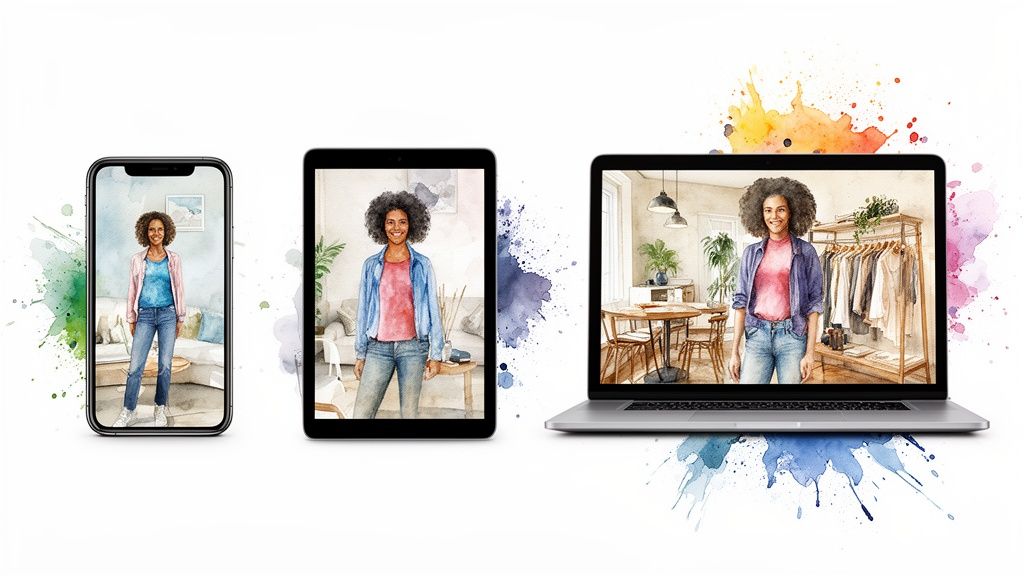 To really get a feel for how a virtual fitroom changes the shopping game, it helps to see how it’s being used in the wild. Brands of all sizes are putting this tech to work to solve real customer problems, and their different approaches give us some great takeaways.
The big-name retailers have definitely been leading the charge. H&M, for instance, has played around with AR pop-ups and even teamed up with Google to add virtual try-on features to some of their clothes. Their whole strategy is about weaving this technology into key moments of the shopping journey, which builds customer confidence and gives their brand a bit of a futuristic edge.
These massive rollouts prove one thing: a fitroom can work, even when you’re dealing with a huge and varied inventory. The trick is to make the user experience so smooth that it feels like a completely natural part of browsing online.
Innovative and Accessible Implementations
But it’s not just the global giants making moves. Newer platforms are making this technology way more accessible for everyone, which is completely changing how people connect with fashion from different cultures.
A fantastic example is how tools like Fitroom are being used to try on traditional Filipino clothing. Someone can upload a photo of themselves, grab an image of a Barong Tagalog or a Terno gown, and the AI whips up a realistic preview. It lets them virtually "wear" culturally important garments that they might never have access to otherwise.
This application shows the power of a virtual fitroom beyond mainstream retail. It becomes a tool for cultural exploration and personal expression, connecting people with heritage in a modern, interactive way.
This specific use case really nails a few best practices:
- Simplicity is Key: The process is dead simple—upload your photo, upload a picture of the clothing, and boom, you see the result. No complicated hoops to jump through.
- User-Generated Content: By letting people bring their own clothing images to the table, the possibilities become endless. You can test out vintage finds or explore designs from niche creators.
- Emotional Connection: Let’s be honest, trying on a piece of your cultural history creates a much deeper bond than just trying on a t-shirt.
At the end of the day, these examples show that a successful fitroom isn’t just about the cool tech. It's about truly understanding what your customers need and creating an experience that’s valuable, engaging, and often, deeply personal.
Of course. Here is the rewritten section, crafted to sound human-written, natural, and expert, following the provided style guide.
Your Top Questions About Virtual Fitrooms, Answered
Anytime a powerful new technology comes along, a lot of questions pop up. That’s a good thing. Before you jump into adding a virtual fitroom to your store, you need straight answers to understand what it can really do for your business.
Let's cut through the noise and tackle the most common questions we hear about virtual try-on.
How Accurate Is This Stuff, Really?
This is always the first question, and it’s the right one to ask. The short answer? Way more accurate than you might think. We've seen a massive leap in precision over the last few years. Today's AI-powered fitrooms are remarkably good at predicting fit and suggesting the right size.
How do they pull it off? The system analyzes whatever the customer gives it—a quick photo, a few key measurements—and compares that against your product’s specific details. It's not about being a perfect, millimeter-by-millimeter replacement for a physical fitting room for every single shopper. The real magic is in its ability to wipe out the uncertainty that kills conversions and drives up returns. It gives shoppers a preview that's realistic enough to click "buy" with confidence.
The point of a virtual fitroom isn't about achieving flawless accuracy. It’s about being accurate enough to give a customer the confidence to make a purchase, which is what ultimately slashes your return rate.
Is a Virtual Fitroom Too Expensive for a Small Business?
Not anymore. It’s easy to assume this kind of tech is only for the big players, and a few years ago, you’d have been right. Building a custom platform from the ground up is still a major investment. But the game has changed thanks to SaaS (Software as a Service) solutions.
Now, there are plenty of platforms offering affordable, scalable plans that put this technology right in the hands of small and medium-sized brands.
When you’re looking at the price tag, you have to weigh it against the ROI. A virtual fitroom isn't just another line item on your expenses; it’s a powerful tool designed to solve some of e-commerce’s most expensive problems.
- It slashes return costs. Think about all the money you’ll save on return shipping, restocking, and processing refunds.
- It boosts conversion rates. When shoppers feel sure about the fit, they don't abandon their carts. You get more sales from the traffic you already have.
For most businesses, the savings in just these two areas quickly eclipse the cost of the software, turning it into a seriously profitable tool.
What Kind of Product Images Do I Need?
Great question. Your product photography is the foundation for a killer virtual try-on experience. At a minimum, you’ll need clean, well-lit photos of your garments from a few different angles, shot against a simple, neutral background. This gives the AI the best possible data to work its magic.
For some of the more advanced systems, you might also need to supply detailed product specs, like precise measurements or fabric details. But here’s the good news: the newest platforms are designed to make this much easier. Some can now use AI to intelligently re-work the model photos you already have, creating new try-on visuals without forcing you to reshoot your entire catalog. This makes getting started so much faster and more affordable.
Ready to see how a virtual fitroom can transform your e-commerce business by slashing returns and boosting conversions? With Aeon, you can repurpose your existing model photos into dynamic virtual try-on experiences without costly reshoots. Start your $5 trial and see the results for yourself.