
When you hear the term video distribution center, you might picture a massive warehouse stacked with servers. The reality is much more sophisticated—and thankfully, less physical.
A video distribution center is a digital ecosystem, the command hub for the entire lifecycle of your video content. It’s the engine that automates how you ingest, manage, prepare, and ultimately deliver every video asset across all your channels.
What Is a Modern Video Distribution Center?
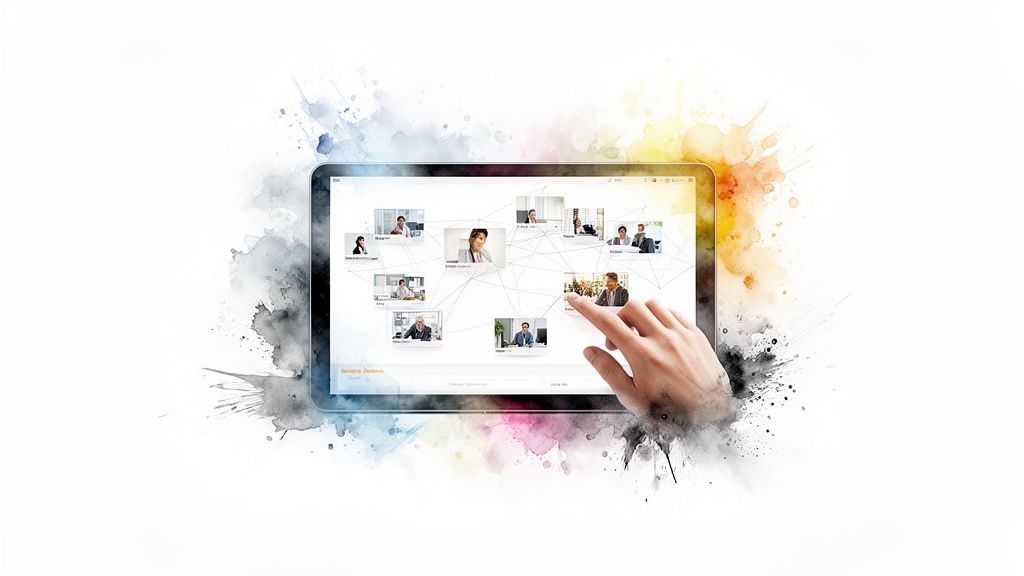
Imagine trying to run a global shipping empire from a messy, disorganized warehouse. Boxes are unlabeled, inventory is all over the place, and getting a single package out the door requires a dozen manual steps. It sounds like a nightmare, right?
For many marketing and e-commerce teams, that’s exactly what managing video feels like. You have files scattered across different drives, multiple versions for various platforms, and no single source of truth. It's organized chaos.
A modern video distribution center is the cure for this content chaos. It's a powerful software ecosystem built to handle everything from raw footage to global delivery, turning that messy warehouse into a smart, automated command center for your entire video strategy.
From Content Chaos to Centralized Control
The biggest problem a video distribution center solves is fragmentation. Without a central hub, teams are stuck patching together different tools and manual workflows. A video gets created by one team, edited by another, and then someone has to manually upload it to YouTube, Instagram, TikTok, and the company website.
This process isn't just slow; it's practically begging for errors and is impossible to scale.
A centralized hub completely flips this dynamic. It gives you a single, organized environment to:
- Ingest and Manage: All your raw video files and finished assets are uploaded and stored in one secure, easy-to-access location. No more hunting for the "final_final_v3.mp4" file.
- Prepare and Transcode: The system automatically converts your videos into the perfect formats, resolutions, and aspect ratios for every single destination—whether it's a 9:16 vertical video for Reels or a 16:9 for your website.
- Distribute and Publish: You can push content out to social media, your CMS, ad networks, and other platforms right on schedule, without the manual grunt work.
- Analyze and Optimize: Performance data from every channel flows back into one place, giving you a clear, unified view of what’s actually working.
By replacing scattered files and manual uploads with a single source of truth, a video distribution center empowers teams to execute a more efficient and impactful multi-channel video strategy.
More Than Just Storage
It’s easy to mistake a video distribution center for just a fancy cloud storage system, but that misses the point entirely. Its real value isn't in housing your assets—it's in its active, operational role.
A simple cloud drive just stores files. A video distribution center processes them.
Think of it as the engine that powers your entire content pipeline. It transforms static assets into active, dynamic components of your marketing campaigns. This fundamental shift from passive storage to active management is what allows teams to move faster, lock in brand consistency, and ultimately drive much better results from their video content.
What’s Under the Hood of a Video Distribution Center?
To really get why a video distribution center is such a game-changer, you have to look under the hood. While the tech behind it is incredibly complex, the whole operation is built on four core pillars that work in perfect sync.
Don't think of it as a single piece of software. It’s more like a high-tech logistics hub designed from the ground up to handle digital video.
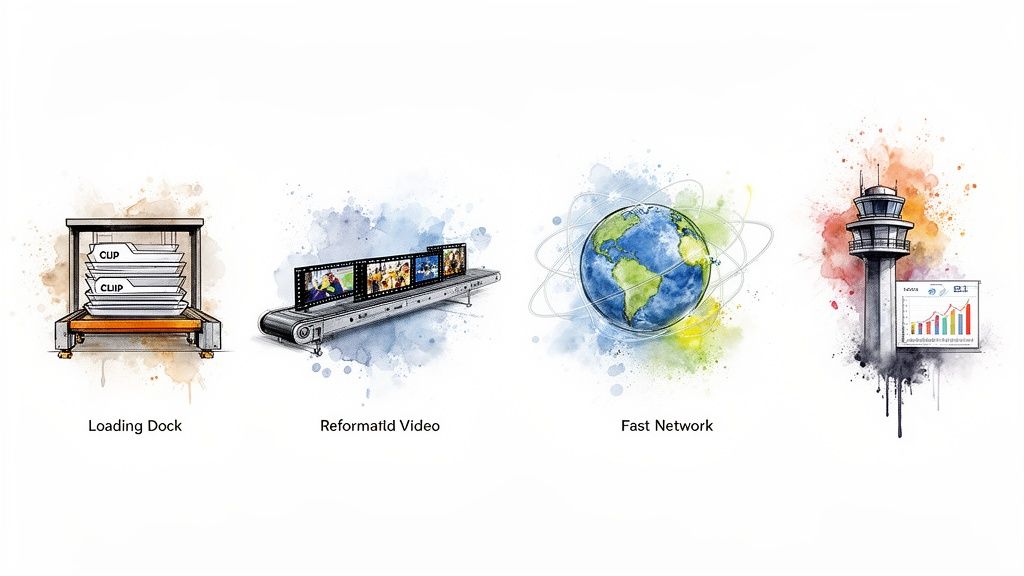
Each of these components handles a critical stage of a video's journey. Together, they turn a raw file into a flawless viewing experience for anyone, on any device, anywhere in the world. It’s an automated workflow that makes sure your content always hits the mark.
To make this tangible, let's break down the four essential pillars of a video distribution center. Each one serves a distinct purpose, moving your content from a simple file on a drive to a monetizable asset reaching a global audience.
Core Components of a Video Distribution Center
These four pillars work together to create a seamless, automated pipeline. It’s a system that not only saves countless hours but also unlocks the true potential of your video strategy.
1. Ingestion and Management: The Loading Dock
Every video's journey starts at Ingestion and Management. Think of this as the digital loading dock where all your video assets arrive. It's a secure, centralized library that holds everything—from raw camera footage and final edits to thumbnails and subtitle files.
No more hunting through messy shared drives or endless email threads. Your team gets one organized, searchable hub for every piece of video content. This is also where metadata—the crucial data tags that make your assets easy to find, categorize, and manage—is handled.
2. Transcoding and Packaging: The Factory Floor
Once a video is in the system, it heads to the factory floor: Transcoding and Packaging. Here's the thing: a single high-resolution video file isn't a one-size-fits-all solution. Someone watching on a 4K smart TV needs a completely different file than someone on a smartphone with a spotty connection.
Transcoding is the process of creating multiple versions of that video, each one perfectly optimized for different screen sizes, resolutions, and internet speeds. If you want to get into the technical weeds, you can learn more about what video encoding is and how it powers this step. The bottom line? This automated process ensures a flawless, buffer-free stream for every viewer.
A modern video distribution center handles this entirely behind the scenes. Your team uploads one master file, and the system automatically generates every necessary variation.
3. CDN Integration: The Global Transport Network
With your video properly packaged, it’s time for delivery. This is where Content Delivery Network (CDN) integration is absolutely critical. A CDN isn't just one server; it's a massive, distributed network of servers strategically placed all over the world.
When a viewer hits play, the video is streamed from the server that's geographically closest to them, not from some distant, central location. This simple difference dramatically cuts down on latency and load times, which is non-negotiable for keeping an audience hooked. After all, poor streaming quality is a top reason viewers bounce—a staggering 40% of consumers will abandon a video if it takes too long to load.
4. Analytics and Monetization: The Control Tower
The final pillar is the control tower: Analytics and Monetization. This is where you see what's working, what isn't, and what the return on your investment really looks like. The system pulls performance data from every single place your video lives—social media, your website, third-party apps—and brings it all into one unified dashboard.
From here, you can track all the key performance indicators (KPIs) that matter:
- View counts and watch time: How many people are watching and for how long.
- Audience retention: The ability to pinpoint the exact moments viewers are dropping off.
- Engagement metrics: The likes, shares, comments, and click-through rates that show audience connection.
- Conversion data: A clear line from video views to actual business results like sales or sign-ups.
This component also plugs directly into ad systems. For publishers, understanding tools like dynamic ad insertion is key to personalizing ad experiences and delivering relevant commercials to specific audience segments, maximizing revenue potential.
Automating Your Video Workflow From Creation to Delivery
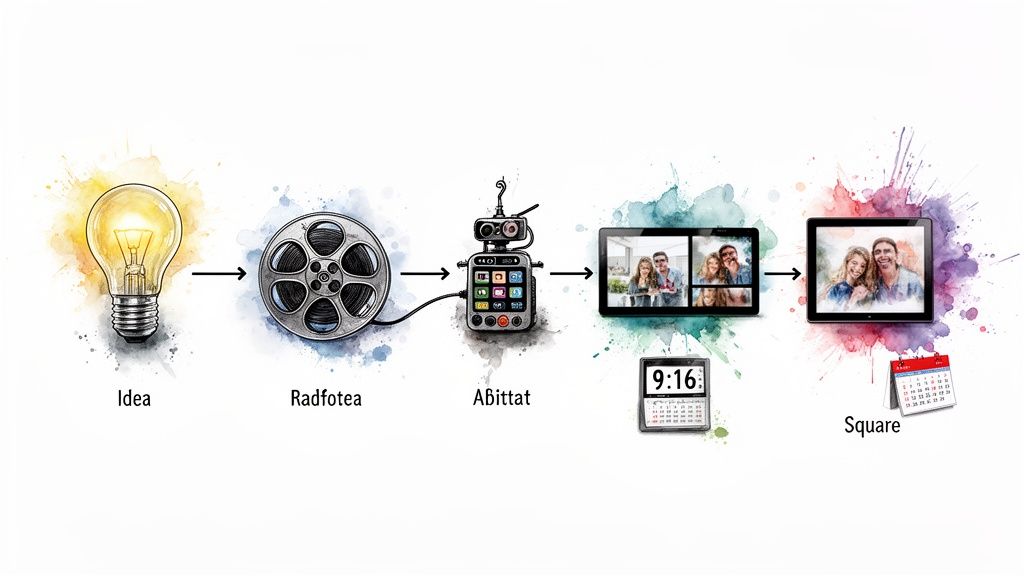
Let's be honest: manual workflows are the biggest roadblock in modern video production. The journey from a great idea to a published video is often a tangled mess of disjointed steps, endless emails, and clunky file transfers. It kills momentum and drains your team's creative energy.
To get ahead, you need an automated pipeline that seamlessly connects content creation all the way through to delivery.
This is where the magic happens when you pair AI creation tools with a video distribution center. Think about it: you could generate a high-quality product demo or a killer social media ad in minutes, not days. With the right AI, a simple text prompt can become a polished, on-brand video that’s ready to go.
But that automated creation is just the first step. The real breakthrough happens when those new videos flow directly into your distribution hub, triggering a hands-off sequence that takes care of everything else.
From Generation to Global Reach, Instantly
Once an AI-generated video is finished, it’s automatically pulled into the video distribution center. From that moment on, the system takes over all the complex, repetitive tasks that used to eat up hours of your team’s time.
The heavy lifting happens behind the scenes. The platform preps the video for every single channel in your network, ensuring you get maximum impact and reach without anyone having to lift a finger.
Here’s a quick look at what that automated sequence does:
- Intelligent Metadata Tagging: The system analyzes the video's content and automatically adds relevant keywords, descriptions, and tags. This is a game-changer for discoverability and keeping your asset library organized.
- Automated Versioning: It instantly creates multiple versions tailored to specific platforms. That single 16:9 widescreen video is immediately repurposed into a 9:16 vertical clip for TikTok, a 1:1 square for Instagram, and any other format you need.
- Scheduled Publishing: The system syncs with your content calendar and schedules each version to go live on the right channel at the perfect time for audience engagement.
This hands-off approach transforms what was a multi-day manual slog into an automated workflow that’s done in minutes. It smooths out the process, gets rid of human error, and frees up your team to focus on big-picture strategy instead of tedious logistics.
The Power of an End-to-End Pipeline
By connecting these pieces, you create a powerful, end-to-end video pipeline. You solve the production bottleneck with fast AI creation and then demolish the distribution bottleneck with automated processing and publishing.
For marketing teams, this means launching campaigns faster and jumping on market trends in near real-time. For e-commerce brands, it means getting new product videos out across all your sales channels almost instantly.
The bottom line? You get a more agile, scalable, and efficient video operation that drives real business results.
Why Centralized Distribution Is a Game Changer
Let's be clear: adopting a video distribution center isn't just about getting organized. It’s about fundamentally changing how your entire business operates. The benefits ripple out far beyond a clean asset library, creating tangible results that hit your efficiency, brand integrity, and ultimately, your bottom line.
Think of it as the difference between managing a fleet of delivery trucks with individual, outdated maps versus coordinating them from a single, intelligent control tower.
This central hub creates huge efficiency gains, which means faster campaign launches and lower operational costs. Instead of your teams burning hours on soul-crushing manual tasks—uploading, reformatting, scheduling, repeat—the system just handles it. In a market that moves at the speed of a viral tweet, that kind of speed is a massive competitive advantage.
And this operational agility is non-negotiable today. Streaming services have completely rewired how content reaches audiences, now capturing a staggering 44.8% of all television usage as of June 2024. The global video streaming market hit $108.50 billion in 2024 and is on track to jump to $137.70 billion by 2027. These numbers don't just show a trend; they scream how critical efficient, scalable video delivery has become. You can dive deeper into these video streaming statistics to see what they mean for creators.
Achieving Absolute Brand Consistency
Without a central hub, brand consistency is a losing battle. You’ve seen it happen: different teams in different regions using old logos, the wrong video templates, or off-brand messaging. Each time it happens, it dilutes your brand's impact. A video distribution center puts a stop to this by becoming the single source of truth for every video asset.
When everyone pulls from the same approved library, you can finally guarantee that every single video published is:
- On-Brand: Using the correct, up-to-the-minute logos, fonts, and brand colors.
- Legally Compliant: Ensuring only licensed music and fully-cleared assets are in the mix.
- Message-Aligned: Reflecting the most current campaign messaging and company values.
This level of control eliminates the brand fragmentation that plagues so many growing companies. It ensures you project a cohesive, professional image across every single touchpoint, from your homepage to your TikTok feed.
A video distribution center acts as your brand’s guardian, enforcing consistency at scale and ensuring every piece of content strengthens your brand identity instead of weakening it.
Unifying Analytics for a Clearer Picture
Maybe the most powerful benefit of all is the shift from fragmented data to unified intelligence. When your videos are scattered across countless platforms, so are your analytics. You're left trying to stitch together messy reports from YouTube, Instagram, and your own website, making it nearly impossible to see the big picture.
A centralized system brings all that performance data into a single, clean dashboard.
This finally allows you to measure what actually matters and prove the value of your video strategy. You can track everything from high-level engagement down to granular conversion metrics, giving you a clear, actionable view of your video performance and its direct impact on business growth.
Scaling Your Global Reach with the Right Infrastructure
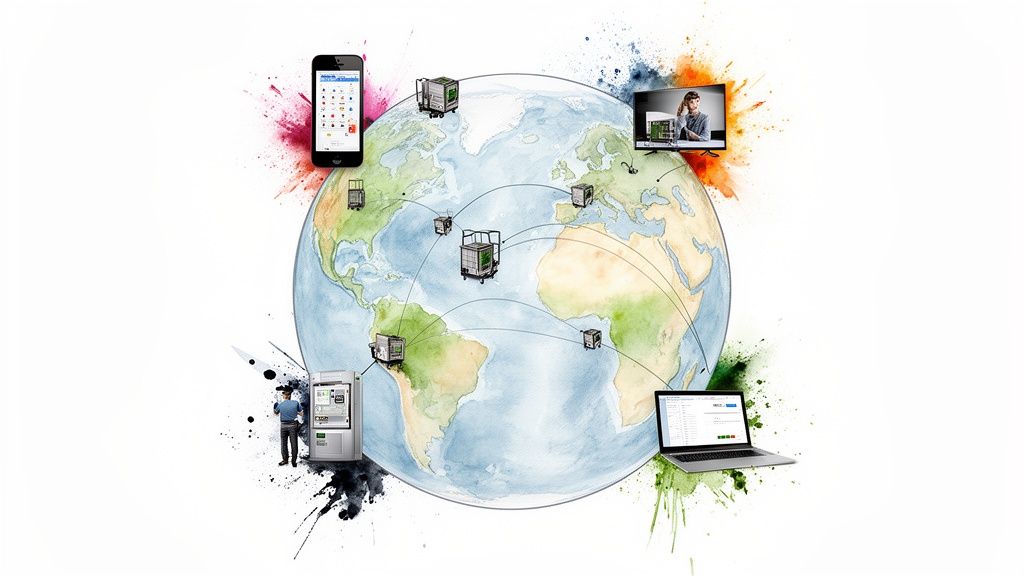
When your brand has its sights set on international markets, a video distribution center isn't just a nice-to-have—it's an absolute necessity. Trying to stream high-quality video across the globe without one is like trying to send a package from New York to Tokyo with a local bike courier. It’s going to be slow, unreliable, and ultimately, it's going to fail.
The internet feels borderless, but it isn't a single, uniform cloud. It’s a physical network of cables and servers, and over long distances, physics gets in the way. That physical distance creates a delay we call latency, and it's the number one killer of global video performance. A viewer in Sydney trying to watch a video hosted on a server in London will be met with endless buffering and agonizingly slow load times. That's a terrible user experience.
Overcoming Global Delivery Hurdles
This is exactly the problem a well-designed video distribution hub, powered by a global Content Delivery Network (CDN), is built to solve. Instead of pulling your video from a single, distant server, a CDN smartly caches (or stores) copies of your videos on servers strategically dotted all over the world.
So, when a viewer hits play, the content is streamed from the server that's geographically closest to them. This simple but powerful shift makes a world of difference:
- Latency vanishes. With content just around the corner, load times become lightning-fast, and playback is smooth and buffer-free.
- Reliability skyrockets. If one server has an issue, traffic is automatically rerouted to the next closest one, keeping your video online.
- Scaling is effortless. CDNs are designed to handle massive traffic spikes, so as your audience grows, your infrastructure scales right alongside it.
A well-architected video distribution center turns a global audience from a logistical nightmare into a competitive advantage by ensuring every viewer gets a flawless, high-speed experience.
Beyond pure speed, a centralized hub helps you tackle the tricky parts of going global, like regional compliance and content localization. From a single dashboard, you can manage different video versions with unique subtitles, voice-overs, and even content edits for specific regions. To see how this works, check out our guide on using a video subtitles translator to automate localization.
Tapping into a Massive Market Opportunity
This kind of setup lets you compete on a truly global stage. To do it right, you need serious infrastructure with enough horsepower to handle the load; looking into unmetered bandwidth dedicated server solutions can be a game-changer for scaling up.
The opportunity is staggering. The movie and video distribution industry is already a global beast, operating across 195 countries. The video streaming slice of that pie, valued at $277.25 billion in 2026, is predicted to explode to $885.95 billion by 2036, all thanks to surging demand for live and personalized content. You can dig into the numbers behind this explosive growth on MarketResearch.com. This trend makes one thing clear: the brands that build the right infrastructure now will be the ones to capture this massive, growing audience.
Connecting AI Creation with Your Distribution Strategy
A video distribution center is a powerful engine, but an engine needs fuel. No matter how sophisticated your delivery system is, it can only distribute the videos you actually create.
For most marketing and e-commerce teams, the real roadblock isn't getting content out there—it's producing enough high-quality video to feed the machine in the first place. This is exactly where AI creation tools come in, forming the missing link for a truly modern video pipeline.
Imagine you could generate a whole series of platform-ready product ads or social promos in minutes, just by typing a few lines of text. This isn't science fiction anymore. Tools like Aeon’s Quick Ad Maker are built to solve that production headache, letting you instantly create polished, high-converting assets on demand.
Building an End-to-End Automated Pipeline
The real magic happens when those AI-generated videos flow directly into your video distribution center. This creates a seamless, hands-off workflow that manages everything from the initial idea to global delivery without anyone needing to click a single button.
Once an AI-produced video lands in the hub, the system instantly gets to work:
- Platform Versioning: It automatically chops up and reformats the video into vertical clips for TikTok, square versions for the Instagram feed, and traditional widescreen cuts for YouTube.
- Intelligent Tagging: The system watches the video, understands the content, and applies all the right metadata, making your assets perfectly organized and easy to find later.
- Scheduled Delivery: It pushes every version to the right social channel or platform, perfectly timed according to your content calendar.
This integration turns two separate, clunky processes into one fluid system. When you solve the content creation bottleneck with AI, you finally unlock the true power of your video distribution center. You can launch campaigns faster, test more ideas, and scale your strategy without burning out your team.
This unified approach just gets rid of the friction, freeing up your team to think about big-picture strategy instead of getting bogged down in tedious production and logistical tasks.
If you're just getting started and want to see how this works from the ground up, our guide on how to create AI video is the perfect place to begin.
Frequently Asked Questions
Jumping into the world of video infrastructure can feel like learning a new language. We get it. To help clear things up, we've tackled some of the most common questions we hear from content teams trying to make sense of it all.
What Is the Difference Between a DAM, a CMS, and a Video Distribution Center?
It's easy to get these mixed up because they often work together, but they play very different roles on the team.
Think of a Digital Asset Manager (DAM) as your digital library—a central, organized place to store all your media files, from images and logos to PDFs and audio clips. A Content Management System (CMS), like WordPress or Drupal, is what you use to actually publish content, like articles and images, onto a specific website.
A video distribution center, on the other hand, is the active, specialized powerhouse built for the entire video journey. It’s not just a storage closet; it’s an automated assembly line that handles everything from ingestion and transcoding to pushing your video out to every platform and tracking its performance. It often plugs into both a DAM (to pull raw files) and a CMS (to embed the final video player).
Can Small Businesses Benefit from a Video Distribution Center?
Absolutely. Don't let the "enterprise" sound of the name fool you. At its core, this is all about making your life easier and your video strategy smarter.
For a small business, even a simplified platform can be a game-changer. It can automate the tedious process of uploading the same video to YouTube, Facebook, and your own website. Just as importantly, it pulls all the performance data back into one place.
This saves an incredible amount of time—often the most valuable resource a small team has. It also ensures your branding stays consistent everywhere and gives you the hard data needed to figure out what's working and what's not. That’s how small businesses punch above their weight.
It's a common myth that this kind of tech is only for massive corporations. The truth is, the automation and unified analytics can give the biggest competitive edge to resource-strapped teams trying to scale their video.
How Does AI Impact Video Distribution?
AI is like a massive shot of adrenaline for your entire video workflow, from the first idea to the final view.
During creation, AI can spin up entire videos from a simple text prompt. When it comes to managing your content, it can automatically generate descriptive tags, create shockingly accurate subtitles, and even snip out killer highlight reels from a long webinar. You can say goodbye to hours of manual work.
For distribution, AI gets even smarter. It can optimize delivery by picking the fastest CDN path for a viewer in real-time or personalize which ads they see. This level of intelligent automation dramatically boosts the speed, scale, and effectiveness of any video strategy. It's the only way to create and share content at the pace today's audiences demand.
Ready to connect AI creation with a powerful distribution strategy? Aeon gives you the tools to generate high-quality, on-brand video ads in minutes and build a seamless, automated content pipeline. Start creating faster by visiting https://www.project-aeon.com.