Picture a digital narrator with a flawless British accent—not a stilted robot, but something more like a seasoned voice actor. That's the magic of modern British text to speech (TTS). This isn't just about reading words aloud; it's about using AI to turn text into incredibly realistic audio, capturing all the subtle rhythms and tones of British English.
What Is British Text to Speech and Why It Matters Now
At its heart, British text to speech is a specialized kind of voice synthesis designed to generate audio with a distinctly British accent. It's less a computer reciting lines and more an AI performer interpreting a script. We all remember the robotic, clunky TTS voices of the past, but huge leaps in neural network technology have changed the game entirely. Today's systems can create voices so natural they're often impossible to tell apart from a human speaker.
This jump in quality has made TTS an essential tool for publishers, marketers, and any creator trying to connect with a specific audience. An authentic voice just feels more trustworthy and professional. It’s a strategic choice that can completely change how your brand comes across.
The Strategic Advantage of an Authentic Voice
Choosing a genuine-sounding British accent is more than just a stylistic flourish; it’s a smart business move. For any company aiming at the UK or Commonwealth markets, a local accent immediately feels more familiar and credible. This simple act of localization can drive up engagement, improve brand recall, and even boost conversions.
Just think about the effect on your video content:
- Enhanced Trust: A familiar accent makes your message feel more genuine, which is absolutely critical for explainer videos, product demos, or any educational material.
- Improved Engagement: Let's face it, people are far more likely to stick with a video that sounds natural and polished. High-quality audio keeps their focus where you want it: on your message.
- Brand Personality: The voice you choose is a huge part of your brand's identity. A refined British voice can project authority, sophistication, or a friendly, approachable vibe—it all depends on the style you pick.
When you use a voice that connects culturally, you're not just reading words. You're communicating intent and building a real connection with your audience. It's a subtle but powerful detail that makes your content stand out.
Scaling Content Production Like Never Before
Maybe the biggest win here is scalability. In the past, creating high-quality voiceovers was a huge bottleneck. It meant hiring voice actors, booking studio time, and getting stuck in endless feedback loops. It was slow and expensive.
Modern British text to speech platforms, like Aeon, flip that script entirely. You can now generate professional-grade voiceovers in a matter of minutes, not days, and for a tiny fraction of the cost. This incredible speed allows content teams to produce and test different video variations at a scale that was once unthinkable. It unlocks massive opportunities for A/B testing, rapid content localization, and quick-turnaround marketing campaigns. This isn't just a small step forward; it's a fundamental change in how video gets made.
Choosing the Right British AI Voice for Your Brand
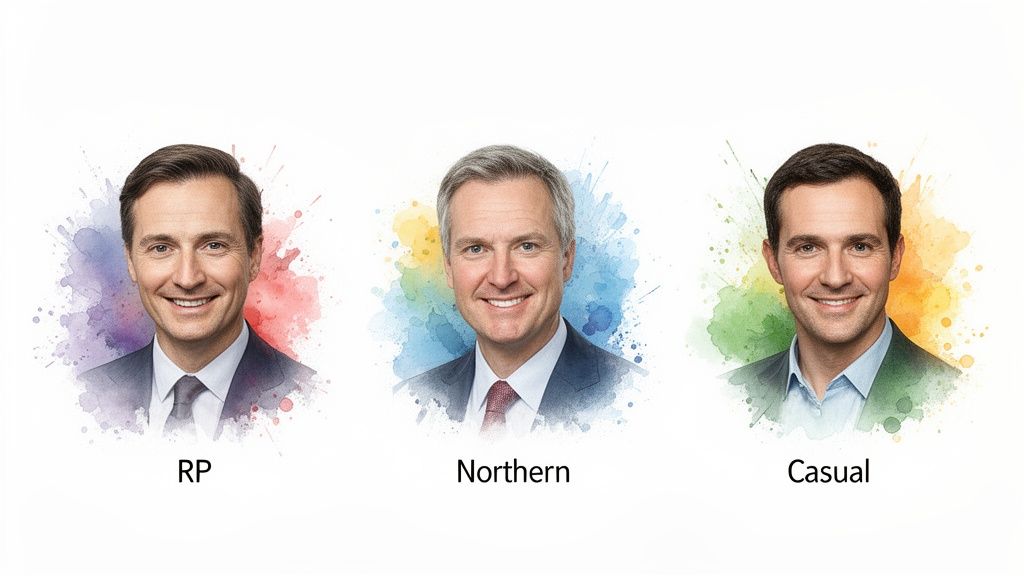
Picking a British text to speech voice isn't just about finding one that's clear. Think of it more like casting an actor for a lead role—the voice you choose becomes the sonic signature of your brand. The idea of a single "British accent" is a total myth. The UK is a vibrant tapestry of dialects, and each one comes loaded with its own unique personality and social vibe.
Your first move should be to sync the voice with your brand's DNA. Are you an established financial firm that needs to project authority and trust? Or are you a fresh e-commerce startup trying to sound friendly, young, and relatable? The right accent can telegraph these qualities in an instant, long before your script gets to the point.
Matching Voice Style to Content Context
The kind of content you’re making is just as crucial as your brand identity. A formal, authoritative voice that’s perfect for a corporate training video would feel completely jarring in a fun social media ad. The trick is to match the vocal tone to what your audience expects from that specific format.
Let's break it down with a few common scenarios:
- For Educational Content: A voice with crisp diction and a steady pace, like Received Pronunciation (RP), is often your best bet. This accent is widely understood and carries a natural air of authority, making it perfect for documentaries or complex explainer videos where clarity is king.
- For Marketing and Ads: Something warmer and more conversational, like a modern Estuary or a soft Northern accent, can feel far more authentic and approachable. This helps dissolve the barrier between you and your audience, making your brand feel less like a corporation and more like a friend.
- For Internal Communications: For company-wide announcements or training modules, a friendly, standard British voice can foster a sense of unity and professionalism, making sure the message lands clearly and consistently.
A brand’s voice is its personality made audible. Choosing an AI voice that aligns with your brand's values doesn’t just make your content sound better—it makes it more effective by building an immediate, subconscious connection with the listener.
The Evolution from Tool to Asset
Being able to make these kinds of strategic choices is a fairly new game. By the late 2010s, British-accented TTS had transformed from a niche accessibility tool into a mainstream marketing asset. This was all thanks to neural models that could finally rival human naturalness.
Google's Tacotron 2 system, for example, hit a Mean Opinion Score that was statistically identical to professional human narration. This leap in quality was a huge deal in the UK, a market of over 67 million people. As publishers started scaling up their video content, neural TTS allowed them to slash voiceover costs by 60-80% and compress production timelines from days into mere minutes—a massive advantage in the fast-paced digital world.
This progress gives creators much deeper creative control. You can now design unique AI character voices that are perfectly tuned for storytelling or immersive brand experiences. And beyond just picking the voice, it's worth exploring the different ways to use AI in your marketing to get a competitive edge. At the end of the day, the goal is to choose a voice that doesn't just deliver your message, but reinforces your brand's identity with every single word.
Mastering Narration with SSML for British Accents
So, you've picked the perfect British text-to-speech voice. That's a great start. But just pasting your script into the engine is like handing a world-class actor a script with no direction. You'll get a decent performance, but you're leaving so much potential on the table.
To get that truly professional, polished narration, you need to step into the director's chair. This is where Speech Synthesis Markup Language (SSML) comes in.
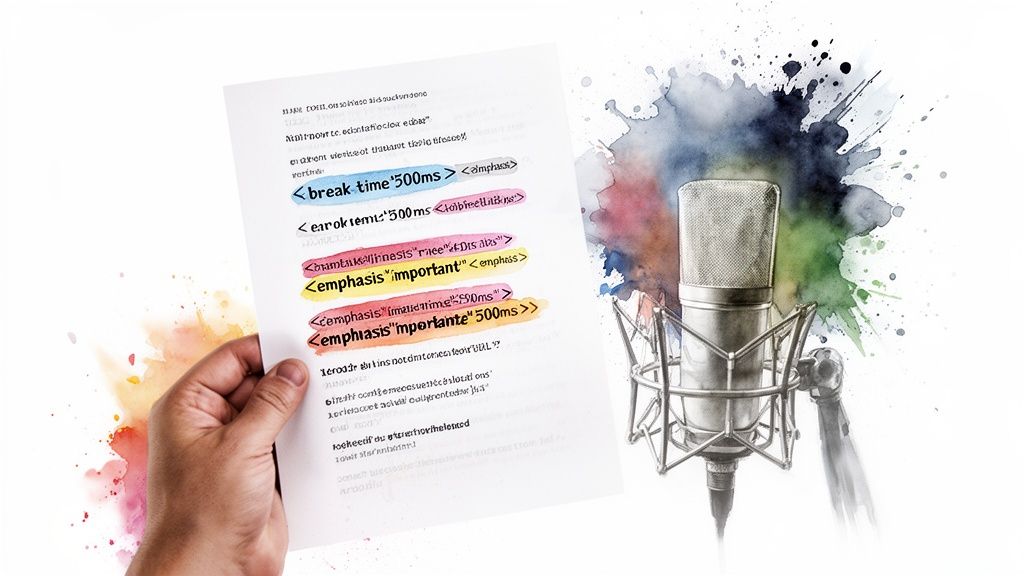
Think of SSML as the secret set of stage directions for your AI voice. It’s a simple but powerful markup language that works behind the scenes, giving you granular control over how the text is spoken. Instead of accepting the default delivery, you can use SSML to control pacing, add dramatic pauses, tweak the volume, and even nail the pronunciation of those notoriously tricky words.
This is what separates a good voiceover from a great one. It's the key to syncing your narration flawlessly with on-screen visuals, creating a final product that feels intentional, compelling, and expertly crafted.
The Director's Toolkit: Key SSML Tags
Don't worry, you don't need a degree in computer science to get the hang of SSML. The whole system is built on a handful of intuitive tags that you simply wrap around your text. Even learning a few of these can radically improve the quality of your British text to speech audio.
Let's look at some of the most powerful tools in your new toolkit:
<break>for Pacing: This tag inserts a pause. You can be incredibly specific, setting the length in seconds or milliseconds (like<break time="500ms"/>). It’s perfect for letting a point sink in or building a little suspense before a big reveal. It’s how you give the narration a natural, human-like rhythm.<emphasis>for Impact: Need a specific word or phrase to stand out? This is your tag. You can set the level to "strong" or "moderate" to subtly guide the listener's attention exactly where you want it.<prosody>for Fine-Tuning: This is the ultimate control panel for rate, pitch, and volume. Want to slow things down for a complex explanation or raise the pitch to convey excitement?<prosody>is your go-to.
With SSML, you're not just a scriptwriter anymore; you're a vocal director. You get to shape the cadence and flow of every single sentence, making sure the AI's delivery hits all the right emotional and informational beats for your video.
Practical SSML for British Accents
While these tags are universal, they become especially useful when you're tailoring a voice to sound authentically British. The nuances of British English—from quirky regional pronunciations to specific terminology—can all be managed with a bit of clever SSML.
A classic example is UK place names. A standard TTS engine might trip over "Leicester" or "Worcestershire." But by using the <phoneme> tag, you can provide the exact phonetic spelling, guaranteeing it's pronounced correctly every single time.
Here’s a quick look at how you can clean up a sentence for a British voiceover:
Our journey begins in Leicester, a city with a rich history. Now, let's look at the numbers.See what we did there? We fixed the pronunciation of "Leicester," added some punch to the word "rich," and popped in a one-second pause to let the opening statement land. It’s this attention to detail that elevates your audio from robotic to realistic. If you want to dive even deeper, our guide on how to explore text to speech emotion to enhance digital voices is packed with more advanced techniques.
Common SSML Tags for British Voiceovers
To help you hit the ground running, we've put together a quick reference guide to the most essential SSML tags. These examples are specifically geared toward creating natural-sounding British narration.
By folding these simple SSML commands into your workflow on platforms like Aeon, you unlock an incredible amount of creative control. This allows you to produce British text to speech voiceovers that aren't just clear and accurate, but also emotionally engaging and perfectly timed to your video content.
Weaving British TTS into Your Video Workflow
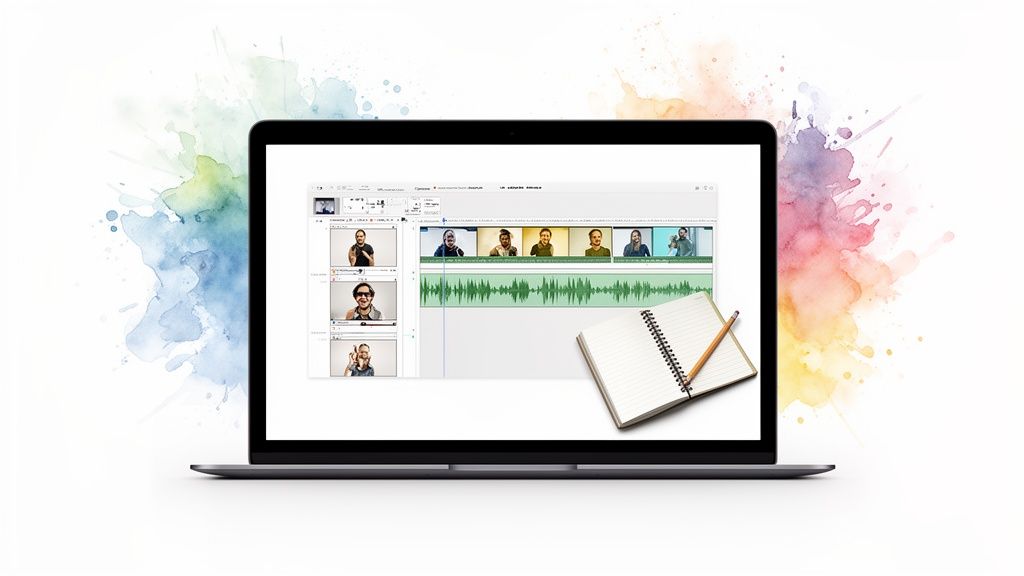
Making the most of British text to speech goes way beyond just clicking a button to generate an audio file. The real magic happens when you build a repeatable process that saves you time and actually makes your videos better. Think of it like setting up a production line just for your voiceovers. A solid workflow turns what was a manual, one-off headache into a scalable system that pumps out top-notch results every time.
This whole process gets started long before you hit "generate." It all begins with the script.
Writing for an AI voice is a bit different than writing for a human. Sentences need to be crystal clear, concise, and structured with natural pauses in mind. Steer clear of complicated clauses that might sound robotic when read aloud. A great tip is to read your script out loud yourself—you'll immediately catch any clunky phrasing.
The Script-to-Screen Process
A well-defined workflow is your best defense against mistakes, ensuring every video hits a high standard of quality. It lays out a clear path from that first spark of an idea to the final published video, making your whole operation run smoother.
Here's a simple but incredibly effective four-step process you can start using today:
- Script and Refine: Write your script specifically for an audio performance. Chop up long sentences, use straightforward language, and don't be afraid to add little notes for tone, like "(upbeat)" or "(serious)."
- Generate and Review: Pop your script into your TTS platform and generate the first draft of the audio. Listen back carefully. Pay close attention to the pacing, the rhythm, and any words that sound a little off.
- Synchronize and Edit: Now, pull that audio file into your video editing software. This is where you line up the narration with your on-screen visuals, cutting scenes to perfectly match the timing of the voiceover.
- Test and Optimize: Before you hit publish, get some fresh ears on it. Does the voice fit the visuals? Does the message really connect? Use this feedback to tweak your script or SSML for the next round of videos.
By following these steps, you create a feedback loop that constantly improves your work. Every video becomes a chance to learn and get better at telling compelling stories with AI voices. For a deeper dive, our guide on using text to speech for videos has more detailed strategies for getting that synchronization just right.
A-B Testing for Audience Resonance
One of the biggest perks of using British text to speech is the ability to test out different vocal styles without breaking the bank. You're no longer stuck with a single voice actor. This opens up some fantastic opportunities for data-driven decisions.
For instance, you could pit a formal RP accent against a more casual Northern one for a product explainer video aimed at a UK audience. Run both versions as separate ads and keep an eye on key metrics like watch time, click-through rate, and conversions.
You might just find that one accent connects far better with a particular demographic, giving you priceless insights that can shape your entire content strategy. This kind of rapid, low-cost testing was simply out of the question with traditional voiceover production.
Rapid Localization for Global Reach
This workflow is also a total game-changer for localizing your content. Let's say you have a killer marketing video with a standard American accent that's doing great. With TTS, you can spin up a British English version in a matter of minutes, not weeks.
This lets you quickly and affordably adapt your content for different English-speaking markets like the UK, Australia, or New Zealand. By localizing the voice, you make your content feel more authentic and trustworthy, which can give your engagement and performance a serious boost.
This agility helps your brand connect more deeply with international audiences, all without the logistical nightmare of juggling multiple voice actors across different time zones. As you work British TTS into your video process, exploring the best AI tools for content creation can help you fine-tune your entire production pipeline. It’s a strategic move that ensures your message isn't just heard, but truly felt, no matter where your audience is.
Comparing AI British Voices to Human Narration
Deciding between an advanced British text to speech voice and a professional human narrator can feel like a major crossroads for your video strategy. This isn't just about picking technology over a person; it's a strategic call that ripples through your budget, production timelines, and even your brand's personality.
Both paths have their strengths. AI voices bring incredible speed and efficiency to the table, while human narrators offer an emotional depth that can be crucial for certain projects. The right choice really comes down to what you're trying to achieve.
Speed and Scalability: The AI Advantage
The biggest game-changer is speed. It’s that simple. With a platform like Aeon, you can go from a finished script to a professional-sounding British voiceover in a matter of minutes. This completely changes the game for content teams, letting them create, test, and publish videos at a pace that was unimaginable with a traditional workflow.
Let’s get practical. Say you need to create a batch of 50 short product explainer videos.
With AI, the process is straightforward: finalize the scripts, generate all 50 voiceovers in less than an hour, and move right into syncing them with your visuals.
The old way? You’d be juggling auditions, booking studio time, sitting through recording sessions, and then dealing with rounds of edits for every single video. The whole thing could easily stretch out for weeks. For any content that needs to be timely—news updates, social media clips, e-commerce ads—AI is the only logical choice.
Cost Efficiency and ROI
The numbers tell an even clearer story. Hiring a pro voice actor means talent fees, studio rentals, and sometimes complex buyout clauses. That can add up to hundreds, if not thousands, of dollars for a single project. Need a few small changes? That's another invoice.
Modern British text to speech tools flip the script. You get access to a whole library of voices for a predictable subscription fee, which can slash your voiceover costs by 70-80% or more. Those are serious savings that you can pour back into other creative parts of your strategy.
For the vast majority of digital content—from internal training to marketing videos—today’s AI voices deliver a fantastic user experience at a fraction of the cost.
The Human Touch: Emotional Nuance
So, where do human narrators shine? In delivering deep, complex emotion. For that one huge brand anthem video or a deeply personal story, the subtle tones and genuine feeling in a human voice can forge a connection that AI is still learning to master.
A talented voice actor doesn't just read a script; they interpret it. They bring their own experiences to the performance, adding a layer of authenticity that can be priceless for projects designed to build your brand’s identity or evoke a strong emotional response.
Making the Right Call
In the end, this isn't an "either/or" situation. Smart content teams are already using both. They rely on AI voices as the workhorse for the 95% of content that needs to be produced quickly and affordably. Then, they bring in human talent for those special, high-impact projects where that emotional connection is everything.
To help you decide where your next project falls, here’s a quick breakdown of how the two stack up.
AI British TTS vs Human Voice Actors
A comparative analysis to help you decide which voice solution best fits your video production needs.
By thinking of AI and human narration as complementary tools in your creative kit, you can build a more flexible, powerful, and efficient video strategy.
Got Questions About British TTS? We Have Answers.
Jumping into the world of British text-to-speech can bring up a lot of questions. As this technology becomes a bigger part of modern content creation, it's only natural for marketing and production teams to want a clear picture of what’s possible.
To help you get your bearings, we've put together answers to some of the most common questions we hear. Think of this as a quick-reference guide to cut through the noise and clarify what you need to know when bringing AI voices into your workflow.
How Realistic Are Modern British AI Voices?
Honestly? They're stunningly realistic. We're now at a point where modern neural British text-to-speech voices are often nearly indistinguishable from a human speaker. The days of robotic, monotone delivery are long gone.
Today's best AI models have been trained on massive datasets of human speech, which lets them master the subtle nuances of intonation, rhythm, and natural cadence that make British English sound so authentic. This leap in quality is all thanks to neural networks that can analyze and replicate the incredibly complex patterns of how people actually talk. The tech now captures the tiny pauses, shifts in pitch, and emphasis that make a voice feel genuine and engaging. For your audience, that means a more professional and trustworthy experience.
What this means for your content is huge. You can now confidently use AI voices for all sorts of high-stakes video projects—from detailed product explainers to polished marketing campaigns—without ever worrying about sacrificing quality. You get a voiceover that not only delivers your message clearly but also builds a real connection with your audience.
Can I Customize the Accent and Style of a British TTS Voice?
Absolutely. Customization is one of the most powerful features of modern TTS platforms. You are by no means stuck with a single "standard" British accent. This flexibility is what allows you to perfectly match the voiceover to your brand's personality and the specific vibe of your video.
Think of it like having a digital voice-casting agency at your fingertips. Reputable platforms give you a whole library of voices to choose from, letting you select:
- Regional Accents: Pick from a range of options, whether you need the formal authority of Received Pronunciation (RP), the warmth of a Northern accent, or the modern, relatable feel of Estuary English.
- Gender and Age: Choose male or female voices that sound young, middle-aged, or mature to perfectly align with your target demographic.
- Speaking Styles: Find voices that are naturally energetic and upbeat for commercials, or calm and measured for instructional videos.
But it doesn't stop there. Beyond just picking a voice, you can direct its performance using SSML (Speech Synthesis Markup Language). This gives you incredible control to fine-tune the delivery, letting you adjust the speaking rate, pitch, and volume. You can even add emphasis to key words, ensuring the narration perfectly complements your brand and message.
What Are the Main Cost and Time Savings of Using British TTS?
The efficiency gains here are a game-changer for content teams. Let's be real: the traditional process of hiring a human voice actor is slow and expensive. You're dealing with talent fees, studio time, and revision cycles that can drag on for days. A single project can easily run you hundreds of dollars.
AI-powered TTS completely flips that script. The audio is generated almost instantly, delivering massive improvements in both cost and speed.
On average, teams can reduce their voiceover costs by over 70% and slash production timelines from days down to mere minutes. This isn't just a small improvement; it's a fundamental shift in how you can produce content.
For teams creating content at scale, this is a massive advantage. It allows you to create, test, and localize videos at a pace that was simply impossible before. That rapid turnaround time dramatically improves your ROI and allows for a much more agile and responsive content strategy.
Are There Legal or Licensing Restrictions I Need to Know About?
This is a critical point, and the good news is that professional TTS platforms are designed to make licensing simple and clear for commercial use. Your subscription typically grants you all the necessary rights to use the generated audio in your video content, as laid out in the platform's terms of service.
This model gets rid of the headaches of negotiating individual contracts, usage rights, and buyout clauses with voice actors. It gives you a predictable legal framework so you can publish your content with confidence.
That said, it’s always smart to review the specific terms of your chosen provider. Reputable services like Aeon are built from the ground up to ensure your content is fully compliant for business purposes, whether you're creating ads, social media videos, or internal training materials. This peace of mind lets your team focus on being creative, not getting bogged down in legal paperwork.
Ready to create stunning videos with authentic British narration in minutes? Aeon gives your team the power to produce high-quality, scalable video content with AI voices that captivate your audience. Discover how Aeon can transform your video workflow today.