Your product photos are your brand’s silent salespeople. Before a customer reads a single word of your description, they've already made a judgment based on your clothes pictures. Think of them less as a catalog expense and more as a direct driver of revenue.
Why Better Clothes Pictures Drive E-Commerce Growth
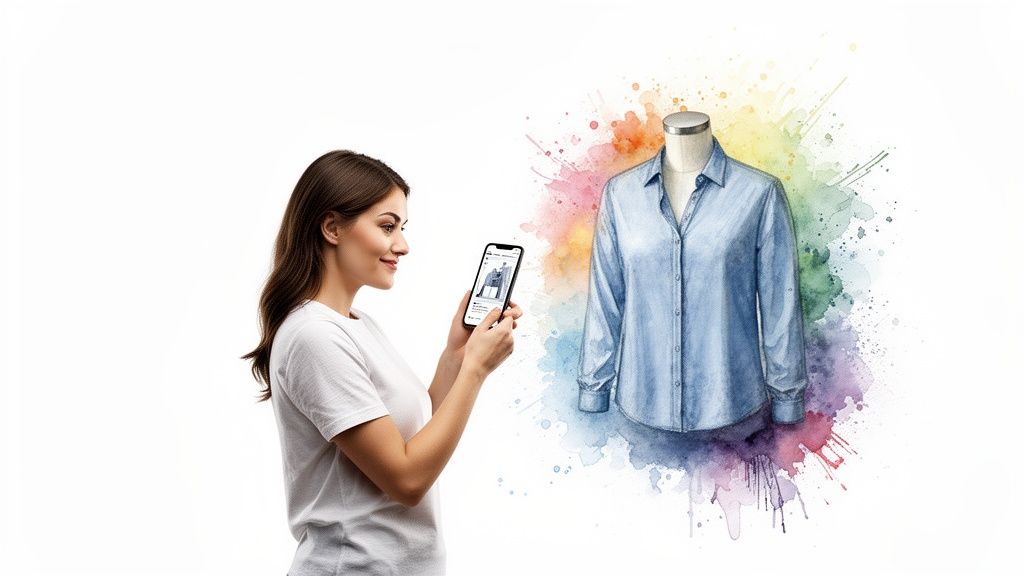
Let's get one thing straight: photos aren't just website filler. In e-commerce, your images are the product until it arrives at the customer's door. Shoppers are making split-second decisions based on the detail, color accuracy, and styling they see on their high-resolution screens. An investment in better photography is a direct investment in your bottom line.
The Psychology of Visual Commerce
We process images far faster than text, which means your clothes pictures make that critical first impression. In milliseconds, a potential buyer is subconsciously assessing the quality of your garment, the trustworthiness of your brand, and your overall identity. That snap judgment determines if they stick around or bounce to a competitor.
The data backs this up. We've seen brands with studio-quality visuals boost their conversion rates by up to 30%. It makes sense—shoppers want photorealistic shots that help them imagine the outfit on themselves. When the online store is the only storefront, it’s those flawless clothes pictures that lock in 94% of purchasing decisions.
Your product photos aren't just showing an item; they are selling a feeling, a lifestyle, and a promise of quality. They have to bridge the gap between looking at a screen and the real-world experience of touching and trying on a garment.
The Tangible Business Impact
Great photography doesn’t just boost sales; it has a direct impact on your operational health. One of the biggest wins? A significant drop in product returns.
When customers can clearly see fabric texture, stitching details, and true-to-life color, their confidence soars. They know what they’re getting, which means fewer surprises (and disappointments) upon delivery. This directly cuts your return processing costs and keeps your customers happy.
For any brand selling online, mastering visual presentation is non-negotiable. Whether you're doing competitive research or just trying to stay ahead, knowing how to download images from websites for e-commerce can be a useful skill for analyzing market trends. It helps you see what your competitors are doing right and what makes their top-performing images so effective. Your goal is to build a visual catalog that not only looks incredible but also works overtime to turn browsers into buyers.
Planning Your Photoshoot for Flawless Results
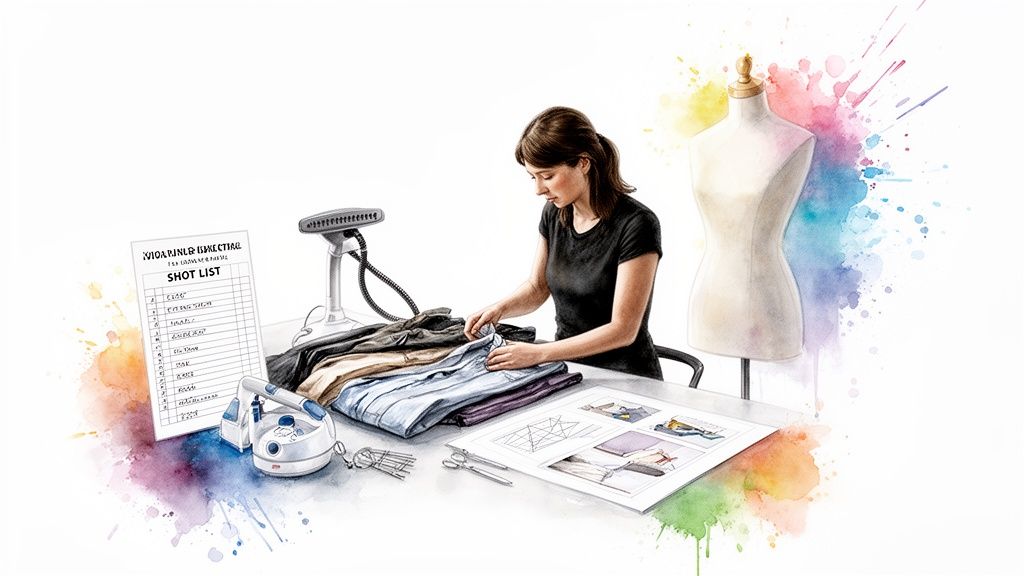
The best clothes pictures never just happen. They’re the result of careful, meticulous planning that starts long before anyone even thinks about picking up a camera. This prep work is the secret sauce, the strategic blueprint that turns a potentially chaotic day on set into a smooth, productive session that delivers exactly what you need.
It all starts with a rock-solid shot list. And no, I don't mean a simple checklist of products. Think of it as a strategic document—your photoshoot bible. It should map out every single image you need, from the essential e-commerce product shots to the dynamic lifestyle photos destined for your Instagram feed.
Crafting a Strategic Shot List
Your shot list needs to get granular. For every single garment, you should detail the specific angles and details required to tell its full story. You'll always need the basics: front, back, and side views. But don't forget to get up close and personal with what makes each piece special, like the texture of the fabric, custom buttons, or unique stitching.
Beyond that, consider the narrative. Do you need to capture the way a skirt flows when in motion? Or perhaps a few beautifully styled flat lays for your email newsletter? Mapping this out for every product is the only way to guarantee a complete and visually consistent catalog.
Here are a few of the non-negotiable shots you should have on your list for every item:
- Full-Length Views: Get the entire garment on your model or mannequin from the front, back, and a three-quarter angle. This is your foundation.
- Detail Shots: Zoom in. Show off the quality textures, intricate embroidery, unique buttons, or sturdy zippers. These are the shots that build trust and justify the price tag.
- Styled Outfits: Don't just sell a shirt; sell an outfit. Showing your product as part of a complete look gives customers inspiration and is a fantastic way to encourage upselling.
- Contextual Shots: If you're shooting an athletic jacket, get it into an active environment. Help your customers see themselves using the product in their own lives.
Selecting the Right Representation
The decision between using a live model or a mannequin is a big one, and it says a lot about your brand. A model breathes life and personality into your clothes pictures, helping customers connect emotionally and visualize themselves in the apparel. Of course, this route comes with added costs for talent, hair, and makeup. If you do go with a model, their posing is everything. You can find some fantastic guidance on modeling poses for western dresses to make sure you’re conveying the right vibe.
Mannequins, on the other hand, are a clean, consistent, and budget-friendly alternative. The "ghost mannequin" technique—where the mannequin is edited out in post-production—is incredibly popular for creating a uniform, product-focused look that highlights the garment's true fit and silhouette.
This isn't just about logistics; it’s a core branding decision. A model creates a human connection, while a mannequin offers a pristine, distraction-free presentation. The right choice is the one that aligns with your brand’s identity and the kind of shopping experience you want your customers to have.
Finally, don't ever underestimate the power of great on-set styling. A steamer is non-negotiable—wrinkles look unprofessional and are a huge distraction. Keep pins and clips on hand to make sure every garment fits the model or mannequin perfectly, getting rid of any awkward bunching or sagging. When you're aiming for flawless clothes pictures that actually sell, every last detail counts.
Essential Gear and Lighting for Perfect Clothes Pictures
Let’s get one thing straight: you don’t need the most expensive equipment to create stunning clothes pictures. What you do need is a solid understanding of which tools give you the most control over the final image. While a modern smartphone can get you surprisingly far, a dedicated camera is still the undisputed champ for professional results.
The real difference-maker is the sensor size and your lens options. A DSLR or mirrorless camera with a larger sensor simply captures more light and detail, which is crucial for showing off fabric textures and the quality of the stitching. More importantly, it gives you full manual control over aperture, shutter speed, and ISO, allowing you to adapt to any lighting scenario.
The big push for high-quality digital images really took off after 2010 with better smartphone cameras, but the pandemic was the true catalyst. As brick-and-mortar stores closed, it drove 58% of consumers to demand a shopping experience that blended in-store detail with online convenience. Suddenly, pro-level photos weren't just a nice-to-have; they were essential.
Choosing Your Camera and Lens
If you’re building your kit, start with a 50mm prime lens. There's a reason photographers call it the "nifty fifty." It provides a field of view that’s very close to what the human eye sees, which means your clothing will have natural, true-to-life proportions. You won't get the weird distortion that wider lenses can sometimes create. It’s an affordable and incredibly versatile workhorse for both on-model and flat-lay photography.
Once you have the budget, adding a macro lens to your bag is a game-changer. It lets you get incredibly close to the product to capture those fine details that scream quality—think the unique weave of a denim jacket or the pearlescent finish on a button.
Don't feel like you need to break the bank. You can find plenty of practical and affordable product photography tips that prove technique often trumps the price tag on your gear.
Mastering Your Lighting Setup
Lighting isn't just an element of photography; it's the element. It’s what sculpts the garment, defines its shape, and guarantees the color you capture is the color your customer receives. Bad lighting can make a premium product look cheap, but great lighting can make even a basic t-shirt look like a must-have item.
Your goal, almost every time, is to create soft, diffused light. This is the kind of light that wraps gently around the product, minimizing harsh shadows and illuminating the entire piece evenly.
You can get this beautiful, soft light in a couple of ways:
- Natural Light: Find a large window and set up near it, preferably on a slightly overcast day. You want to avoid direct, harsh sunlight at all costs—it creates ugly shadows and can completely wash out the colors of your clothes.
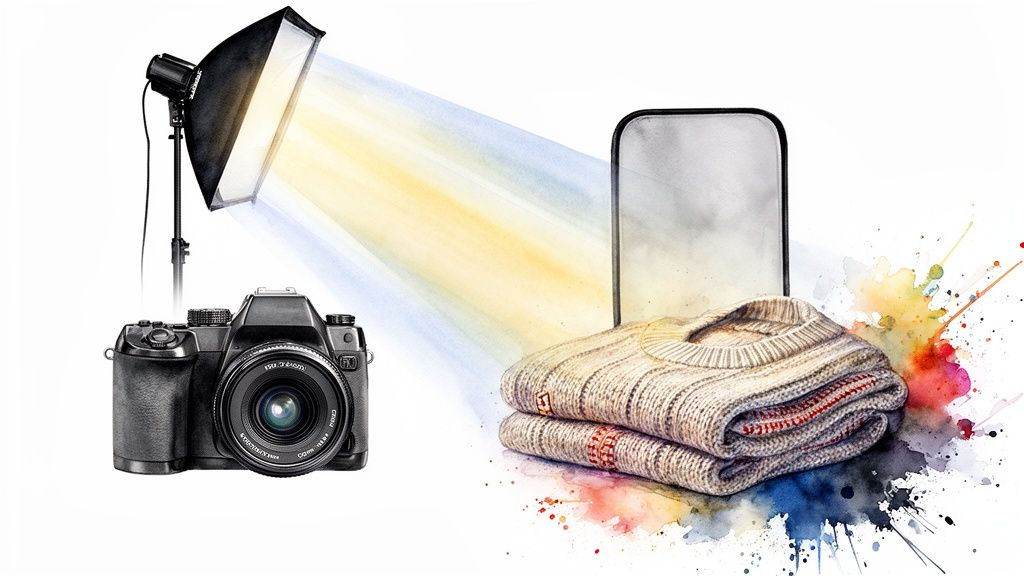
- Artificial Light: For more control, a single large softbox or an umbrella is a fantastic starting point. Place it at a 45-degree angle to your product. This will create just enough dimension to give the clothing shape without introducing distracting shadows.
The real secret to professional clothes pictures is consistency. A controlled lighting setup means you can shoot different products on different days, and they'll all look like they belong in the same catalog. This is how you build a cohesive and trustworthy brand image.
A simple one-light setup is often all you need to get started. Place your main light (your "key light") to one side of the camera. Then, on the opposite side, prop up a white foam core board or a reflector. This will bounce light back onto the garment, filling in any dark spots. It’s a simple trick that makes a massive difference in the final quality of your clothes pictures.
Using AI to Streamline Your Photo Editing Workflow
Once the camera is down, the real marathon begins. Post-production can feel like a huge bottleneck, with tedious, repetitive tasks eating up hours you could be spending on creative strategy or planning your next launch. A fast, consistent editing workflow is absolutely crucial for getting products live quickly, and this is where artificial intelligence has become a total game-changer for apparel brands.
Manual editing isn’t just slow; it’s a recipe for inconsistency. When you’re trying to process thousands of clothes pictures, ensuring every background is the exact same shade of white or that every color is perfectly corrected becomes a monumental task.
AI-powered tools are built to handle this kind of high-volume, precision work without breaking a sweat. They can analyze an image, instantly identify the product, and remove the background with pixel-perfect accuracy in seconds. You can batch this process across an entire photoshoot's worth of images, guaranteeing a uniform look for your whole catalog. The result is a polished, professional storefront where every single product is presented with the same high standard of quality.
Automating the Tedious Stuff
Think about the most soul-crushing parts of editing clothes pictures. It's usually the repetitive, non-creative work that drains your team's energy and resources. AI excels at taking over these jobs, freeing up your creatives to focus on what really moves the needle—styling, campaign concepts, and brand storytelling.
Here are just a few of the key tasks AI can take off your plate:
- Background Removal: Forget manual masking. AI can instantly create clean, white backgrounds perfect for product listings. This is a massive time-saver for any e-commerce team.
- Automated Retouching: Remove dust, wrinkles, or tiny imperfections from garments in huge batches. AI learns to spot these issues and correct them consistently across hundreds of photos.
- Color Correction: This is a big one. AI algorithms can analyze and adjust colors to ensure the product in the photo is a perfect match to the real-life item, which is a major factor in reducing customer returns.
AI isn’t here to replace photographers or editors. It’s here to give them superpowers. It handles the 90% of editing work that is repetitive, so human creativity can be focused on the 10% that truly makes a brand stand out.
This shift creates an incredible opportunity for speed and scale. For example, AI tools are completely changing the game here: platforms like Aeon can generate 4K photorealistic clothes pictures instantly from simple text prompts. This can slash production time from days to mere minutes and cut costs by up to 90% compared to a traditional photoshoot. For a deeper dive, check out this report on the global apparel industry.
Generating New Visuals Without a Photoshoot
Maybe the most exciting part of all this is AI's ability to create entirely new visual assets from the ones you already have. This opens up a world of possibilities for marketing and e-commerce teams working with tight budgets and even tighter deadlines.
Instead of scrambling to organize a costly and time-consuming new shoot, you can use AI to get more mileage out of your existing photos. For instance, virtual try-on technology lets you take a photo of a garment on one model and digitally place it onto models of different sizes and body types. It's a powerful way to create more inclusive and relatable clothes pictures for your audience. If you want to explore this, our guide on the AI dress changer offers a great look into this technology.
The same idea applies to generating new product variations. Have a great shot of a blue shirt? An AI tool can realistically change its color to red, green, or any other shade in your inventory. This means you can create a full set of product images for every color variant without ever having to photograph each one individually. That’s a huge win for cutting down production costs and getting your products online faster.
Turn Your Still Photos Into Engaging Video Content
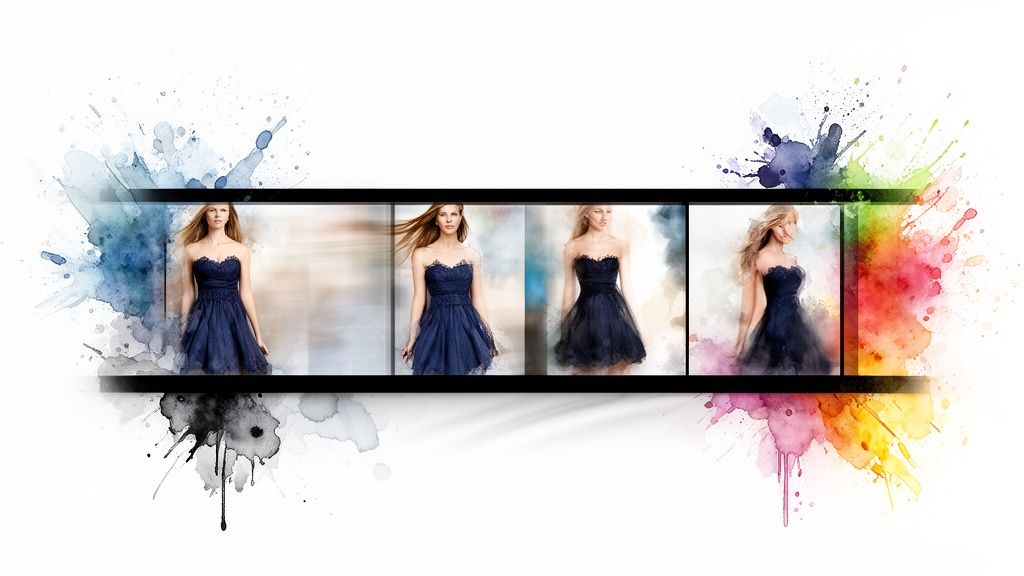
You've got a whole library of high-quality clothes pictures. That's not just a collection of static assets; it's a goldmine of potential content just waiting to be tapped for TikTok, Instagram Reels, and even your own product pages.
This isn't about firing up complex video editing software or booking expensive new shoots. Modern AI tools can breathe new life into your existing photos, creating smooth, cinematic motion from just a single image. It's a game-changer for multiplying your content output without adding a single photoshoot to the calendar.
Think about it. For content teams, simply A/B testing clothes pictures can boost click-through rates by 25%. In an industry churning out 100-150 billion garments a year, the right visual isn't just nice to have—it’s pure profit.
Creating Animated Lookbooks and Spotlights
One of the quickest wins is turning your static shots into animated lookbooks. Imagine taking your best on-model photos and adding a subtle pan, a gentle zoom, or a cool parallax effect. That tiny bit of motion is often all it takes to stop the scroll and hold a viewer's attention.
Here are a few dead-simple video ideas you can create from your existing stills:
- Product Detail Zooms: Animate a slow zoom into a key feature, like the texture of a knit sweater or the unique detail on a button. Slap some trending audio on it, and you're good to go.
- Outfit Transitions: Create a fast-paced slideshow that cycles through different ways to style a single piece, like a versatile blazer or a classic pair of jeans.
- 3D Photo Effects: Use an AI tool to add a sense of depth, making it look like the camera is actually moving around the subject in your original photo. It’s an incredibly cool effect.
The real strategy here is maximizing the value of every single asset. One great photo can become the foundation for a dozen different video clips, each one tweaked for a specific platform or marketing goal.
From Static Shot to Dynamic Ad
The goal is to shift your audience from passive viewing to active engagement. By adding motion, text overlays, and a clear call-to-action, a simple product photo is instantly transformed into a compelling video ad.
Tools like Aeon take this a step further by letting you animate a reference image while perfectly preserving the first and last frames. This is perfect for creating those seamless, looping videos that perform so well on social media.
This approach gives you the agility to test different creative concepts on the fly. You can see how your audience responds to different styles of motion or text without having to commit to a full-blown video production budget. You can learn more about how to make your fashion images stand out using these kinds of innovative techniques.
FAQs for Nailing Your Clothing Photos
Even with the best plan in place, shooting apparel can feel like you're constantly running into new questions. Whether it's about stretching a tight budget or figuring out the technical details, getting these things right is what really separates so-so shots from incredible clothes pictures that actually sell. Let's dig into some of the most common questions we hear from e-commerce brands and marketing teams.
One of the first hurdles for just about every brand is the budget. The good news? You absolutely do not need a massive investment to get started. It’s all about being smart and resourceful.
How Can I Get Professional Shots on a Tight Budget?
Your best friend here is natural light. Seriously. It's powerful, flattering, and completely free.
Set up your shooting space next to a large window, ideally on a slightly overcast day. This gives you soft, diffused light that makes any garment look amazing. You can get fantastic results with a newer smartphone camera, a basic tripod to keep things sharp, and a few white foam core boards from any craft store to bounce light back into the shadows.
Spend most of your energy on meticulous prep—steaming every single wrinkle is non-negotiable. After the shoot, a little love in a post-production app for color correction and cleaning up the background will give you that polished look that easily rivals more expensive studio setups.
The real secret to great budget photography isn't pricey gear; it's mastering the elements you can control. A perfectly steamed garment shot in beautiful, soft light will always look more premium than a wrinkled one shot with a high-end camera.
What Is the Best Background for Clothes Pictures?
For most e-commerce product pages—think Amazon or your own Shopify store—a pure white or light gray background is the undisputed champ. It’s the industry standard for a reason.
This clean, simple approach gets rid of all distractions, makes sure the product's color is spot-on, and creates a crisp, consistent look across your entire catalog. That kind of visual uniformity builds trust and makes it way easier for customers to shop.
But when you're creating content for social media, email campaigns, or your brand's lookbook, that's where lifestyle backgrounds shine. A backdrop that tells your brand's story—whether it's a sleek urban setting or a breezy outdoor scene—helps create an emotional connection and stops the scroll.
The demand for high-quality visuals is just exploding. E-commerce apparel sales rocketed to an incredible $509.1 billion online in 2021 and are on track to hit $785.66 billion by 2025. In this market, sharp, professional clothes pictures are what turn casual browsers into loyal customers. You can dive deeper into the global apparel industry statistics to see just how essential great visuals have become.
Ready to create stunning, on-brand visuals in minutes? Aeon combines expert marketing playbooks with production-grade AI tools, letting you generate studio-quality images and video ads from a simple prompt. Start your $5 trial and see the difference